/pic7266624.jpg)
In Tales of the Arthurian Knights, you are a hero or heroine in a story of adventure and awe! You and your fellows will travel the land at the behest of the renowned King Arthur. Through a series of quests, you will make impactful choices that will steer the course of your journey. Secure your place in history by achieving glorious feats, lest your efforts be doomed to obscurity. Gather your band of Knights around the table to enjoy your own epic tale as it unfolds!
Building on the mechanisms from the classic storytelling game Tales of the Arabian Nights, you now find yourself in the age of chivalry alongside Lancelot, Merlin, and many other characters from Arthurian lore. Quests will lead to glorious battles, daring rescues, and the discovery of such marvels as the Holy Grail.
As you navigate through this paragraph-driven experience, an updated victory point system will track your success. Tales of the Arthurian Knights eliminates matrixes and charts in favor of a streamlined method of dictating the paragraphs that will shape your adventure. After making your choices, a single roll plus skill bonuses will determine success or failure.
Choose your actions carefully, and you will be rewarded with skills, renown, and nobility. Choose poorly, and be scorned, cursed, or made a pariah. Bring the age of King Arthur to life in this incredibly replayable board game with a plethora of tales that are sure to challenge, amuse, surprise, and entertain!
—description from the publisher



- narrative-driven adventure
- medieval/fantasy
Mechanics (from transcript analysis)
Video topics + discussion points
Quotes (from this video)
- it's essentially two games in one
- the boards are beautiful
- the production value is honestly pretty terrible
- this update is kind of like me broadcasting about the cool stuff that some of my friends are doing
References (from this video)
- strong narrative and player agency
- book of tales provides varied, replayable encounters
- engaging card art and encounter variety
- player interaction and evolving storylines
- heavy randomness and luck in encounters
- potential for negative statuses to hamper play for turns
- game length and complexity can be intimidating
- destiny, renown, courtly romance, and knightly quests
- Camelot and Arthurian legends with various locales
- interactive storytelling with a book of tales guiding encounters
- Tales of Arabian Nights
Mechanics (from transcript analysis)
- destiny/age scoring — End-of-age scoring based on highest skill/renown and other conditions.
- places of power and story tokens — Encounter cards and tokens lead to story progress and special encounters.
- quests and locations — Players have quest tokens and move to locations to trigger encounters and progress quests.
- Renown trackers — Three trackers (Divinity, Romance, Villainy) determine movement and other effects; players gain ranks.
- Skill checks with dice — Dice rolls with modifiers based on skills; success yields rewards, failure yields consequences.
- Status Effects — Status tokens (e.g., wounded, smitten, betrothed) affect abilities and future checks.
- storytelling encounters via a book of tales — Players read adventure entries from a large reference book and choose actions based on their stats.
- Track Advancement — Three trackers (Divinity, Romance, Villainy) determine movement and other effects; players gain ranks.
Video topics + discussion points
Quotes (from this video)
- welcome to Jong games
- the book of tales is enormous
- Destiny is Essen victory points
- this is a storytelling game
- the art on this is spectacular
References (from this video)
- Reworking of a classic game.
- Theme is right up the reviewer's alley; medieval stuff, chivalry, knights.
- Mechanically, there's next to nothing going on, making it more of a storytelling game.
- The book of tales is the cool thing; choices made are very interesting.
- Can get a lot of fun from the game if you get into it and focus on the encounters.
- Almost a time piece game that will be kept for the rest of the reviewer's life.
- Looks lovely, mechanically clean.
- Lots going on, but still comes down to storytelling.
- Compelling, with good storytelling and epic things that can happen.
- Very impressed with the system in its entirety.
- Barely a board game, more of a storytelling game.
- Mechanically, there's next to nothing going on.
- Comes down to a dice roll.
- Apprehensive about replayability, hence playing it infrequently.
- Scalability: three or four players can lead to a longer game (two and a half to three hours for three players). Two players might be the sweet spot.
- Medieval chivalry, knights, fighting dragons and bandits.
- Arthurian Legends
- Storytelling game with choices that affect the narrative and character development.
- Lands of Galia
Mechanics (from transcript analysis)
- Choose Your Own Adventure — Players make choices within the narrative presented by the book.
- Dice Rolling — Dice rolls are used, but their impact is mitigated by character stats and skills.
- Encounter resolution — Random encounters occur as players travel the map, with outcomes often determined by dice rolls modified by character abilities.
- Stat tracking — Players build up stats like sword and shield fighting, and mounted ability, which improve over the course of the game.
- Storytelling — The core mechanic involves drawing cards that direct players to passages in a book, presenting scenarios and choices.
Video topics + discussion points
Quotes (from this video)
- So, automatically I was starting off on a kind of a handicap really and it was very difficult for me to fight my way through those dice to try and build those patterns.
- But there is a nice degree of um of kind of logical reasoning and a deduction going on here.
- The game is is very enjoyable.
- It looks lovely. It's fast.
- This is pretty standard fair. There's a lot of games out there like this where you're just collecting your currency and then cashing them in to um against contracts to get you points.
- I loved how simple the turn system in this game is.
- This game kept it so clean and easy to understand, but kept the deduction part of the game really juicy.
- This is definitely one of the best ones that I've played.
- Be aware this game is barely a board game, although it is a game you play on a board.
- So think of it more of a storytelling game, more of a role-playing adjacent game than a traditional, you know, board game where you're making tons of decisions. More of a choose your own adventure if you want to put it that way.
- So, you know, the game is a mish mash of random encounters, but the stories you can tell over the course of the game are really enjoyable.
- So for me, this is almost like a time piece game that I'll keep for the rest of my life.
References (from this video)

- Really enjoyed this one
- Has its own niche
- Needs to be played more
- Arabian Knights
Mechanics (from transcript analysis)
Video topics + discussion points
Quotes (from this video)
- Baron strong debut at number 77 as well.
- Floriferous has actually been in my collection for many years, but year after year it does nudge up and up and up, which goes to show it strength because of course we play more games each year, which naturally makes things fall down. But the fact this has gone from number um 98 to number 78 and it's a new best foriferous 2.
- kind of a passive rise for underwater cities. It's such a quality little engine building game from back onto the list from number 107 up to number 83.
- NAR as well has actually again been in my collection for a couple of years now, but last year in its debut year, it came in at number 124. So, it's pushed onto my top 100 for the first time at number 85.
- Get on board has come back into the top 100 as well, going from number 110 up to number 89.
- another debut with Toy Battle at number 90.
- Far Away, come back onto the top 100 from number 116 up to number 91.
- The same goes with QE went from 120 up to number 92 because I did play that one recently and obviously enjoyed it.
- other than that, we had a bit of a fall for games like Gold West, a bit of a fall for games like Mexico.
- Even brass fell a little bit, just hanging on to my top at 100, going from number 78 down to 96. Now, I really like brass, but I don't really play it too often um anymore.
- No Thanks, the classic little bidding or anti bidding game goes from a 104 up to number 97 back onto the list.
- interestingly, um Subastral and Stellar, two card games I recommended. They've always kind of just held on onto my top 100. Um they are now at number 98 and number 100. Um which was slightly down from number 95, 96 last year.
- the last kind of debut taunt game onto my top 100 is Tag Team. Um, a game I've reviewed recently uh on the channel.
- So, those are all the new games this year.
- So that's kind of why I didn't want to do the whole top 100 again because I thought, you know, it's going to be quite similar to last year's with a few jiggles up and down.
- a lot of these more unique games are going up. card game seem to be climbing for me quite a bit and those euros may be holding their place or slightly falling but the great euros of course I'm anchoring themselves at the top of my of my top 100.
References (from this video)

- Reimagining of popular legends
- Loved theme and setting
- Unique gameplay experience
- Funny outcomes
- Creates an epic tale to share
- Wonderful production
- Good writing
- Protective of the book, not wanting to play it all the time to avoid overexposure.
- Storytelling based on Arthurian Legends
- Arthurian Legends
- Storytelling through reading passages from a large book based on player choices and stat checks.
Mechanics (from transcript analysis)
- Character progression — Players are "improving your stats to try and overcome these different difficulties".
- Dice Rolling — Stats are used to overcome difficulties, implying a dice or random element in resolution.
- Event resolution — Players react to "different people, different um occurrences, different things that you can run into and reacting accordingly."
- map movement — Players are "traveling around this map of, you know, England, Scotland, and Wales and so on."
- Storytelling Game — Described as a "pure kind of storytelling game".
Video topics + discussion points
Quotes (from this video)
- So, that is Overparked at number 10.
- So, that is Citizens of the Spark at number two.
- So, that is The Druids of Adora at number one.
- So, there we have it. That concludes the video.
- And for me, 2025 has been a fantastic year for uh new designs.
- If you have, please be sure to hit like and subscribe to the channel and check out my other content, too.
References (from this video)

- Exceptional writing and care in story entries
- Immersive and well-crafted narrative passages
- Storytelling
- Arthurian Legend
- Passage-based storytelling
- Oathsworn
Mechanics (from transcript analysis)
Video topics + discussion points
Quotes (from this video)
- it is a crime against somebody that this game has not been just been picked up because people that have played this game, I still have the game and and you know, they love it.
- overrated, I'm going to probably get hated for this is I'm just going to say Magic the Gathering.
- it really elicits a lot of the interesting feelings of the movie.
- Now Urban Sprawl is like a city building game. Like think of SimCity or something like that. But, it's a little bit more I would say mean, but the players aren't really mean to each other.
- But, the combat everything else that happened in that round and in previous rounds and what might happen in the next round informs that moment of fight, that moment of conflict.
- it abstracts it in such a compact way that everything else in the in the system is is important and that's what actually where the combat is. So, the fight isn't where you think it is.
- it really just got me into the hobby, like learning about mechanics, reading reviews and all of that and then like really sitting with the game strategically and thinking about stuff
- his boards are seamless. Like it looks like an actual landscape and then the spaces are there as opposed to like, you know, drawing a border or a box.
- but they're they're written the best I've ever seen a like piece of flavor text or a paragraph written in the board game space
- Tales of the Arthurian Knights. It's beautiful game. The reason this is the top one for me is because the the level of care and craft that goes into the story entries
- they're written the best I've ever seen a like piece of flavor text or a paragraph written in the board game space.
- I will lose myself in the paragraph and feel like, oh this is like a good snippet from some ancient tale or something written in the 50s or whatever, you know, and or the 1800s.
- Rangers of Shadow Deep, which has been like my number one game for the last couple of top 50s that I did.
- it's a solo co-op miniature skirmish game that has a really vast expansive narrative campaign.
- It gives me that D&D sort of taste cuz it's a D20 system and it's very like miniature scape world building type of thing.
- it's just great. It's it gives you the chance to just play with all of your toys and play with all of your your terrain and your models and your your creative thinking, your world building cuz you can still kind of be a game master for yourself because the the game lays out like a narrative thing and then there's some like deck of card things that sort of change up the scenarios if you play them more than once. And so there is sort of a game master there, but the game master's kind of like left the table by the time you get there. They're gone. They gave you the outline and then you're there to kind of game master and play at the same time.
References (from this video)

- Silly, random
- Liked everything else about it
- A little long in the text
- Takes itself more seriously than desired
- Arthurian
- Tales of Arabian Nights
Mechanics (from transcript analysis)
- Sequel — this is a game that's a sequel to the Tales of Arabian Nights.
Video topics + discussion points
Quotes (from this video)
- I had to increase this rating to a 10. I play this all the time. Love this game, it's fantastic.
- This is a remake of an older game. Um Miss Miss Miss Miss I forget the Missenium or whatever it's called. Um from Reiner Knizia and the cows are being abducted. It's weird and unusual and I There's some things I liked about it, but I can't really recommend it because I think it's too odd.
- My kids liked it more though, but 6.5.
References (from this video)
- The book is well written.
- The choices are very interesting.
- The stories that can be told are really enjoyable.
- The storytelling is good.
- Some really epic things can and do happen.
- The system in its entirety was very impressive.
- More tailored to the host's preferences than other similar games.
- Mechanically, there's next to nothing going on.
- Apprehensive about replayability, leading to infrequent plays.
- Be prepared for a longer game with 3 or 4 players (2.5 to 3 hours for a 3-player game).
- Chivalry, knights
- Medieval
- Storytelling, choose your own adventure
- Tales of the Arabian Knights
- Lands of Galia
Mechanics (from transcript analysis)
- Card drawing — When coming into certain locations, a card is drawn which directs the player to a passage in a book to read.
- Character improvement — Players gain legendary points, improve stats, collect items, and gain traits or companions that affect their character.
- Choice-driven narrative — Players are allowed to make choices on what path they want to go down, leading to different outcomes and potential consequences like gaining a bad reputation.
- Dice rolls — The game involves dice rolls, and building up stats effectively mitigates these dice rolls.
- Stat tracking — Players have a knight character with stats like sword and shield fighting, and mounted ability, and slide up tracks to get more powerful.
Video topics + discussion points
Quotes (from this video)
- So, this is a reworking of the classic Tales of the Arabian Knights, which was a game that I sadly never had the chance to play despite really wanting to.
- And yes, it does all come down to a dice roll. But if you really get into it and you don't focus too much on the on the dice rolling and just focus on how those encounters are going and trying to um I suppose get into it, then you can get a lot of fun from this game.
- So for me, this is almost like a time piece game that I'll keep for the rest of my life.
- prepare for just a night of storytelling.
References (from this video)
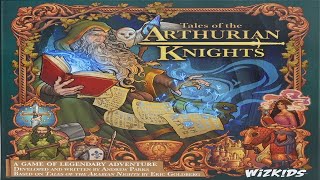
- More streamlined than Tales of the Arabian Knights
- Better game overall
- More appealing setting (Arthurian)
- More cohesive narrative
- Extremely descriptive and well-written encounters
- Easier to manage skills, statuses, and quests
- Offers variable game lengths
- Provides an epic experience in a shorter timeframe
- Less wacky/whimsical than Tales of the Arabian Knights
- Limited player interaction (mainly placing quest markers)
- Reliance on reading can be a barrier for some players
- Knights of the Round Table, mystical enchantment, King Arthur
- Arthurian
- Storybook, choice-driven encounters
- Tales of the Arabian Knights
- Eldritch Horror
- Twilight Imperium
Mechanics (from transcript analysis)
- destiny scoring — The game's winner is determined by whoever has the most destiny points at the end, which are accumulated through various means including renown and skills.
- Quest management — Includes starting quests and a deck of draw quests, with an easier system for tracking them. Player interaction exists in placing quest markers.
- Skill System — Features a level-up system for four types of skills (marshall, spiritual, courtly, wilderness) with a cap on how high they can go, making encounters easier to resolve.
- Status Effects — Status effects are tracked with time-based decks, moving down a track and expiring, providing a cleaner way to manage them.
- storybook encounters — Players draw encounter cards that lead to sections in a large book of tales, offering numerous choices for interaction and reaction.
- variable game length — Players can choose to play a one, two, or three-age game, influencing the overall game length and how destiny points are scored.
Video topics + discussion points
Quotes (from this video)
- for all intents and purposes, a better game.
- It's just such a better streamlined process.
- The writing is very very well done.
- Tales of the Arabian Knights was brutal.
- This is clearly just better. It's it's more cohesive, more streamlined, more structured, uh more detailed. It it is better writing.
- Arabian Knights just had a more wacky, whimsical, silly vibe to it.
References (from this video)
- Effortlessly fun and quick to learn
- Excellent for solo or cooperative play with a dedicated deck
- Narrative direction is more focused and tailored than the predecessor
- Compact components with streamlined rules
- Map can look dull in pictures; larger table footprint
- Characters have no unique abilities; limited differentiation between knights
- Heavy reading load for multiplayer sessions
- No web app integration to link paragraphs directly (book of tales still paper)
- destiny, renown, chivalry
- Camelot, Round Table, Arthurian legend
- branching, paragraph-based Book of Tales
- Tales of the Arabian Knights
Mechanics (from transcript analysis)
- Encounter deck and quest markers — Events drawn from an encounter deck; track quests with markers and tokens.
- Grand Quests and Era-based structure — Optional endgame quests and era progression that add depth.
- Locations and map exploration — Fixed map with regions and location cards that influence encounters.
- Narrative book of tales (paragraph-based choose-your-own-adventure) — Story events and outcomes are read from the Book of Tales with paragraphs guiding decisions.
- Narrative Choice — Story events and outcomes are read from the Book of Tales with paragraphs guiding decisions.
- Renown and status tracks — Renown, Divinity, and Romance/Villainy tracks influence movement and scoring.
- Skill trees and leveling — Four skill groups with progression and focus, allowing upgrading a skill.
- Solo/Co-op support with dedicated decks — A deck of cards tailored for solo and cooperative play to introduce randomness.
- Tech Trees — Four skill groups with progression and focus, allowing upgrading a skill.
- Time-limited afflictions — Status effects that last a limited number of turns to avoid endless penalties.
- Treasure cards and equipment — Deck of treasures granting bonuses; rarer finds are possible.
Video topics + discussion points
Quotes (from this video)
- it's effortlessly fun
- the stories are more directed and tailored to what you are actually expecting to encounter
- I am very happy to own both of them
- this game is effortlessly fun
- I think the stories are more directed
References (from this video)
- Strong narrative emphasis with high rating
- Intriguing thematic linkage to Arabian Nights motif
- Narrative-heavy experiences can be variable in personal taste
- choose-your-own-adventure, narrative-driven
- Arthurian legend; narrative journey
- branching, story-first
- Tales of the Arabian Knights
Mechanics (from transcript analysis)
- Narrative Choice — player choices drive story outcomes
- Narrative choices — player choices drive story outcomes
- reimplementation of Tales of the Arabian Knights — uses a proven narrative framework with new framing
Video topics + discussion points
Quotes (from this video)
- It's 2026 now, which means it's time for that thing that I like to do every single year
- I want to play 30 of the 35 games I set out for myself
- Three games a month would make it doable
References (from this video)
- Story-driven decisions reminiscent of Witcher-style narrative
- Potential high replayability due to branching outcomes
- Rule complexity and learning curve
- Possible heavy setup for cruise play
- narrative consequences drive progression and rewards
- Fantasy realm with story-driven, choice-based events
- story-driven, branching outcomes
- Tales of Arabian Nights
- The Witcher
Mechanics (from transcript analysis)
- story/decision cards — Player decisions determine outcomes and rewards; narrative flow drives play
Video topics + discussion points
Quotes (from this video)
- If we get enough votes, maybe we'll get a chance.
- Our bottom five, numbers 10 through six of our top 10 games we want to play on the Dice Tower cruise this year.
- No Thanks is referenced as a benchmark in the bidding/auction space.
References (from this video)

- flavorful storytelling and humor
- clear mechanism for advancing stories and character arcs
- easy to pick up with a collaborative vibe
- heavy reading/reading aloud may slow play for some groups
- could feel like a Choose Your Own Adventure-lite if flow is not managed
- narrative-driven choose-your-own-adventure style
- Arabian-inspired storytelling with mythic adventures
- story-driven with character stats and progression
- Tales of Arabian Nights
Mechanics (from transcript analysis)
- Character progression — Characters gain stats and abilities that influence outcomes across sessions
- Choose-your-own-adventure storytelling — Cards convey story excerpts the players read and respond to as the narrative unfolds
- Narrative Choice — Cards convey story excerpts the players read and respond to as the narrative unfolds
- Social/reading-paced play — Reading aloud of story text and collaborative storytelling shape outcomes
- Storytelling — Reading aloud of story text and collaborative storytelling shape outcomes
Video topics + discussion points
Quotes (from this video)
- flowcharts are amazing
- it's not a trick taking game it's just an action resolution system using playing cards
- it's basically a Choose Your Own Adventure
- the technology tree is layered
- Moving Wild is fast, it's quick