/pic8054188.png)
Game Info
Year
2024
Collection
Ratings
Creator Score
Expansions & Family

/pic1691099.jpg)
/pic332870.jpg)
Mechanic profile
Not enough video data yet
Vibe profile
Not enough video data yet
Description
The otherworldly artefacts known as Talismans have once more descended onto the mortal plane, signaling the dawn of a new era— and the need for a new ruler!
In Talisman: The Magical Quest Game – 5th Edition, set forth on an epic adventure, racing to be the first to obtain a Talisman, reach the Crown of Command in the center of the board, and defeat the elder dragon to win.
—description from the publisher
Talisman Family
(7 games)
Part of the Talisman family — see Talisman for the combined view.
/pic1405986.jpg)
/pic8054188.png)


Featured Videos


Ask a Rules Question
All mentions
Browse transcript mentions, sentiments, pros/cons, mechanics, topics, quotes, and references.
Total mentions: 3
This page: 3
Sentiment:
pos 1 ·
mix 2 ·
neu 0 ·
neg 0
Showing 1–3 of 3
Video k73d1z4sXCE
Rules Teach at 0:19 sentiment: mixed
video_pk 67249 · mention_pk 163212
Click to watch at 0:19 · YouTube ↗
Overall sentiment (raw)
mixed
Pros
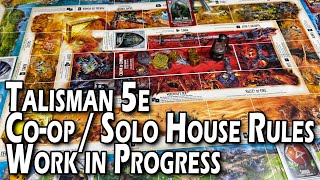
- Provides a co-op/solo experience for a game that previously lacked satisfying implementation of these modes.
- Introduces threat management as a core element, adding strategic depth.
- Simplifies character progression and leveling up.
- Offers more ways to spend resources like trophies.
- The custom rules are designed to be simple and not bog down the game.
- The host finds the design path promising and is having fun with it so far.
Cons
- The official Alliances expansion for co-op/solo was a major disappointment.
- The official Call of the Hunt expansion's one-vs-many mode was not desired.
- The custom rules are still a work in progress and require finessing.
- Some elements of the original game and expansions are not liked by the host.
Thematic elements
Comparison games
none
Mechanics (from transcript analysis)
- Combat — Players engage in combat with enemies, where dice rolls are modified by character stats and abilities. Special character powers, like the Minotaur's stampede, can significantly alter combat outcomes.
- Doom track — Used from the Alliances expansion, this track moves down and reaching the last space signifies game over. Its values affect villains and the final confrontation.
- event cards — Removed from the main adventure deck and placed in a separate deck. These are drawn based on dice rolls and can have various positive or negative effects on players.
- Leveling up — Characters can increase their stats (like strength) by meeting certain conditions, such as defeating specific enemies or using collected trophies, which is a simplified system in these custom rules.
- Movement — Players roll a die for movement, with options to spend fate tokens to increase movement range. Character abilities can also influence how far or where they can move.
- Player Turn Structure — After each player's turn (or the solo player's turn), an event chart is rolled, influencing the game state with various outcomes like doom track movement, space closures, or villain spawns.
- Psychic Combat — A specific event can trigger a round of psychic combat with a set value, which players can attempt to prevent using resources like trophies or followers.
- Space Closures — Certain corner spaces in the outer or middle regions can become closed for a set number of turns as dictated by the event chart, restricting player movement.
- Trophy Collection and Usage — Trophies can be spent to ignore certain negative events, level up characters (e.g., strength), or potentially be used with companions and boons from other expansions.
- Villain Management — Villain cards from the Alliances expansion are used as threats that must be cleared before players can progress. They spawn on the board and must be managed.
Video topics + discussion points
No key topics recorded for this video.
Quotes (from this video)
- Uh, in my review of the year 2025, I mentioned that the allianc's expansion for Talisman was my biggest disappointment.
- So, I started designing some of my own solo rules. And they're relatively simple.
- All villain enemies must be destroyed before any player can enter the portal of power.
- I think this brings you know Talisman more in line to what I would want from a cooperative or from a solo version.
- I wanted to give some additional things to spend trophies on, some additional ways to use the villains as trophies, some different ways to use the villains as kind of a threat management thing because I like threat management in a co-op game, and just add a little more choice, but not bog the game down with too many changes.
- So far I'm having a lot of fun with this very, very simple co-op/solo variant for Talisman Fifth Edition.
References (from this video)
No references stored for this video.
Video 2FgvySvgSPE
Playthrough at 0:03 sentiment: mixed
video_pk 66578 · mention_pk 162247
Click to watch at 0:03 · YouTube ↗
Overall sentiment (raw)
mixed
Pros
- The cooperative 'Alliances mode' offers a different way to play Talisman.
- Characters have distinct abilities and starting spells that influence gameplay.
- Item and trophy systems allow for character progression.
- The game can be tense and challenging.
Cons
- The host made tactical mistakes due to misunderstanding rules or poor execution.
- Dice rolls heavily influence outcomes, leading to frustration.
- The 'Doom Tracker' or timer mechanic can feel punishing.
- The game can be lost due to close calls and small margins.
Thematic elements
- Adventure and questing in a fantasy world
Comparison games
none
Mechanics (from transcript analysis)
- Combat — Characters engage in combat, with options for strength-based or psychic combat, and can use items and spells to gain advantages.
- Cooperative Goal — The primary objective is to bury two Talismans on specific locations and then defeat the Dragon at the Portal of Power.
- cooperative play — The 'Alliances mode' allows players to work together towards a common goal.
- item acquisition — Players can gain items through encounters and by trading trophies.
- Movement — Players roll dice to move their characters around the board.
- questing — Characters can undertake quests, such as those from the Warlock's Cave, to gain rewards like Talismans.
- Spell Casting — Characters can cast spells, with some characters starting with spells and having abilities related to spellcasting.
- Timer/Doom Tracker — A doom tracker or timer advances, increasing pressure and consequences as the game progresses.
- Trophy System — Defeating enemies grants trophies that can be traded in to increase character stats.
Video topics + discussion points
No key topics recorded for this video.
Quotes (from this video)
- The Portal of Power will not open until two Talismans have been buried in the four corner locations.
- Every single time I play this game, I say I've got to be very careful on burying the second Talisman because as soon as you do, a timer starts kicking on even faster and you have limited turns to then win the game.
- Experts of the game are probably watching this back... and criticizing my every move saying everything that I'm doing wrong.
- Oops. Oops. Oops. Thankfully, my armor has saved me from making a mistake.
- Learn how to play the game. You can't attack enemies with psychic combat.
- I tried to attack a dragon with psychic combat and you can't. Yeah, silly daddy.
- I think we've lost. I think we've lost.
- Oh, so close again. But there were definitely a few I more than a few tactical mistakes that I made in this game.
References (from this video)
No references stored for this video.
Video vVwxpPyuU7E
Drive Thru Games Review at 0:25 sentiment: positive
video_pk 6919 · mention_pk 104657
Click to watch at 0:25 · YouTube ↗
Overall sentiment (raw)
positive
Pros
- Faster early progression and clearer board layouts
- High-quality components and minis for the price point
- Improved clarity on cards and board text compared to some editions
- Plans for co-op campaigns and future expansions add longevity
- Fate movement provides intentional, purposeful play
Cons
- Some card and board text remains hard to read due to small font
- Board art in this edition is not as strong as the fourth edition in the speaker’s view
- Long play time at higher player counts (four is sweet; six can be lengthy)
- Cones for tracking stats can be hard to distinguish at a glance
Thematic elements
- Heroic fantasy exploration and race-to-the-center quest with combat, magic, and encounters.
- A high-fantasy realm where players quest across a modular board to obtain a Talisman and reach the center to defeat a dragon.
- Quest-driven, encounter-forward progression with evolving board state and law of the card/space-driven adventures.
Comparison games
- Talisman Fourth Edition
- Relic
Mechanics (from transcript analysis)
- Adventure deck encounters — Landing on spaces often triggers drawing from a large adventure deck with items, monsters, or events.
- Death/penalty rule change — Death is softened: you respawn at the Village with one life but keep your items (optional rule exists to reset completely).
- Fate tokens and rerolls — Fate can be spent to roll dice or reposition (within range) to improve outcomes or target specific spaces.
- Merchant and equipment deck — Players can buy armor, weapons, and items from merchant spaces to improve stats and carry capacity.
- Movement and dice-based progression — Roll a die to move across a large map, choosing direction and encountering spaces that draw cards and resolve encounters.
- Spell deck and casting — Spells can be acquired through craft checks and spell decks, usable on turns or against other players.
- Strength and Craft combat — Combat uses two main attributes: physical strength and craft (magical/intellectual) to resolve encounters with monsters or other players.
- Talisman/center reach endgame — Obtaining a Talisman unlocks access to the center ring, culminating in a dragon encounter to win the game.
Video topics + discussion points
No key topics recorded for this video.
Quotes (from this video)
- when you die in this game you basically just go back to the Village you reset to one hit point but you keep all your stuff
- the Fate movement thing... that's really cool
- these are some very nice Miniatures here
- it's a little bit more traditional ameritrash type of thing
References (from this video)
No references stored for this video.
Transcript Navigation
Showing 1–3 of 3