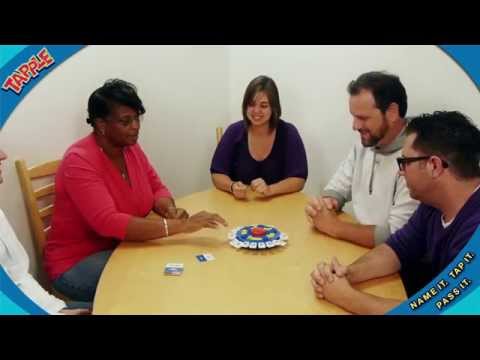




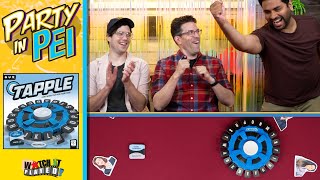
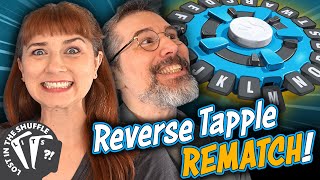




Each round in Tapple, one player draws a topic card, then starts the timer. In the next ten seconds, that player must give a single word answer that fits within the topic, press down the letter key in a special electronic device that corresponds to the first letter of that word, and restart the timer. The next player must then think of a word for the topic that starts with a different letter, press down that starting letter, and restart the timer.
If a player runs out of time, they're out for the round. If only one player remains in a round, they collect the topic card. If players manage to press down all of the letters before knocking all but one player out of a round, the players reset the device, draw a new topic card, then start the timer again, this time needing to give two answers for the topic – each starting with a different letter — within the allotted time. Whoever collects the most topic cards wins!
- Smooth, family-friendly gameplay with clear rules
- Cute penguin components and approachable theme
- Turn-order mechanic adds strategic depth, especially with more players
- Board scales with player count, increasing locations and fish to contest
- Expansions add spice and replayability
- Base game can feel underwhelming or lacking pizzazz
- Not particularly memorable without expansions
- Expansions feel necessary to refresh the experience
- fish gathering and majority area control
- Antarctic/ice floe with penguins
- non-narrative, abstract spatial strategy
Mechanics (from transcript analysis)
- area majority — Scoring based on majority in each fish pool and surrounding areas; larger clusters score more.
- Area majority scoring — Scoring based on majority in each fish pool and surrounding areas; larger clusters score more.
- cluster scoring — Grouping penguins yields higher points; clusters of 2,3,4 penguins increase values.
- Compound Scoring — Grouping penguins yields higher points; clusters of 2,3,4 penguins increase values.
- doublers/penguin tokens — Two-penguin pieces that count as two in scoring; finetuning positioning.
- expansion tiles (orchid tiles and eggs) — Optional expansions add tiles that modify scoring and board control.
- passing and turn-order marbles — Passing moves your marble to the other side, shifting turn order for strategic advantage.
- placement — Players place penguin tokens on a hex grid around designated locations.
Video topics + discussion points
Quotes (from this video)
- The turn order track is very important.
- Expansions helped, but wasn't enough to make it be like something brand new.
- Great for families. It's just very smooth.
- This game was fine. It was a fun game. It just isn't a game that I'm going to remember.
References (from this video)
- Fast, accessible area-control with elegant tension
- Good for families and casual players
- Simple setup and quick rounds
- Wish for more modules or variations to increase replay variety
- Some players may crave more depth beyond base rules
- Penguin-area control around fishing holes
- Arctic ice floes with penguin groups
- Bright, brisk, family-friendly theme with tactile pieces
- Scout
- Panda Spin
Mechanics (from transcript analysis)
- Area Control — Place penguins on ice locations to gain control of fishing holes.
- Marble-driven turn order — A marble track progresses and determines initial player order each round.
- Passing/scouting ahead — Players can pass to wait for the next round, gaining strategic positioning.
- Variable board layout and pacing — Center board layout can be adjusted by player count for asymmetry.
- Waddles and scoring — End-game scoring uses penguin groups (waddles) and majority around holes.
Video topics + discussion points
Quotes (from this video)
- I love this game.
- I love area control.
- I would rather play Scout.
- The end of the game... the showdown ending was really weird to me.
- I adore tile placement games.
- It's a simple, easy, straightforward tile placement game.
- This is a really fun, simplified quick blast of an area control game.
- I can play this with my kids.
References (from this video)
- Short, easy-to-teach rules and quick setup
- Deep strategic planning through penguin placement and blocking
- Multiple scoring paths (waddles and fish pools) add depth
- Good replayability due to randomized boards
- Charming art and approachable components
- Cardboard components (not wooden)
- Fish scoring can be tricky to gauge during play
- Might be too light for players seeking heavier strategy
- Penguin placement and area scoring with race-to-fish mechanics
- Randomized board with icy lakes; penguins gathering around lakes to score fish
- Instructional/Strategic
Mechanics (from transcript analysis)
- Double penguin tokens — Two tokens that count as two penguins for scoring when used.
- End condition and scoring — After all ice spots are filled, total waddles and fish scores determine the winner.
- Finishing pools / fish scoring — Lakes have fish values; more penguins around a lake yields higher fish points for that lake.
- Penguin placement — Players place penguins on ice spots around the active lake to form waddles and influence scoring.
- Randomized board setup — The board is set up randomly each game, creating new layouts and strategies.
- Scouting ahead — If no good ice spots, players can scout ahead to move to the next lake and gain turn order advantage.
- Token Pairing — Two tokens that count as two penguins for scoring when used.
- Turn order via marbles — A random line of marbles determines the next turn; the bottom marble indicates whether to place or scout.
- Variable Set-up: Board — The board is set up randomly each game, creating new layouts and strategies.
- Waddles (groups of penguins) — Scoring is based on groups of penguins (waddles) around lakes.
Video topics + discussion points
Quotes (from this video)
- I have loved these one minute teach games, including this one here, Waddle.
- The game is all about planning.
- Not a hard game, but it will require some brain power.
- The board is randomly set up.
References (from this video)
- Adorable penguin theme
- Easy to teach
- Family-friendly with 2-5 players
- Varied board layout increases replayability
- Strategic depth from track jumping and surrounding ponds
- Compact box and approachable components
- Two-player variant has different rules
- Penguin colony competing for fish and territory around ponds
- Penguin-themed board game with a modular pond board and variable water spaces
- Array
Mechanics (from transcript analysis)
- Compound Scoring — End-game scoring uses ponds with weighted fish values depending on penguin distribution.
- End-game waddles scoring — Score per waddles (line of penguins) with cap at eight per waddles.
- Majority scoring around numbers — Fish are awarded based on majority of penguins around a numbered space.
- Penguin placement and track jumping — On your turn, place a penguin on spaces adjacent to numbers; you can jump tracks to influence turn order.
- Pond-based scoring — End-game scoring uses ponds with weighted fish values depending on penguin distribution.
- Two-penguin pieces (doubling) — A space can carry two penguins, counting as two for scoring and surrounding logic.
- variable board setup — Board is randomized at setup, creating different configurations each game.
- Variable Set-up: Board — Board is randomized at setup, creating different configurations each game.
Video topics + discussion points
Quotes (from this video)
- The board looks different every time you play.
- I am really enjoying Waddle from All Play.
- It's a fun game because it's really approachable.
- It's really easy to teach.
References (from this video)
- Self-guided rule discovery emphasizes engagement
- In-book tutorial structure mirrors video game tutorials for learning mechanics
- Physical components (marker sheet, erasing) enhance tactile play
- Reusable marking surface enables experimentation without waste
- Clear progression with increasing complexity and new shapes
- Some pages missing reduces learning context
- Puzzles can be challenging for beginners
- Deductive approach may be intimidating for some players
- Rule discovery through self-guided puzzles; alphabet-based shapes; non-permanent marking
- Abstract puzzle world centered on AB creatures and puzzle sheets.
- Tutorial-like, in-book progressive rule reveal
- Artist Bomb
- Lock and App Deck
Mechanics (from transcript analysis)
- Grid placement with rotation — Place rotated A/B shapes into a grid to satisfy puzzle constraints.
- Hints and solutions at end — End-of-book hints and solutions aid learning.
- Marker overlay — Use a non-permanent marker or overlay to mark attempts and erase.
- Self-guided rule discovery — Rules must be inferred by solving exercises rather than being taught.
- Shape rotation — Shapes can be rotated to fit different orientations.
- Unique solution constraint — Each exercise has a unique solution to validate the rule set.
Video topics + discussion points
Quotes (from this video)
- This is a little puzzle book.
- there's actually like a built-in tutorial and you have to kind of learn the game without being taught the rules directly.
- Every exercise has a unique solutions.
- At the end of the book, you can find hints, explain rules, and solutions.
- I will put a link there where you can get these uh books in the description of this video so you can get one yourself.
References (from this video)
- Fast-paced and great for groups
- Easy to teach and learn
- Strong party-game appeal
- Price point noted as a potential drawback in the discussion
- rapid word formation under category constraints
- Family party game with word association
- light, social, party-game mood
Mechanics (from transcript analysis)
- letter-based play device — A wheel/device dictates the starting letters for each round.
- time pressure — A timer or rapid turn structure pressures players to respond quickly.
- word association — Players think of words that fit a given category starting with a selected letter.
- Word building — Players think of words that fit a given category starting with a selected letter.
Video topics + discussion points
Quotes (from this video)
- these are some board games I'd recommend
- Ticket to Ride is another great family game where you're trying to place trains across the United States
- this game is a little pricey
- you're given a topic and you must think of words associated to that topic as long as the letter is still available
- to family and friends try out chameleon
- there's tons of War games out there but
References (from this video)
- Fast, approachable play
- Nice family-friendly interaction
- Possibly light for experienced gamers
- Group formation and resource control
- Penguin crews competing to control fish
- Light, family-friendly theme with light competition
- Twinkle
- Andromeda
Mechanics (from transcript analysis)
- Area Control — Players form penguin crews to maximize fish control
- area control / group formation — Players form penguin crews to maximize fish control
- turn planning — Strategic sequencing to build larger groups and maximize fish
Video topics + discussion points
Quotes (from this video)
- I walked away from that game night saying I want more of whatever this is
- the writing in this game is the best writing I have ever seen in a board game
- it's my first time playing it and we've set the scene and there's like candles to make it spooky
- Choose Your Own Adventure flare
- the wonderful mysterious and sometimes wacky universe that we call home
References (from this video)
- Energetic and social; great for groups
- Short, replayable rounds; easy to pick up
- Encourages creativity and quick thinking
- Vocabulary-dependent; may be challenging for some players
- Can feel chaotic if the group is very large
- Word categories; rapid-fire clueing under time pressure
- Group party game session in a living room or casual game night
- Competitive banter with lighthearted humor
- Battletech
Mechanics (from transcript analysis)
- Fast-paced clueing and guessing — One player provides clues first; the other player can interrupt to guess; faster guessing yields more points.
- Letter-based clueing with cross-off letters — Clues are given that start with letters; letters are marked off as players respond, narrowing the possible category.
- Memory/association and cross-domain references — Players draw on pop culture and name associations to form clues that start with remaining letters.
Video topics + discussion points
Quotes (from this video)
- Not traditional Tapple. This is a custom challenge that we put together.
- The faster you go, the more points you get.
- Flea. F L E A. Flea.
- We begin.
- Don't give me hints.
- 14 points.
- Close, but no cigar.
References (from this video)
- tight economy of choices
- great tension around blocking and routing
- solid family-friendly depth
- area control genre can feel mean in multiplayer
- replay variety depends on board setup
- territory influence and group formation
- Arctic/earthy penguin-themed area control
- playful, competitive
Mechanics (from transcript analysis)
- Area Control — players place penguins to influence areas and connect territories
- network / route building — forming contiguous groups yields points and strategic options
- Network/route building — forming contiguous groups yields points and strategic options
- turn-order management — players decide to commit to spots now or wait to secure future turn order
Video topics + discussion points
Quotes (from this video)
- This game you're going to be basically dressing up uh the kids in different costumes.
- You're going to be mixing and matching or matching and placing them on different things.
- Waddle is kind of a meaner area control game.
- There's a little bit of everything here. There's pressure your luck. There's some planning and mitigating.
- Datoms is a crunchy puzzle to figure out.
- Ink is a lot nicer than Azul, I would say, uh because you can't really totally hoe someone by sticking them with tiles they can't have.
- Positano. Tons of interaction. If you like sort of meanness blocking with some secret auction, that is very interesting.
References (from this video)
- easy to learn
- family-friendly
- fast rounds that suit groups
- timer pressure may cause stress
- categories can become repetitive
- word association within categories
- family game night, quick play sessions
- light, fast-paced party game
- Monopoly
- Operation
- Risk
- Jenga
- Clue
- Dungeons & Dragons
- World of Warcraft
- StarCraft
Mechanics (from transcript analysis)
- category-based rapid word naming — Players name an item in the given category within a 10-second window.
- timer-driven play with letter selection — After naming, players press the first letter of their item; timer resets for the next player.
Video topics + discussion points
Quotes (from this video)
- this is taple it is a light family alphabet category game the object is simple you have a category you have 10 seconds to name an item within that category press the first letter of that item and then reset the timer for the next player it's simple
- it's simple let's give it a shot
- this is the game of telephone turned into a drawing game you remember that game where you whisper something into a neighbor's ear and then they pass it around the circle and by the time it comes back it's a completely different story
- first and foremost is to absolutely laugh hysterically because what happens is the communication breaks down pretty quick
- this is a fast-paced simultaneous play card game for two to five players
- the race is on to build stacks from one to five
- Crossways which is a light strategy path building game the beautiful thing is you have to build a path from one side of the board to the opposite but your path does not have to be a straight line
- you're using multiple ways to play those cards
References (from this video)
- simple to learn and quick to play
- great for large groups and casual gatherings
- versatile with different holiday-themed categories
- repetitive for long sessions
- depends on players' willingness to participate
- category word game
- holiday party
- fast-paced, energetic
Mechanics (from transcript analysis)
- category-based word generation — Players name a word that fits the current category within a timer.
- rotating timer / wheel mechanic — A timer wheel or mechanism constrains how long players have to think of a word.
- thematic category variety — Categories can range from Christmas movies to other holiday topics.
Video topics + discussion points
Quotes (from this video)
- it's basically like a drawing version of the game telephone
- it's on the box literally Telephone Game sketched out
- this one is holiday themed yep and it is chaos
- food and play games eat food play games
- we're going to be talking about four amazing games that you can play at your holiday party
- it's a great convention game just saying
- not to be confused with Blank Space by Taylor Swift in blank slate
References (from this video)
- fast-paced
- low setup
- group dynamics impact
- chaos potential
- rapid-fire social expansion
- Party word-guessing
- light-hearted, party game
- Rhino Hero Super Battle
- Fake Artists
Mechanics (from transcript analysis)
- word association — Players provide quick words under time pressure.
Video topics + discussion points
Quotes (from this video)
- it's less about the game at the table it's more about the people
- laughter is something that's extremely good for you
- any bad game can be made good with good people
- the accessibility to get into the hobby is minimal