









































Targi Deep Dive
What the Community Thinks About Targi
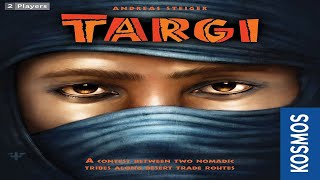
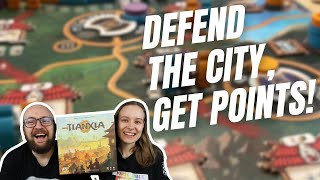
Targi has earned a devoted following among two-player game enthusiasts, with reviewers consistently ranking it among the best the format has to offer. Published by KOSMOS in 2012, the game draws on the culture of the Tuareg people of the Sahara, where women run the household and men navigate harsh desert trade routes. That theme feeds directly into the resources at the heart of play: salt, dates, pepper, gold, and coins.
Reviewers who have catalogued dozens or even hundreds of two-player games tend to reach for Targi when building personal top-ten lists. The game's reputation rests on a specific kind of satisfaction: a ruleset compact enough to teach in minutes that conceals a decision space that takes many plays to fully appreciate. Those who love it rarely describe it as complicated. They describe it as deceptively deep, a puzzle that keeps revealing new layers the more familiar you become with it.
Targi also sits comfortably between casual card games and heavier strategy titles. At around sixty minutes, it asks for real engagement without demanding an entire evening. That combination of modest physical footprint, genuine strategic depth, and tight two-player focus is what keeps the game on shelves long after other games in a collection have been traded away.
Core Mechanics That Define Targi
The Border Placement Puzzle
The defining mechanism in Targi is the way workers get placed. Each player has three Targi tokens, and every round those tokens go onto the border spaces surrounding a central grid of cards. The critical rule: you cannot place opposite your opponent's token, and you cannot share a space. This creates what reviewers call a "constricted" worker placement experience, one where every decision carries immediate consequences for both your own plan and your opponent's access to the board.
Once all six tokens are placed, each player's three tokens create two intersection points inside the grid. Those intersection cards are where tribe cards get activated, but you must commit to your border positions before the intersections are fully resolved. The result is a placement puzzle that requires thinking about which row and column you want access to, not just which single action you are taking. Reviewers frequently note that the spatial thinking required to visualize intersections before placing can trip up new players, but becomes second nature with experience and remains a big part of what makes the game feel fresh across many sessions.
The robber token circling the board adds another layer, blocking one space each round and forcing both players to adjust. Raids trigger when the robber reaches corner positions, imposing small penalties that ripple into scoring if resources have been mismanaged.
Resource Flow and Tableau Building
Targi balances two parallel economies: resources (salt, pepper, dates, gold, and coins) and the tribe cards that fill your tableau. Border positions mostly yield goods; interior intersection cards mostly allow you to purchase tribe cards and add them to your growing display. The tension between these two economies sits at the center of every round's decision-making.
Tribe cards build a tableau of up to twelve cards arranged in rows of four. Each card has a point value and often a persistent ability: you might gain extra salt whenever you collect a date, or receive a discount on future cards of the same type. End-game bonuses reward completing rows with all identical card types (four bonus points) or with all different types (two bonus points). This scoring structure gives the set collection element real teeth; a tableau built around a clear type focus scores more than one assembled at random.
Resource management stays tight throughout because goods can be spent on tribe cards or traded at the Trader action for coins, which themselves convert to victory points via the Silversmith. Reviewers note that this economy rarely feels loose. You are almost always one resource short of your ideal play, and that scarcity is by design.
The Targi Experience
Solitary Puzzle, Intimate Conflict
One of the more interesting things reviewers say about Targi is that it feels simultaneously solitary and intensely competitive. On one level you are building your own engine, gathering resources and filling your tableau toward a personal set-collection goal. The game does not punish you directly or destroy what you have built. In that sense it has a quiet, puzzle-like quality: you are solving your own problem.
But the worker placement rules ensure that your opponent's presence shapes every move you make. A token dropped in the wrong column closes off an entire row of options. A player who can read your tableau knows which card you need next, and they can place specifically to deny you access to the intersection where that card would land. Reviewers describe this duality as one of the game's signature pleasures: you feel like you are working in your own private space, and then the other player reaches in and rearranges everything. As kovray puts it, although it feels somewhat solitary in what you are trying to accomplish, the other player can simply place their worker on the card you were hoping for, forcing you to wait or pivot entirely.
Gateway Depth and Rewarding Mastery
Targi occupies an unusual position on the complexity spectrum. The rules are approachable enough that reviewers regularly recommend it to players still building their game vocabulary. The iconography is clean, the action menu is small, and the turn structure is consistent. A new player can be functional after a single round of explanation.
Yet experienced players find plenty to master. Understanding which border positions maximize your intersection options, recognizing when to race for specific tribe cards versus stockpiling resources, and learning when to deny your opponent rather than pursue your own best move: these are the skills that separate good Targi players from great ones. Reviewers who have logged many plays describe a satisfying arc from confusion to competence to genuine strategic creativity, the kind of progression that keeps a game in regular rotation for years.
What Makes Targi Stand Out
A Genuinely Unique Worker Placement System
Worker placement is one of the most-used mechanisms in modern board games, and it can feel familiar to the point of invisibility. Targi's version does not feel like anything else. The border-and-intersection structure means you are never simply picking the best action from a shared menu; you are committing to a geometry that determines which cards you can even reach. Reviewers who cover two-player games extensively tend to single out this mechanism as genuinely novel, something that rewards spatial reasoning in a way most worker placement games do not ask for.
The Fata Morgana card, which lets you move one of your placed tribe tokens to a different revealed card, adds flexibility at the cost of an action, giving experienced players a safety valve when the intersections fall badly. The Noble action lets you play or discard the card held in hand, adding a hand management layer that keeps options open without bloating the decision space. Rolls in the Family captures the core appeal: every move you make is picking which things you will have an option for, but also what you are going to block from your opponent, so you are always simultaneously wanting and not wanting access to the same cards.
Compact and Replayable Design
Reviewers frequently mention how well Targi travels. The game comes in a small box, the card-based board is modular, and a full play sits comfortably inside an hour. This physical lightness complements the mental engagement rather than conflicting with it; Targi goes places that heavier strategy games cannot. Meeple University notes the game's portability and light engine building make it a strong candidate for players who want a thoughtful two-player experience without committing to a full evening or a large table.
The game's replayability receives consistent praise. The modular board ensures a different card distribution each session, the Tribal Expansion action introduces cards from the deck in a partially random order, and the variety of tribe cards means no two tableaus develop identically. For a game this small and approachable, reviewers consider its longevity impressive.
Potential Drawbacks
The Spatial Reasoning Barrier
The same intersection mechanic that makes Targi distinctive can frustrate players who struggle with spatial thinking. Visualizing which cards your tokens will intersect, while simultaneously accounting for the robber position and your opponent's placements, requires holding a mental map of a shifting board. Meeple University acknowledges this honestly: when the spatial reasoning became overwhelming during play, the reviewer simplified to "one of these three cards I will get," accepting a less optimal outcome rather than locking up. That is a real ceiling for some players and a worthwhile warning for anyone considering introducing the game to partners less drawn to spatial puzzles.
Pacing and Playtime Expectations
Reviewers occasionally note that Targi can run longer than expected on first plays, particularly with players new to the intersection system who need time to evaluate each placement. Rolls in the Family mentions sitting down for what felt like a quick game and discovering it was "a little thicker and longer" than anticipated, landing closer to forty-five minutes than thirty. This is not a complaint about the design so much as a calibration note: Targi rewards deliberate play, and players who want a fifteen-minute filler will want to look elsewhere.
The fixed twelve-card tableau limit means the game's end condition can arrive suddenly if one player accelerates their purchases. Managing the pace of your own tableau while monitoring your opponent's progress adds a timing awareness that casual players may not notice on a first play and therefore may not fully enjoy until subsequent sessions.
If You Enjoy Targi
Targi sits in a specific niche: cerebral, intimate, and built around a placement puzzle that rewards mastery over many plays. If those qualities appeal to you, there are a few directions worth exploring.
For other tight two-player card experiences, Fox in the Forest delivers head-to-head trick-taking with a similarly compact ruleset and a real learning curve. The Crew offers cooperative trick-taking with escalating puzzle complexity across many short scenarios, appealing to players who appreciate the quiet collaborative side of Targi's solitary-yet-contested feel.
If you enjoy the tribal and desert resource theme, Jaipur is a natural companion: faster and more forgiving but built around a similarly tight commodity trading and set collection economy. For players drawn to spatial reasoning in two-player games, Patchwork shares Targi's quality of feeling simple while hiding meaningful placement decisions.
The Targi expansion is also worth noting for fans of the base game. It introduces new tribe cards and mechanics that layer additional complexity without breaking the game's compact feel, and reviewers who have sampled it suggest it extends replay life meaningfully for players who have worked through the base game's strategic variety.
What Reviewers Are Saying
"It's so simple and yet unique in how it makes you think in this kind of head-to-head game. Every move you make is picking which things you're going to have an option for, but also what you're going to block. You're always thinking about which three cards you want but also don't want your opponent to have access to, because you can see their tableau and often know what they're interested in."
— Rolls in the Family
"It really feels unlike any other two-player game. Although it does feel kind of solitary in a sense of what you're trying to accomplish and the workers you're placing, it also ends up being risky because the other player can just place their worker on the card that you were hoping to place on, and then you've got to wait or pivot."
— kovray
"It's a lot of spatial thinking, like where are my pieces going to intersect? When it was getting too hard for me to understand I would just place and in my head it was all right, one of these three cards I will get eventually by placing my next two Tarji tokens. So it's very interesting."
— Meeple University