






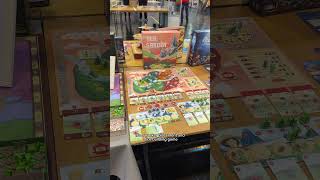






































As the proud owner of one of the tea gardens in the the Chinese Yunnan region, your mission in Tea Garden is to cultivate and expand your empire by establishing new tea gardens along the serene river valley. Tea leaves are your most prized asset, with six grades of tea quality and each region producing a different quality of tea. Transform your fresh, vibrant green tea leaves through fermentation, elevating them to rich, aromatic brown leaves that grow in quality — and value! — as they mature.
Harness the power of your deck of cards to orchestrate up to four main actions each game round. The strength of these cards is important for performing the chosen action; the higher the strength, the better the effects you will achieve. With your cards, you will build new tea gardens, acquire new cards, trade your tea with eager caravans, ferment your tea leaves, and harvest more tea. Couple your main actions with the power of secondary actions to navigate the river, produce tea cups, or practice tea studies at the university.
- Clean, accessible design for a hobby game with simple core mechanics
- Excellent balance between action quantity and action power
- Engaging secondary actions that create meaningful, hard-to-predict decisions
- Beautiful production for a retail game (screen-printed meeples, pagotas, dual-sided tea leaves)
- Tension and depth in decision-making keeps rounds engaging
- Potential for analysis paralysis due to combinatorial decisions
- Hard to start; the first turn is tough to plan
- Mostly iconography with limited art variety; some icons required lookup
- Cup tiles feel less thematic and slightly disconnected from tea theme
- End of game can come unexpectedly quickly, rushing endgame
- Deck-building, set collection, and resource optimization centered on tea production, fermentation, and tea cup dominance.
- An East-Asian-inspired tea empire-building setting where players grow and sell tea leaves to fulfill contracts and ascend a river rondelle.
- Rule-focused playthrough with step-by-step demonstrations; emphasis on planning and cascading actions through secondary actions and tableau development.
Mechanics (from transcript analysis)
- contract fulfillment — Sell tea leaves to complete contracts for points and emperor tokens.
- Deck building — Draw four cards each turn and build a stronger deck to support actions.
- deck-building — Draw four cards each turn and build a stronger deck to support actions.
- purchasing and teapot mechanic — Spend resources and teapots to acquire new cards that enter your hand.
- resource conversion (tea leaves fermentation) — Ferment or age tea leaves to increase quality and scoring potential.
- Rondel — A circular track that determines action options and interactions with the river path.
- rondell (rondelle) action selection — A circular track that determines action options and interactions with the river path.
- set collection / tableau building — Collect cards / pieces to build a personal tableau and unlock future actions.
- tableau building — Collect cards / pieces to build a personal tableau and unlock future actions.
Video topics + discussion points
Quotes (from this video)
- This is one of those games that if I were to sit down at a convention and demo this, I would have absolutely bought it
- I would still be playing it and I would not be unhappy that I bought this game
- it is a very nice production for a retail game
- the kudigrass of this game is the secondary actions
- it's a clean and for a hobby game simple game
- the balance of the number of actions you're going to take versus the power of these actions
- end of the game can absolutely get away from you
- there's just three basic actions that you're doing and they're all very easy to understand
- I wish there was a solo mode
- this is a clever little game
References (from this video)
- Neat ripening/fermentation mechanic
- Intriguing teacup set-collection for Emperor's favor
- Emperor track and Emperor cards for endgame scoring
- Multiple currencies and actions support engine-building
- Teapots enable secondary actions
- Not scratching the reviewer’s itch
- Caravan selling feels thematically awkward in a desert setting
- High currency clutter and potential fiddliness
- Thematic coherence of caravan market questioned
- Tea production, fermentation, and endgame scoring through imperial rewards
- Empire-building tea trade with caravans, cultivation and processing in a tea-centric region
- Euro-style engine with set collection and resource management
Mechanics (from transcript analysis)
- Card play and action sequencing — Your starting hand defines available actions; some cards unlock secondary actions.
- deck-building / card acquisition — Buy new cards to improve your engine and unlock more actions.
- Endgame track and emperor cards — Advance on the Emperor track to gain endgame bonuses and special cards.
- Infrastructure Building — Build houses and pagodas across the board.
- Market selling to caravans — Sell tea to caravans for points; limited restrictions on some caravans.
- Resource management — Multiple currencies: green tea leaves, brown tea leaves, teapots, and points.
- Ripening and fermentation timing — Tea ripens or ferments; young tea can fall off while fermented tea increases value.
- set collection — Teacups with matching icons provide access to actions and Emperor's favor.
- Track advancement — Track progress for scoring opportunities.
- University of Tea Studies — Track progress for scoring opportunities.
Video topics + discussion points
Quotes (from this video)
- overall Tea Garden is not for me
- not for me if tea is really for you you might like this
References (from this video)
- Tight deck-building loop with meaningful decisions on resource allocation
- Strong thematic flavor that ties tea production to gameplay
- Satisfying combo potential through cup tiles and caravan bonuses
- Short session length with high tension and replayability
- Clear win conditions and visible engine progression
- Deck-building within a flavor of tea production and imperial diplomacy; resource conversion and strategic timing.
- An imperial tea-trade setting where players harvest tea leaves to please the emperor, trade with caravans, and manage a brief, intense sequence of turns.
- Abstract flavor with thematic flavor text, no ongoing campaign or narrative arc; focuses on high-tension decision moments.
- White Castles
Mechanics (from transcript analysis)
- Action economy and turn pacing — Each turn allows up to four actions, with a fourth turn available only if the player pays a cost (two green leaves and one brown). This creates a tense trade-off between immediate card access and saving resources for future turns.
- Action points — Each turn allows up to four actions, with a fourth turn available only if the player pays a cost (two green leaves and one brown). This creates a tense trade-off between immediate card access and saving resources for future turns.
- Caravan selling and bonuses — Two caravan actions enable selling tea for bonuses, expanding the engine beyond simply building a deck. These bonuses provide end-of-round effects and ongoing benefits throughout the game.
- Combo-driven play — The game heavily rewards chaining purchases, caravan activations, and cup bonuses to create satisfying, high-impact combinations that accelerate your engine.
- Cup tiles and circle bonuses — Certain actions generate cup tiles. When enough cups are collected and arranged, a circle is formed; spending a cup yields a special bonus, encouraging deliberate placement and sequencing of tiles.
- Deck building — Players start with a small, fixed hand and acquire new cards from a central supply by spending resources. The deck evolves as cards are bought and added to the player's hand, driving future options.
- deck-building — Players start with a small, fixed hand and acquire new cards from a central supply by spending resources. The deck evolves as cards are bought and added to the player's hand, driving future options.
- engine building — The game heavily rewards chaining purchases, caravan activations, and cup bonuses to create satisfying, high-impact combinations that accelerate your engine.
- Limited-turn pressure — The finite number of turns and the cost to gain extra turns create a persistent tension between acceleration and resource management, making early planning crucial.
- Resource currencies — Tea leaves are the primary currency used to buy cards. Green leaves and brown leaves serve as the cost for extending the number of turns, introducing a layered resource management decision.
- Resource management — Tea leaves are the primary currency used to buy cards. Green leaves and brown leaves serve as the cost for extending the number of turns, introducing a layered resource management decision.
Video topics + discussion points
Quotes (from this video)
- At its heart, Tea Garden is a standard deck builder.
- It's a game where you really have to control how you're spending your resources.
- Did I mention there's a lot of combos in this game?
- If you are a fan of things like the White Castles where you have a limited amount of turns and you really need to combo up in really satisfying ways, then I highly recommend you give this one a look.
References (from this video)
- Multiple paths to victory and rich decision space.
- High replayability due to varied scoring and map interactions.
- Satisfying scoring alignment (cups, river, university) that reinforces strategic choices.
- End-game length can feel short for some players or sessions that linger.
- Strategic tea economy with route-building and open-ended scoring paths.
- Tea trading and tea garden development on a map featuring rivers, universities, and ceremonial scoring tracks.
- Puzzly, decision-driven Euro-style with multiple scoring routes and evolving board state.
- Merchants Cove
Mechanics (from transcript analysis)
- Area Control — Control of regions and tracks (e.g., emperor track) influences end-game scoring and pacing.
- area_control — Control of regions and tracks (e.g., emperor track) influences end-game scoring and pacing.
- Compound Scoring — Scoring comes from multiple sources (river progression, university matches, car displays, etc.).
- Resource management — Players allocate and manage resources to activate actions and purchase capabilities.
- resource_management — Players allocate and manage resources to activate actions and purchase capabilities.
- set collection — Players collect items/resources to form scoring combinations across different zones.
- set_collection — Players collect items/resources to form scoring combinations across different zones.
- tile placement — Tiles representing tea gardens are placed to shape scoring opportunities and map layout.
- tile_placement — Tiles representing tea gardens are placed to shape scoring opportunities and map layout.
- variable_scoring — Scoring comes from multiple sources (river progression, university matches, car displays, etc.).
Video topics + discussion points
Quotes (from this video)
- In Tea Garden, for instance, there are a bunch of different ways to score.
- Good games will make you wonder about all of those possibilities.
- The game asks you questions.
- Hence why we play Tea Garden again back to back.
- Time just freaking flies by.
References (from this video)
- Beautiful artwork adds to the zen tea garden vibe
- Accessible mechanics with a satisfying tactile feel
- Theme may feel abstract to some players
- Scoring can be opaque without a clear guide
- tea culture and garden aesthetics
Mechanics (from transcript analysis)
- hand management — Organize and optimize a hand of actions/cards to maximize efficiency.
- hand_management — Organize and optimize a hand of actions/cards to maximize efficiency.
- set collection — Collect and assemble components to trigger effects or scoring.
- set_collection — Collect and assemble components to trigger effects or scoring.
Video topics + discussion points
Quotes (from this video)
- These are my top 10 Udemy board games
- for number ten, I have Bus, a wacky but mean worker placement game.
- For number nine, I have Scythe, an engine building game.
- For number eight, I have Necoima, a much better version of Jenga.
- For number seven, I have Tea Garden, a hand management game with beautiful artwork.
- For number six, I have Mountain Goats, a push your luck racing game.
- For number five, I have Rebel Princess, a trick-T game with asymmetric abilities.
- For number four, I have Andromeda's Edge, a worker placement game, but with a lot of things going on, but it's so much fun.
- For number three, I have Wingspan. You guys know what this is at this point.
- For number two, I have Distilled, where you're making whiskey in this game.
- for number one, I have STI, where you're trying to find extraterrestrial life.
- And this game is beautiful.
References (from this video)
- Deep engine-building and strategic depth
- Strong thematic integration around tea gardening
- Replay value and player interaction
- High complexity for new players
- Rule overhead and slower early play
- tea production, resource management, engine-building
- Tea garden labor, production, and tea engine in a stylized economic environment
- procedural euro with theme-forward mechanics
- SETI
Mechanics (from transcript analysis)
- Deck building — players assemble and lean on a tea-point engine by drafting and playing cards to trigger actions
- set collection — collect and convert tea-related resources to fulfill orders and activate chains
- set collection / resource management — collect and convert tea-related resources to fulfill orders and activate chains
Video topics + discussion points
Quotes (from this video)
- Cardboard is my app. I launched it a few weeks ago.
- This is my August plays list here.
- I want you to come along the ride with me.
- Welcome to Ctier. Great.
- I'm absolutely passionate about creating this board game discovery community.
- If you are not a member for Cardboard, crdbrd.ap, go sign up now. It's the world's greatest board game community.
References (from this video)
- Deep engine-building with multiple action paths
- Strong interaction between main/secondary actions creates strategic depth
- Thematic tea ceremony flavor with a tangible pot/leaf system
- Expansions (Court of Nobles) add options and replayability
- Solid weight that sits between accessible and thoughtful
- Steep learning curve and potential for first-time players to feel overwhelmed
- Balancing of teapot/pot mechanics can be fiddly and tricky to manage
- Some players may struggle to grok optimal engine trajectories without multiple plays
- Tea production, ceremonial tea preparation, and strategic resource management
- A stylized tea garden/tea trade setting with pagodas, teapots, and tea leaves weaving into gameplay
- engine-building with modular expansion and thematic flavor around tea ceremony
- SETI
Mechanics (from transcript analysis)
- action selection — Players choose between main and secondary actions, enabling layered strategy each turn.
- Caravan/card market — Caravan/purchasable cards in a market row drive end-game scoring and offer tactical choices.
- End-game scoring via emperor track — Advancing on emperor tracks and completing caravan combos yields significant points.
- Engine-building with pagodas — Pagodas generate resources; multiple pagodas amplify yields and unlock more actions over time.
- Resource management — Careful management of tea leaves, teapots/pots, cups, and emperor tokens to fuel actions.
- Trash to upgrade — Trashing cards to gain emperor tokens and access higher-tier options.
Video topics + discussion points
Quotes (from this video)
- Tea Garden. This game is great.
- SETI is in my top 10.
- I like SETI. I really do, but one of my game groups is Obsessed.
- GG, man. That's a fun one.
- The expansion is very good.
- It's a medium plus.
References (from this video)
- Stunning production quality and distinctive old-school visual aesthetic
- Novel meeple movement mechanic with strong potential
- Accessible rules and quick playtime for gateway players
- Drafting pool can feel restrictive at 3-4 players and often yields limited appealing choices
- Scoring mechanics can feel repetitive with little variance, leading to a perceived lack of excitement
- Compared to other puzzle-draft games, it can feel derivative and lacks a memorable 'wow' factor
- Garden creation and growth with decorative features
- Garden design and landscape development on a modular board
- Minimal narrative; puzzle-driven, with visual scoring tiles
- Cartographers
- Isle of Skye
Mechanics (from transcript analysis)
- card drafting — Players draft cards from three visible rows, selecting a card that determines placement and score opportunities.
- Meeple movement along rows — After placing a card, the player's meeple is moved along the corresponding row toward scoring opportunities, influencing future rounds and scoring.
- Modular endgame scoring tiles — Advanced tiles change scoring rules and add variability at endgame, increasing depth without overburdening the basic rules.
- Pattern-based scoring tiles — Various features (trees, lakes, fountains, benches, statues, roads) score points in different patterns, both midgame and endgame.
- tableau building — Cards must be built outward from the middle of the player's board, creating evolving structures and proximity-based scoring opportunities.
- Tableau building with middle-out placement — Cards must be built outward from the middle of the player's board, creating evolving structures and proximity-based scoring opportunities.
Video topics + discussion points
Quotes (from this video)
- I was completely enamored with the way the game looks and really intrigued about this meeple movement system.
- this meeple movement system is a very novel mechanism.
- it's tailored towards a more introductory level gamer.
- not a recommendation.
References (from this video)
- Strong thematic integration with food/drink
- Euro game goodness with crunch
- Multiple gameplay layers
- Straightforward to learn
- Tea cultivation
- Tea types (black, green, etc)
- Garden management
- Harvest and processing
Mechanics (from transcript analysis)
Video topics + discussion points
Quotes (from this video)
- you don't take my word for it folks I was watching the uh Dice Tower Essen excitement list
- I vouch for each of these quite highly
- so much game play depth in less than 15 minutes
- one of the prettiest games you will ever see
- a good tile layer needs to be so kind of connected together
- I want a statue to myself
- it just really seems like a very exciting modern trick-taking game
- beautiful and then you see the completed thing that's one of my favorite things
References (from this video)
- Interesting deck-building mechanics
- Multiple paths to scoring points
- Strategic depth
- Variable card availability
- Can be challenging to manage multiple strategies
- Complexity increases with more card types
- Tea garden cultivation and trade
- Yunan region of China
- Economic strategy
Mechanics (from transcript analysis)
- action selection — Choose from five main actions each turn
- Deck building — Players purchase and manage action cards
- hand management — Strategically playing cards for actions
Video topics + discussion points
Quotes (from this video)
- As the cards get more expensive, you need the more valuable leaves
- It's not great if you just keep buying cards and not actually removing the bad ones