/pic218485.jpg)
User review
Set up:
The game contains twelve map tiles. Each map tile is made of one hexagon surrounded by six hexagons. Each tile will have a mixture of any or all of five types of terrain: grasslands, farmlands, mountains, woods, and hills. Each player gets a Player Aid card, selects a color of people tokens and places the era cube of the matching color on The Era Starting Box on the Progress Column part of the game board. A starting player is selected. Some tiles are placed contiguously on the game board (the number of tiles depends on the number of players) one at a time in turn order. Each player, in turn, places three of their people tokens on the game board contiguously. The game is now ready to begin.
Game play:
Players should note which terrain will be worth Progress Points at the end of the era. Progress Points are the number of hexes occupied of the scoring terrain by one’s token plus the number of city tiles plus the value of all eligible Idea Cards. The player or players with the most Progress Points will advance to the new era and get an advantage over the other players.
In turn, a player may:
- Move people
- Have babies (increase the number of people tokens on the game board)
- Have a fight (initiate the diceless combat system against another player)
- Have an idea (draw chance cards)
- Build a city (replace people tokens with a city tile)
After all the players have used all of their turns the era has ended. If this not the first round then all the players’ Era Cubes are advanced to the level of the leader(s). Progress Points are then compared and the leader(s) advance to take advantage of one’s newest ability.
The game is over after ten eras. Victory Points are the total of number of non-mountain hexagons occupied by one’s tokens plus the values of one’s cities plus three points for advancing to the final era. The player with most Victory Points is the winner.


- Little shedding style game
- Awful game name
- Risk of drawing 'indigestion cards'
- null
- null
- null
Mechanics (from transcript analysis)
- Push Your Luck — Trying not to draw 'indigestion cards' when restocking.
- Shedding game — Shedding cards from hand.
Video topics + discussion points
Quotes (from this video)
- hey everybody and welcome to February's edition of board game Buys
- I only have eight games here to talk about but hopefully there's something here to grab your attention
- it's just more to give you an idea about what's coming up on the channel
- let's start with probably the the heavy hitter of the bunch which is setti the search for extraterrestrial intelligence
- it kind of got relentlessly positive reviews
- I generally like the games that cge put out there
- so I have can I have played this one a few times already
- so that is seti the search for extraterrestrial intelligence onto an older Euro now then this is um hadara
- always had my eye on hadara but never really managed to um to find a copy at a reasonable price
- so that is hadara another more recent game is a message from the Stars
- so I'll leave it at that I do need to play this one some more before I solidify solidify my thoughts
- so that is a message from the Stars a couple of fillers now uh tempura is one of those an awful game name
- hit uh also known as no mercy
- and this is hit extreme which I think adds in some more kind of special rules and special powers
- so yeah finally got this one played um and yeah I'll share my thought thought soon
- Druid is another one that was very kindly um sent to me
- so that is Druid another one that I'm sure you guys wouldn't have heard of is time of War
- this is a kind of a negotiation auction game
- this is definitely a homemade product know definitely um self-published which I think is always cool
- no spoiler I've got some positive things to say about um this game
- so that is uh time of War and the final game is a game I know nothing about actually
- so not to end it on on a high uh this is uh shitenno I don't know anything about this game at all other than it's got some very nice Vincent D trait artwork
- so that is shitenno let me know if you've played that one cuz I'd like to hear your thoughts
- that's it really that's all of the games that I have um picked up
- so some pretty pretty wacky games here old games kind of forgotten about games um self-published games kitsa Classics uh and sell on little card games and even some Euro such as setti uh and hadara
- so hopefully you've enjoyed the video
- see you next time on chairman of the board bye-bye
References (from this video)
- Happy we bought this one.
Mechanics (from transcript analysis)
Video topics + discussion points
Quotes (from this video)
- So many games and we can't play them all because we're not robots. We have to eat and sleep and do other things as well.
- I really enjoyed the concept of this. It's a co-op game. This we got even before I started going to say hating co-op game, but understanding they weren't for me.
- It sounds okay, but it also big and we don't need it.
- This is actually not sad. It's actually a positive thing getting these out of the house so we can get more games into the...
References (from this video)

- Too high rating
- So abstract
- So meh
- Civilization
Mechanics (from transcript analysis)
Video topics + discussion points
Quotes (from this video)
- Hens is a game I didn't like at all.
- Gobblet is a simple game in which you are to stacking pieces and trying to get four in a row, but bigger pieces cover up other pieces.
- Dice as resources to buy cards, kind of like a Dominion-style game. And it was fine. It just didn't have any kind of air of excitement to it.
- And it's a big, grandiose Euro-style game that I thought worked pretty well.
- The biggest problem with Echoes of Time is I think it's almost too short.
- It's a cool mechanism. This is the game that should have it.
- It's a very different feeling of Lost Cities. It's not as good as Lost Cities, but it's still pretty cool game.
- It's very Ameritrashy.
- It's a lot going on in this game.
- I think my favorite of those is Pixel Tactics 2.
- Thanks as always for joining me in my pile of mid games.
References (from this video)
- Mechanically interesting push and pull with multiple players.
- Hand management and risk assessment elements.
- Nice components.
- Variable setups and maps.
- Fairly straightforward gameplay loop.
- Can feel like a push your luck game with extra steps.
- Tension doesn't build until it's too late.
- Can lead to losing suddenly with little recourse.
- Having two matriarchs in hand results in losing significant energy and flexibility.
- guiding a herd of elephants across the savannah, visiting landmarks, and reaching the end tile.
- savannah
Mechanics (from transcript analysis)
- event cards — Event modules introduce additional challenges and rule modifications that affect gameplay.
- Hand Management — Players manage a hand of cards, deciding which to play for effects or to discard for basic actions.
- Push Your Luck — Players must balance taking risks with drawing cards or moving into dangerous areas against the potential for losing the game.
- Resource Management — Players manage 'energy' as a resource, which is spent and can be regained through various actions.
- Set Collection — Players need to visit specific landmarks and gather certain tree types.
- Tile Placement — Players place tiles on the board to create pathways and cover landmarks.
- Variable player powers — The 'matriarch' elephant acts as a key piece that influences gameplay and strategy.
Video topics + discussion points
Quotes (from this video)
- The lions will probably eat us.
- Oh, wow. That is that's a brutal way to start off hand.
- The tricky part is these elephants are these lions are going to close in on us sooner rather than later and we are going to run out of elephants sooner rather than later.
- This game effectively is a push your luck game with a lot more steps thrown in.
- It's one of those games where it feels easy the entire time until you lose and then you just find yourself in a hard position where you're like, 'Oh, I lost now. Nothing I could have done at that point.'
- The part of the challenge of this game as far as part of why I don't love it, but like I enjoy it is it's one of those games where it feels easy the entire time until you lose and then you just find yourself in a hard position where you're like, 'Oh, I lost now. Nothing I could have done at that point.'
References (from this video)

- not for me
- changing history, traveling through time
- possible paths history can take
Mechanics (from transcript analysis)
- Card Play — You also play cards for additional actions and score points.
- Movement — So you move your meeple around these cards in the timeline, taking the action on those cards, changing the timeline as you go.
- Timeline Manipulation — In Temporum, the board shows the possible paths history can take and the actual path it currently takes. On your turn, you can change history, travel through time, and visit a point in history.
Video topics + discussion points
Quotes (from this video)
- Let me know what you think of these five time travel board games in the comments below.
- Necessity is the mother of invention, but invention is also the mother of invention.
- It's the heaviest game on the list, and it's also the most timey-wimey brain-burning.
- So you create a paradox.
- It's rated as the top 100 games of all time.
- Get it? Future.
- It sounds like a head-scratcher, like that tri-dimensional chess on Star Trek.
- It's chaotic, silly, and all about seeing how strange history can get when everyone is meddling with it.
- Everyone hates Bob.
- It's essentially a cop investigation where every reset makes you a little smarter about what you're going to do next time.
- I haven't played Temporum. Never heard of it. Stick a look on BGG.
References (from this video)

- around the same complexity and difficulty level
- cute C art
Mechanics (from transcript analysis)
Video topics + discussion points
Quotes (from this video)
- Probably the most complex game I have in my collection, which is Lisboa.
- Wild Garden, super fun, but the group I played it with just took so long in their turn so I'm like, I need a break from this game for a second.
- Thunder Road: Vendetta continues to be a game that I introduce to brand new players and people just have so much fun with this game.
- I played and I love this game.
- this was so much fun.
- This game slaps.
- It feels like a 2D arcade scrolling game and we're looking for it.
- I've had so much fun with Street Fighter and I've always kept it around because I just love the miniatures
- This is a really fun building game.
- This plays so different from other Lacerda games of course, because it's way easier.
- I just think the style overall just feels a lot more like flowy, a lot more straightforward than his other games
- Snow Planner, really love this game.
- Thank you to Leder Games for sending this one over. Of course, I cannot wait to play this.
- With that in mind, the final count is 160 games.
References (from this video)

- found it to be okay
- little lucky in the setup
- little odd communication
- something about it missed the mark
- wasn't necessarily bad, but it was okay
Mechanics (from transcript analysis)
- Cooperative — A cooperative game.
Video topics + discussion points
Quotes (from this video)
- I feel like that was the case here. Uh it just kind of distracted I felt from what I like in the core experience of Azure.
- But man, I wish a few tweaks uh could be made to it to make it a truly excellent, excellent game.
- It it just doesn't feel like any other uh cooperative game that I can think of and I love the theme and the look of it.
- This is one where I really feel like it gives me more of what I already like about Moour.
- There just something about it that missed the mark for me. It wasn't necessarily bad, but it was okay.
- The pirates has almost nothing to do with the theme at all, but a fun little game.
- It's a nice looking game from Panosaurus. It just at the end it just felt it felt fine.
- but the the game itself is a really nice game.
- It's like an adult version of the Haba game Monza.
- Beautiful cards, but not a great game.
- Really enjoyed this one.
References (from this video)

- Cute kittens were a deciding factor for purchase
- Entertaining
- Fun dexterity elements (flicking, throwing)
- Game is about losing points
- Eating contest
- Taiwanese snack bar
Mechanics (from transcript analysis)
- Push Your Luck — Players are challenged to eat more than they can imagine as competitors continue to challenge them to push themselves further, until one player has collected three negative points.
- Take That — Competitors continue to challenge them to push themselves further.
Video topics + discussion points
Quotes (from this video)
- my name is at the start it's fine is it hello i'm matthew and joining me to count down the 10 games our viewers are playing this month is paula hi everyone i'm here too uh because we're in my house right now i'm at your house also i am real jet-lagged so who knows how this is gonna go
- fun flippin right like game the special abilities feel great a fun puzzle to solve each time and solo is quick to play it's great i love you when every card feels super good yeah a game where you're like everyone else has way better powers than me but everyone else is like oh everyone else is weird yeah yeah yeah i love it it's fun i like it it does kind of feel like a flipping right but it's not it's a it's a flipping place cubes yeah it's a flipping cube we've coined it it's a coin game
- got it as a late birthday present the gifter was originally going to buy a different game but she was swayed by the cute kittens i would be too and that's why i had to interrupt you so but what we were talking about is being a teppanyaki chef over our hot hibachi grill and it sure does look entertaining but could you be one throw the egg grab the pepper and find out in hibachi players are japanese teppanyaki chefs who must use their hibachi grill to please hungry customers by throwing disks which are actually poker chips onto the board where the chips land determines which ingredients the chefs can buy or sell and which special actions they might be able to take the first chef to complete three orders from customers not just ones they made up out of their brain wins in that it's obvious like i win nobody wants everyone i did it they just came in for water they did it viewer jonathan l recently fired up this game stating hauling poke chips across the board to complete recipes and getting to annoy your friends by kicking their chips around what not to like my brother really enjoyed this game well the game that this was really based on yes this sounds really fun i like it's obviously a dexterity game it is but also the way you go about it is very very fun it's like flicking throwing and flick i think it'd be bad at it i just need to get some gums i wish what did they look like did the pieces feel like slices of the onion volcano oh exactly like that of course that's exactly how i was going to describe it before you started saying the deluxe version of this game should have actual edible bits that you're throwing on the board i feel like you think that you want that but you don't want that i want it no don't tell me what i don't want okay it comes with an egg
- this game is more phenomenal it creates the most faithfully immersive board game experience for a franchise that i never stopped loving since i was a kid the sheer number of expansions allow for so much gameplay variety creating unique combat puzzles for each playthrough depending on the combination of rangers and their fighting styles that you're playing with also the miniatures are so cool i think i had the last jason toy that was in the country my mom had to drive to a port to get it from a guy who had it in a box oh wow oh it was huge never let me forget it
- deduction and suspense deduction and suspense carefully observe strange clues strange and ominous patterns it's actually quite distracting when you do that now think about it distracting in the things going on in the apartments across the way there's parties knives a saw bickering laughing music and a mysterious trunk do you detect a murder or is the secret private world of
- Knocking it out of the park at number two is Barron park.
- The first game is the guild of merchant explorers in which cities will grow in reach as players traverse the map to increase their network of connections and build routes toward the goal of achieving their personal secret objectives.
- Parks are created by combining polyamidos with players scoring for animal house animal areas completed construction and more.
- We were just taught this at a game night with friends we had such a great time and it's one of the best games we've played recently and autumn p adds just charming not all the babies are bears oh the game sorry cares like charmin is what i thought just charming because they have a bear mascot that's true
- Near and Far in which players explore different maps in a search for the last ruin recruiting adventurers hunting for treasure and competing to be the most storied traveler they must collect food and equipment at town for long journeys to mysterious locales making sure not i do the pointing that's my thing i have the mug and the pointing i'm so sorry long journeys mysterious locales making sure not to forget enough weapons to fight off bandits living statues and rusty robots statues exactly you've got to watch out for the living statues sometimes travelers run into something unique in a mini adventure is read from a book of stories it's giving the player a choice of how to react creating a new and memorable tale each game
- We just started playing this one and are so impressed with the different modes of play campaign character arcade is like a choose your own adventure book inside the choose your own avenger book
- I like the characters in storytelling
- Maybe my favorite red raven game maybe my favorite game ev my favorite game ever
References (from this video)
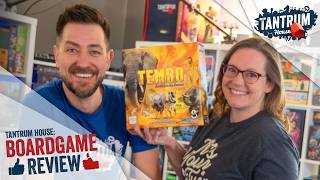
- Immersive theme and cute elephant artwork
- Tight cooperative puzzle with meaningful decisions
- Interesting spatial footprint mechanic
- Multiple difficulty modes and solo/campaign options
- Steep learning curve for new players
- Lions can end game abruptly on bad draws
- Pace can feel slow early if not set up quickly
- Survival, teamwork, resource management
- Savannah, guiding a herd of elephants across a dangerous landscape
- Dynamic, living herd system with matriarch-led journey
Mechanics (from transcript analysis)
- Card economy and end conditions — Deck is finite; players must manage cards to illuminate landmarks or risk running out.
- Card placement to build savannah — Players expand the map by placing terrain cards to unlock resources and progress toward landmarks.
- Elephant placement pattern — You must match footprint patterns and card orientation when placing elephants, creating a spatial puzzle.
- Hidden information and communication — Players can't see others' hands; communicate without full visibility, fostering table talk and teamwork.
- Limited Communication — Players can't see others' hands; communicate without full visibility, fostering table talk and teamwork.
- Lions threat mechanic — Lion cards move toward the nearest elephants; they eat elephants and can end the game if not managed.
- Matriarch movement and reset — Revealing the matriarch moves the herd and resets certain resources, driving strategic placement.
- Resource Management — Balance limited energy, elephants, and landscape resources; trees and waters affect actions.
- Terrain and tree interactions — Trees provide energy; eating trees is limited to one type per matriarch cycle; terrain differences affect movement.
Video topics + discussion points
Quotes (from this video)
- Not just about getting from point A to point B. It's all about survival and efficiency and teamwork.
- There is a really interesting spatial puzzle here.
- This is not an easy game.
- The game is enjoyable. It does feel very immersive.
References (from this video)

- Accessible entry point for new players with a clear cooperative objective
- Strong thematic cohesion: matriarch-led elephants navigating a dangerous savannah
- Tight synergy between card actions, elephant placement, and landmark collection
- Multiple scenarios and a campaign-like pathway via introductory mode and optional variants
- Visually appealing components and a satisfying sense of progression when landmarks are visited
- Rule complexity can spike during advanced maneuvers (double matriarchs, terrain interactions)
- Late-game pressure from the lion deck can lead to dramatic, high-stakes losses
- Potential for suboptimal early decisions to cascade through the rest of the game
- Component count and orientation rules may create a steeper learning curve for casual players
- Animal herding and survival under cooperative constraint, where a matriarch leads a herd through an increasingly perilous landscape, balancing energy, resting elephants, and landmark objectives against predators and deck-driven events.
- Savannah biome depicted as a stylized game map, with elephants and lions moving between purple-labeled landmarks across a tiled grid. The setting emphasizes a journey across open grasslands, water sources, rocky terrain, and forested pockets, all guiding a matriarch-led elephant herd through a sequence of safe havens and contested zones.
- Narrative-driven co-op with modular map layouts, where the elephant herd advances toward two final goals while tourying through a sequence of landmarks; the elephants’ fortunes are tightly coupled to the matriarch’s movement and the deck’s random encounters with lions.
- Aqua
- Hutan
Mechanics (from transcript analysis)
- Card-driven action placement — On a player's turn, a card from hand is chosen and placed on an available space to trigger its action. Cards can be rotated and placed adjacent to the matriarch or existing elephants; some cards also interact with terrain and landmarks and may be rotated to optimize the action.
- Elephant placement and orientation rules — Placement requires following an exact orientation relative to the seated players. Diagonal connections count for placement, and there are constraints about where elephants can be placed in relation to the matriarch and existing elephants.
- Energy and rest economy — Elephants can be rested to regain energy, and the matriarch’s actions often involve paying energy to reposition and reset certain board elements. Energy management sits at the heart of planning moves, as exhaustion or depletion leads to losses.
- Landmarks and victory conditions — Progress is measured by visiting six landmarks and then reaching the two final destination spaces. Visiting landmarks typically requires covering specific spaces on the board, and some landmarks are only accessible after certain conditions are met.
- Limited Communication — Players can discuss their hands and intentions but cannot reveal exact cards. This creates tension and strategic dialogue while preserving fog of decision-making.
- Lions as deck-driven antagonists — Lions appear from the deck as encounters that gradually push toward elephants. When lions engage with elephants, elephants may be discarded or sent back to exhaustion; lions’ movement is toward the closest elephants, with tie-breaking rules.
- Matriarch movement and multi-matriarch penalties — The matriarch card(s) move the matriarch figure and trigger a sequence of effects, including returning elephants to exhaustion, paying energy, and potentially resetting the board. Holding two matriarchs introduces a heavy energy penalty and altered sequence.
- Shared information and communication — Players can discuss their hands and intentions but cannot reveal exact cards. This creates tension and strategic dialogue while preserving fog of decision-making.
- Terrain effects and two-step placements — Certain terrain cards force players to place two elephants, or to ignore rough terrain only if a matriarch is involved. Terrain shapes influence possible pathways and the efficiency of landmark visitation.
Video topics + discussion points
Quotes (from this video)
- we'll be taking the roles of elephants.
- The matriarch slowly make its way throughout the savannah, avoiding the lions, hoping to visit all the landmarks
- Lions will slowly be coming out through the deck and then moving towards the elephants.
- The elephants have traversed the savannah.
- This is the introductory mode. There's many different scenarios of different map layouts you can play.
- We are also using all five resource markers that'll make it a little bit easier for us and five of these cards as well.
- The first cooperative game.
- The matrix elephant will slowly progress through the map, and we'll wander our way over all the way to the very end in hopes of winning.
- Energy sneaks up on you; it's actually quite handy to have it around.
References (from this video)

- Beautiful mini-game packaging
- Simple, tense decision-making with escalating risk
- Can be perceived as light or lightweight by some players
Mechanics (from transcript analysis)
- Push Your Luck — Players draw and place cards with the goal of building a set; risk increases as more cards are played.
- push-your-luck — Players draw and place cards with the goal of building a set; risk increases as more cards are played.
- set building and risk management — Players match on-table cards; accumulating points while avoiding negative draws.
Video topics + discussion points
Quotes (from this video)
- Lovely production nice artwork it's been around for years now
- it's a push your luck game and it's quite simple but tense
- it's a game of chicken and the dungeon gets bigger and scarier
- it's a neat little decision
- it's a classic trick taking game
References (from this video)
- Accessible and quick to teach with a clear flow
- High-quality components and attractive artwork
- Rich decision space given a relatively small footprint
- Good variety of scoring interactions and replayability
- Can feel brain-burny due to many scoring interactions and optional optimizations
- Solo rules and some expansions add complexity not shown in base game
- Requires careful tracking of many moving parts and end conditions
- Cozy coastal town development with terrace-building aesthetics
- Seaside town in Wales, UK
- Casual, instructional, community-playthrough tone
- Where's Wally
Mechanics (from transcript analysis)
- End-game scoring via residence cards — Players maintain secret residence cards that provide end-game bonuses based on finished streets, best street performance, or all streets combined.
- Life rings as currency — Life rings are used to modify offers, add cards to offers, move cards, or take more actions; they have no end-game point value.
- Movement of existing cards — Two life rings can reposition a card anywhere legally within the board to optimize scoring adjacencies.
- Night/day phases — A two-phase flow where decisions are made at night that directly resolve actions in the daytime, in a left-to-right resolution order.
- Tile/edge placement on streets — Cards representing terraces, peers, and landmarks are placed into streets with matching edges; edges must match for a legal placement.
- Town card types and icons — Terraces, peers, and landmarks provide versatile placement options and scoring potential; icons on cards enable specific draws or top-deck access.
- Turn order and day cards — At the start of each round, players choose day cards to determine the action order for the day phase; the unchosen card yields a life ring and will be available next round.
Video topics + discussion points
Quotes (from this video)
- The artwork is gorgeous and it fits the feel of the game.
- The component quality is also really nice. These are just really nice. Nicely printed.
- It's a relatively simple game, we're going to do pretty much a teach at the start.
- There’s a lot of depth if you want it, but it’s still approachable.
References (from this video)
- cute artistic presentation
- quick to teach and play
- light and accessible with a fun theme
- heavy reliance on luck
- some players may tire of the theme
- cats eating sushi with a comical indigestion risk
- cute, cat-themed sushi dining
- playful, whimsical
- Welcome to the Dungeon
- Welcome to the Dungeon: Our mini-series lineage
Mechanics (from transcript analysis)
- card play / set collection — collect and play cat dishes to manage sushi types
- card-driven turn order — special action cards can modify the flow of play and turn order
- push-your-luck / deck management — drawing from the deck carries risk of indigestion tokens
Video topics + discussion points
Quotes (from this video)
- it's the perfect game when I'm waiting for somebody else to turn up because you can have a game of croc and all that takes two minutes
- it's basically as simple as that
- I would often choose to play this over the original just because I've played the original so many times
- this monster of a box is it's just so beautifully produced
- it's the best word game I've played
References (from this video)
- Simple to teach
- Similar to card shedding games like Uno
- Beautiful presentation
- Creates tension through bust mechanic
- Cooking
- Kitchen
- Light
- Uno
Mechanics (from transcript analysis)
- Card Play — Match top card or draw cards equal to discard pile sum
- Going Bust — Drawing indigestion cards ends your turn and adds to your bust count
Video topics + discussion points
Quotes (from this video)
- the reason I wanted to talk about this topic was one was because I've just picked up the quacks of qward Lindbergh expansion the herb witches which is a really good expansion just to add some more of the same really more variety to that game which was my favorite game of last year
- so push your luck or press your luck games as they tend to be called in America
- it's looking at the odds and trying to make a mathematical decision is it worth me taking this risk or is it not and of course the presence of other people around the table changes that because it's not just about the maths it's also about knowing the psychology of those other people
- I love all the messin about you doing captain carcass you turn over one card it allows you to do something else and then you can use this special power to do something else
- the pushier luck stuff is strong in throne that's where the fun in the game is it's recognizing how many does to throw
- I love this honour of games I wish there were more of them
- thank you very much for watching I hope this was interesting for you if you enjoyed it please watch some of my other videos on BoardGameGeek I'm Adam 78 on YouTube I'm Adams Borg in wales on twitter i'm at board game wales