


Terror in Meeple City Deep Dive
What the Community Thinks About Terror in Meeple City
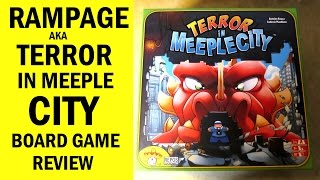
Terror in Meeple City, the 2013 game formerly known as Rampage, is viewed by reviewers as a boisterous game built around controlled chaos. The points of agreement are clear: it is loud, silly, and designed to make players laugh as much as they compete. Board to Death TV describes it as a foot stomping, meeple munching giggle fest, and the reviewers there say everyone at the table had a smile on their face for the whole session. Board Game Sanctuary calls it a fun light dexterity game that appeals to every member of the family, and gives it an overall thumbs up.
Where reviewers diverge is on depth. Board to Death TV finds a lot of skill involved and little strategy, and suggests the outcome almost doesn't matter once the group has had a good time. Board Game Sanctuary is more favorable about the design itself, praising its balancing system and its card variety, while also flagging rules that need clarification and a few powers that feel too strong. Board Games UnLocked lists the game among its honorable mentions in a top ten innovative games discussion, describing it as unique and a blast to play with family. That video offers the most enthusiastic tone of the three, though its discussion is brief compared with the two full reviews.
Core Mechanics That Define Terror in Meeple City
Throwing, Flicking, and Bouncing
The defining mechanic is physical launching. On a turn, a player takes two actions from a menu that includes Move, Demolish, Blow, and Throw a Vehicle, and most of those actions are resolved by flicking, dropping, or launching pieces across the board. Board to Death TV explains that moving means removing your monster pawn from its paw disc and flicking the disc in the desired direction, with the turn ending if the disc leaves the table. Demolish works differently: the paw disc must touch the sidewalk of the target building, and the player holds the monster pawn over it, keeps the arm parallel to the table, and drops it. Whatever lands is where the damage falls.
Board Game Sanctuary highlights how much the surface matters. The board includes raised trash squares that act as buffers, so a flick often bounces between the streets on its way to a target zone. The reviewer notes that players may need a bit of billiards or pool experience to find the right angle, which turns a simple flick into a small skill test. Board Game Sanctuary also credits designers Antoine Bauza and Ludovic Maublanc with the design, which places the game in a line of tactile, component-driven titles.
Devouring and the Runaway Meeple Track
The second mechanic that reviewers single out is the devouring phase and the penalty system that follows it. After the action phase, a monster eats meeples in its neighborhood, up to the number of teeth it still has, with a minimum of two teeth that can never be lost. Board Game Sanctuary explains that when a player knocks meeples off the board, they land on a runaway track. Filling a line on that track triggers negative effects for the player who caused it, and the next player chooses where the monster goes. The reviewer calls this the mechanism that balances the game, because it discourages players from simply demolishing the whole city in one large blow. Players who want to demolish a tall building or a stadium have to weigh how many meeples they will send running.
The Terror in Meeple City Experience
Chaotic, Giggling Silliness
Playing Terror in Meeple City feels like a pop culture stunt show. Board to Death TV describes a session where one player laughed so hard they could not perform their blow action, and the group's verdict is that the game is silly in the best sense. Board Game Sanctuary describes the appeal as the chance to reenact the arcade classic Rampage on a tabletop, with the satisfaction of watching the city come apart. Both reviews agree that the chaos is the point: pieces fly, monsters get knocked over, and nobody takes the game too seriously.
Restrained Destruction and Tension
Beneath the silliness is a tension about how far to push. Because knocking pieces off the board sends meeples onto the runaway track, every aggressive flick carries a cost, and players must decide whether a big demolition is worth the penalty. Board Game Sanctuary describes this as adding a real layer of strategy, since a player may want to knock down a tall building or stadium but holds back for fear of filling the track. The result is a rhythm in which bold attacks are constantly weighed against consequences that could hand the turn to someone else.
What Makes Terror in Meeple City Stand Out
A Three-Dimensional City on the Table
Reviewers consistently praise the presentation. Board Game Sanctuary calls the art of the board beautiful and says that the raised, three-dimensional buildings give the game an eye-catching hook. The reviewer points to pop culture references hidden in the detail, including a Godzilla nod, a Captain America shield, a bat signal, and Calvin and Hobbes style artwork on some tiles. The components also draw praise for their durability and wood construction, with the reviewer noting that the stickers on later editions can peel after repeated play. The same reviewer says the theme pops out like a pop-up picture book, and that playing the game feels like participating fully in the experience.
Card Combinations That Keep Replays Fresh
Board Game Sanctuary argues that the game's simple rules hide considerable variety. Power cards, character cards with personal victory conditions, and a secret superpower that each player can use once all combine in different ways from game to game. The reviewer describes this as immense replayability and notes that the game is easy to teach to a family, which encourages repeat sessions. The same reviewer adds that the game is fun even when a player is not winning, and that it is one of those rare games you pack up as you play it, since the board is cleared as the city falls.
Potential Drawbacks
Rules That Need Clarification
The most consistent criticism concerns the rulebook. Board Game Sanctuary says the game needs clarification on several points, such as whether meeples still support a structure once it has lost its top piece, whether a structure with nothing on it can be claimed, and how a claimed structure is stored in a monster's secret area. The reviewer considers these gaps important enough to resolve before play. Board to Death TV also notes that rules may change before release because the copy reviewed was a prototype, which suggests that the published version may address some of these concerns.
Superpowers That Can Overpower the Balance
Board Game Sanctuary raises a fairness concern about the secret superpowers. The vacuum power, for example, can suck up meeples that have fallen off the board and place them in a zone of the player's choosing, which can bypass the runaway track that otherwise keeps the game in check. The same reviewer notes that turn order can disadvantage a fourth player in the first round, because much of the city may already be destroyed by the time their turn arrives. Board to Death TV offers a related caution about the game's strategic depth, saying it leans heavily on skill with relatively little strategy.
If You Enjoy Terror in Meeple City
Board to Death TV closes its review by comparing the game's appeal to King of Tokyo, asking who would want to be the king of Tokyo when they can destroy it. That comparison points to the most natural recommendation. Players who enjoy Terror in Meeple City's monster-driven destruction will find a similar satisfaction in King of Tokyo, where giant creatures battle over a city and the fun comes from tearing it apart while others try to stop you. Players who value the flicking and dropping mechanic may find King of Tokyo a more predictable, dice-driven alternative, which makes it a good first step for a table that wants the monster theme without the physical dexterity.
For groups that enjoy the dexterity side of the game, the reviewers' emphasis on flicking, bouncing, and balancing risk suggests that Terror in Meeple City rewards players who like physical play with real consequences. Players who want the theme and the laughter but are willing to accept a bit more rules clarification may find that the game delivers exactly the kind of messy, joyful table experience reviewers describe.
What Reviewers Are Saying
"Rampage is a foot stomping, meeple munching, giggle fest of a silly game. It introduces crazy shenanigans and new game mechanics, and everyone has a smile on their face throughout the whole game."
— Board to Death TV
"First of all it is deliciously fun. I love the fact that you can take on these monsters, reenact Rampage the video game, and destroy the buildings and eat all the meatballs. There's something glorious about devouring the city and taking it down."
— Board Game Sanctuary
"You can hit each other, you can knock each other down, and you lose a tooth. It's really unique, you know, and we might played, it's been out for a while, and I played the first time maybe a month ago with the family and it was just a blast."
— Board Games UnLocked