






















The 7th Citadel Deep Dive
What the Community Thinks About The 7th Citadel
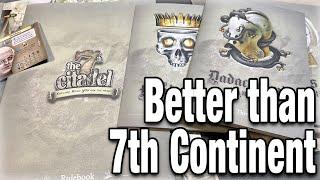
Reviewers generally treat The 7th Citadel as a successor to The 7th Continent from the same creators, one that keeps the overworld exploration and removes much of the friction that frustrated players of the earlier game. The Dungeon Dive, for example, says the survival and crafting loop has been dropped and that this change made the game far more enjoyable. Board Games UnLocked agrees that the story is more prominent here, with the game feeling "a lot more Adventure driven than its predecessor."
The points of agreement end where the structure begins. Most reviewers see the added direction as a welcome refinement, since the world is still open to explore but is less cryptic. Others feel the guidance goes too far and makes the adventure feel like it runs on rails. That split shapes nearly every discussion of the game, and it is the main reason viewers come away with different recommendations.
Core Mechanics That Define The 7th Citadel
Narrative Choice
Story progression in The 7th Citadel runs through a dialogue book and a steady stream of in-fiction text, which reviewers single out as one of the game's strongest additions. Board Games UnLocked notes that the dialogue is descriptive and that the story is told directly to the player instead of being pieced together from abstract art and curses, as it was in The 7th Continent. Choices lead into skill checks, item gains, and conversations with the inhabitants of the Collapsing Lands, so the game reads more like a guided tale than a sandbox. Reviewers consistently point to this text as the reason the adventure feels grounded in its world.
Scenario / Mission / Campaign Game
The game is organized into scenarios that carry into a campaign, and reviewers describe that structure as the main source of its pacing. Board Games UnLocked describes the design as "much more scenario-based," with more direction than the open-ended approach of the earlier title. Mike of One-Stop Co-op Shop returns to the new mission and campaign released with the expansion, while Barren of Meet Me at the Table works through Dashim's Awakening, a mission built around carrying jars back to the citadel. Reviewers view this as a strength for pacing and narrative, though it also ties progress to fixed objectives in a way some players find restrictive.
The 7th Citadel Experience
Adventurous Storytelling
Playing The 7th Citadel feels like stepping into a fantasy adventure in which the people of the world matter as much as the board. A Board Games UnLocked video says the game offers "a lot more interaction with the world," including talking to inhabitants and completing quests. That sense of living characters and unfolding plot gives sessions a narrative momentum that reviewers describe as the game's emotional core, even when the mechanics take a back seat.
Guided Exploration
The second dominant feeling is one of being nudged in the right direction. Board Games UnLocked says the game is "not 100% handholding," but clues such as a town lying to the east give players a way to get their bearings. Compared with the cryptic directions of The 7th Continent, where a clue might point toward eight possible caves, this approach reduces frustration. Some reviewers, however, feel the design overcorrects, and that the player's ability to wander freely is sacrificed for a more predictable journey.
What Makes The 7th Citadel Stand Out
Health as a Currency
The Dungeon Dive praises the removal of survival and crafting in favor of a health system that doubles as a resource. Health can be spent at any time to recharge discarded action cards, and the reviewer notes that fewer heroes in play means more health for each one, with a single hero starting at 45 health. The easy difficulty setting, which allows three discarded cards to be recovered for every point of health spent, is singled out as the setting that made the game enjoyable for this reviewer.
The Dialogue Book and Personal Action Decks
Board Games UnLocked highlights the dialogue book as a major addition, praising the descriptive writing and the way it brings the setting to life. The same preview credits the personal action decks and hit points for giving each character a distinct identity in solo play. Reviewers who value a story-first design find these features especially satisfying, because they reward the player for engaging with characters and events rather than simply managing resources.
Potential Drawbacks
Constant Card Management
The Dungeon Dive finds that the card-based core of play is less exciting than the story around it, and points to the amount of card handling as a source of friction. Board Games UnLocked raises a similar concern about the flow of moving between locations, where drawing and resolving cards can interrupt the sense of exploration. Reviewers who enjoy tight, streamlined systems may find this overhead tiresome over a long campaign.
On-Rails Structure and Limited Replayability
Some reviewers say the added direction tips into a rails experience, where the freedom that defined The 7th Continent is reduced. Board Games UnLocked's preliminary review also raises concerns about replayability, pointing out that the game has only three threats and that this limits how much variety a repeat playthrough offers. Those criticisms do not prevent praise for the overall experience, but they are the main reasons reviewers give for holding back a perfect score.
If You Enjoy The 7th Citadel
Players who enjoy the overworld exploration and the core resolution system of The 7th Continent will recognize the same design sensibility here, with the survival layer removed. Board Games UnLocked says the newer game "smoothed a lot of the rough edges" of its predecessor, so fans of the earlier title are a natural audience. Players who want more open-ended exploration may prefer Sleeping Gods, which one reviewer describes as the closest equivalent to the earlier game's freedom. Those who like the idea of an expanding map where every card connects will find a similar concept in Tainted Grail, which another reviewer notes was influenced by the same design lineage.
What Reviewers Are Saying
"In 7th Citadel there really are no survival mechanisms here. You don't need to craft items and you don't need to hunt, and so eliminating those two things from this game did help me enjoy this game a lot more than seventh continent."
— The Dungeon Dive
"The story wasn't told to you, you had to go out of your way to figure out the story. Here the story is being told to you. It feels a lot more adventure driven than its predecessor."
— Board Games UnLocked
"I leveled up a whole bunch. I still have four glimmers of hope to be close to leveling up. These are cards you earn that can eventually become a card called Hope Reborn, and that lets you kind of fill out the skill tree to level up."
— Mike, One-Stop Co-op Shop