


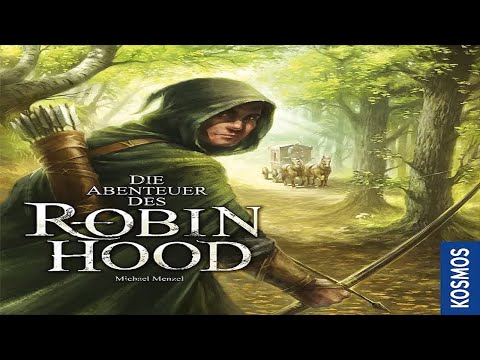


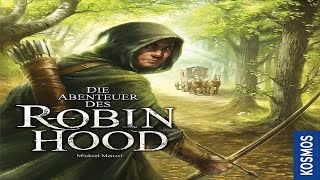
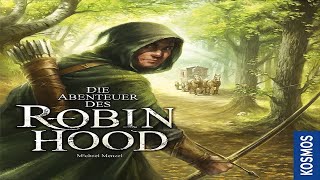
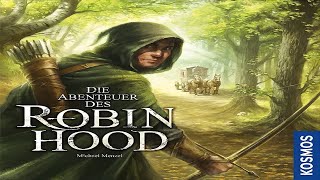
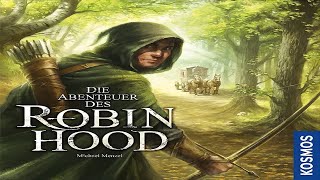


















The Adventures of Robin Hood Deep Dive
What the Community Thinks About The Adventures of Robin Hood
The Adventures of Robin Hood has captured the hearts of board game enthusiasts across multiple communities. Reviewers consistently praise its elegant blend of narrative storytelling and accessible gameplay. The game has become a standout recommendation for families and cooperative players seeking a beautifully illustrated experience that does not demand heavy rules learning. While more strategically minded players note that the mechanics are relatively light, the broad appreciation centers on how the game, designed by Michael Menzel and published by KOSMOS, delivers an emotionally resonant adventure rather than pure mechanical depth.
Core Mechanics That Define The Adventures of Robin Hood
Movement Through Gridless Navigation
At the heart of The Adventures of Robin Hood lies its distinctive movement system. Players physically slide figures across the beautifully illustrated medieval map using wooden movement pieces of varying lengths, navigating around obstacles without a grid. Choosing to move cautiously with shorter pieces preserves strength and lets players add white success cubes to a shared cloth bag for later use. This trade-off between speed and resource accumulation creates a meaningful decision on every turn, while preserving the smooth, tactile quality that makes the game stand out from grid-based adventures.
Bag-Building Conflict Resolution
Combat and challenges resolve through a simple yet satisfying push-your-luck mechanic. Players draw cubes from the shared bag, hoping to pull white success cubes while avoiding the darker failure cubes. The more white cubes added throughout play by moving carefully, the better the odds in a confrontation. This creates a satisfying feedback loop where earlier cautious movement pays dividends during tense moments, ensuring that positioning decisions matter beyond simple exploration and giving every careful step a later reward.
The The Adventures of Robin Hood Experience
Book-Driven Narrative Exploration
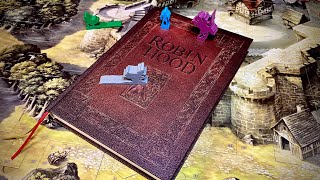
The game's storybook serves as both rulebook and narrative guide, teaching mechanics organically as play unfolds. When players explore marked locations, they turn to corresponding pages to discover what happens next. A dual-ribbon bookmark system tracks progress across scenarios, while color-coded elements connect theme to systems. This integration means players never feel the weight of complex rules; the story simply unfolds, making the game welcoming for families and newcomers who might be intimidated by a traditional rulebook.
Emergent Stories Within a Crafted Narrative
While the scenarios follow a designed path, each group creates its own emergent narrative based on character choices and bag draws. Robin Hood and companions like Little John, Will Scarlet, and Marian each have slightly different abilities that shape their roles. Reviewers note that how characters approach objectives often matters as much as whether they succeed, turning even setbacks into meaningful story beats. Because turn order is determined by drawing character discs from a bag, no two playthroughs feel quite identical despite following the same core scenario.
What Makes The Adventures of Robin Hood Stand Out
A Gorgeously Illustrated, Interactive Board
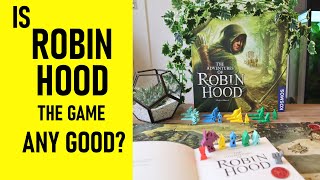
The game's most visually striking feature is its multi-layered board by artist Michael Menzel. Small recessed sections throughout the map flip open as scenarios progress, revealing enemies, allies, and story items in a way reviewers often compare to an advent calendar. This physical interaction turns exploring the board into a tactile, rewarding experience. Reviewers consistently rank the artwork among the best they have seen, with the medieval aesthetic perfectly complementing the Robin Hood theme and serving as both strategic canvas and functional art.
Accessible Teaching Through Integrated Gameplay
Rather than forcing players to digest a rulebook first, The Adventures of Robin Hood teaches itself. The book directs players to begin immediately and introduces rules as they become relevant. This philosophy removes friction for teaching and learning, making the game equally approachable for casual family players and for experienced gamers introducing someone to adventure games. Early scenarios feel manageable precisely because complexity arrives gradually, building confidence before later chapters add new wrinkles.
Potential Drawbacks
Light Depth for Mechanically Minded Players
The Adventures of Robin Hood prioritizes narrative and theme over mechanical innovation. Players seeking intricate economic engines, spatial puzzles, or deep optimization will find the core systems relatively straightforward. The bag-building and movement systems, while thematically resonant, do not demand the calculation that defines heavier games. This is intentional design rather than a flaw, but it is worth noting for players whose primary satisfaction comes from outmaneuvering opponents or solving systems rather than experiencing a story.
Component Wear and Limited Replay Once Solved
The recessed board tiles are flipped repeatedly across a campaign, and over many plays their cardboard edges can show wear. More significantly, because the scenarios are story-driven, much of the experience is consumed once played; the surprises that power early sessions do not land the same way on a replay. The game wisely keeps key information visible rather than hidden behind worn tiles, but groups who prize either pristine components or endless replayability should weigh the one-and-done nature of the narrative.
If You Enjoy The Adventures of Robin Hood
Players drawn to The Adventures of Robin Hood should explore Sleeping Gods, which offers a similar open-world feel with a beautiful illustrated atlas and book-driven narrative, though with deeper resource management across longer sessions. The 7th Continent provides a more demanding exploration experience with branching path choices and resource scarcity for those who want greater weight. The Lord of the Rings: Journeys in Middle-earth combines app-driven storytelling with physical exploration for players seeking narrative adventure with more granular mechanics. And Isle of Skye, while a competitive tile-layer rather than an adventure, shares the gentle, family-friendly accessibility that makes Robin Hood so welcoming.
What Reviewers Are Saying
"You get a storybook and it'll say go here, do this, when this happens this is what it means, read this page. It just teaches you as you go in such a beautiful way that you don't need to be stressed about learning rules."
— Foster the Meeple
"The board is probably the best looking board I've ever seen, to be honest. Absolutely gorgeous Michael Menzel artwork, among the best boards I think, probably in my top five boards I've ever seen."
— Chairman of the Board
"As the story progressed, I was able to do things gameplay-wise but I didn't have to be a character, and that's what I really like. I can be this person, I can move around and make choices, but I don't have to come up with the story."
— Ryan and Bethany Board Game Reviews