/pic2618699.jpg)





















The Bloody Inn Deep Dive
What the Community Thinks About The Bloody Inn
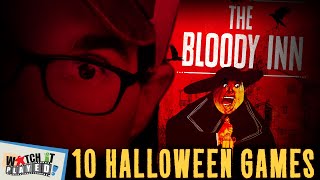
The Bloody Inn commands respect from gaming reviewers for its audacious theme combined with surprisingly elegant mechanics. Reviewers consistently praise the game's ability to marry dark humor with strategic depth, creating a memorable experience that lingers long after players pack it away. The community recognizes it as a rare card game where theme and mechanics align seamlessly, with one reviewer noting that the artwork immediately communicates the morbid nature of the enterprise. Players appreciate that the game doesn't take itself seriously while delivering genuine tactical engagement.
Core Mechanics That Define The Bloody Inn
Hand Management and Multi-Use Cards
At its heart, The Bloody Inn is a hand management game where every card in your hand serves multiple purposes. Players must carefully decide which guests to recruit, murder, bury, or use for other actions. Cards that represent guests can be discarded to bribe new arrivals, killed for money, buried under your extensions to hide them from police, or played for their special abilities. This multi-use system creates constant tension because deploying a card for one action means it cannot be used for another. Reviewers highlight that managing this limited resource creates the game's primary decision space, forcing players to evaluate opportunity cost with each play.
Push Your Luck with Money and Police Detection
The Bloody Inn incorporates subtle push-your-luck elements through the police investigation system. Players collect money from murdered guests and must launder it by moving it off their money track before police arrive to search. You can continue accumulating wealth from your criminal enterprise, but leaving unburied corpses on the table or holding too much cash makes you vulnerable to investigation. When police investigate, unburied bodies cost you money in bribes to the undertaker. This creates a constant low-level tension about knowing when to stop and secure your gains versus pushing forward to accumulate more wealth. Reviewers note that this design choice captures the desperation and time pressure of running an actual criminal operation.
The Bloody Inn Experience
Narrative-Driven Humor and Immersion
The Bloody Inn establishes itself as a darkly comedic experience where reviewers find themselves laughing at the absurdity of their own choices. The game excels at creating moments of cognitive dissonance, where players suddenly realize they are actively committing imaginary murder and disposing of bodies, a phenomenon reviewers describe as intensely thematic. One reviewer captured this perfectly, noting that the game starts as cute and fun until you catch yourself justifying why you need to build an annexe specifically to bury hidden corpses, which tips the experience into genuinely horrific territory. The artwork amplifies this with evocative illustrations that reinforce the macabre setting and create an atmospheric, immersive world.
Crunchy Decision Weight and Tactical Depth
Despite its light presentation, The Bloody Inn delivers substantial mechanical depth that rewards careful planning. Players must balance multiple competing priorities: accumulating guest cards to enable actions, building extensions to manage corpses, laundering money to avoid police discovery, and maintaining just enough resources to continue operations into the next round. Reviewers appreciate that the game never feels like a race or a pure luck-based affair, instead offering moments where clever card play and forward thinking translate into victory. The game's brevity (approximately 30 minutes to one hour) makes the decision density feel appropriately weighty without outstaying its welcome.
What Makes The Bloody Inn Stand Out
Unprecedented Thematic Integration
The Bloody Inn occupies a unique space in the board game landscape as possibly the most thematic expression of criminal enterprise in tabletop gaming. Reviewers struggle to name any comparable game that pushes its theme this far while maintaining mechanical elegance. The game based on historical precedent makes it even stranger to contemplate, as it references the real story of an actual murderous inn where family members killed travelers for their possessions. This historical grounding means the game is engaging with genuine darkness rather than abstracted evil, which several reviewers note creates a distinctive emotional tone compared to fantasy-themed alternatives.
Clever Economy of the Card System
The game's central genius lies in how it constrains player actions through card economy. Reviewers note that the system of paying for actions with cards from hand is deceptively simple but creates elegant trade-offs. Using a level-one guest costs one card, level-two costs two, and level-three costs three. But you can discount actions by having matching guest types, and certain guests unlock special abilities. This creates a clean, intuitive system that feels fair while maintaining meaningful choice. The way the game balances your ability to continue taking actions against the mounting pressure from undisposed corpses and accumulating wealth forces you to make decisions that feel genuine to the scenario.
Potential Drawbacks
Theme May Not Translate into Moment-to-Moment Play for Some
Not all reviewers felt the theme came through equally in the moment-to-moment gameplay. While most praised the thematic integration, at least one reviewer noted that while the trappings and premise are excellent, the actual mechanical actions sometimes feel abstracted from the horrific narrative. Playing cards and managing cards can feel like a puzzle or optimization exercise separate from the dark comedy. For players seeking a game where every mechanical action reinforces immersion moment-by-moment, the distance between theme and mechanics might be noticeable, though this did not prevent that reviewer from appreciating the game's overall design.
Player Count Variability and Solo Experience
The Bloody Inn supports 1-4 players with different rule sets for solo versus multiplayer modes. In multiplayer, players can engage in higher-risk push-your-luck decisions because police investigation punishment is not automatic failure. In solo mode, getting caught with a corpse means immediate loss. This creates different strategic contexts that reviewers found interesting but potentially limiting. The solo mode restricts some of the transgressive fun that comes from taking risks at the table with others. Additionally, some reviewers noted that the two-player game requires removing certain police cards from the deck, which changes the experience in ways that require tracking to ensure consistent play.
If You Enjoy The Bloody Inn
Reviewers who loved The Bloody Inn often gravitated toward games that combine strong thematic premises with elegant card mechanisms. Games like Love Letter, Whirling Witchcraft, and The Thing: Infection at Outpost 31 appeal to the same audience for their combination of deduction, push-your-luck, and thematic resonance. Players seeking more morbid humor might explore Horrified for light-hearted monster confrontation or Gloom for transparent card manipulation and dark comedy. Those drawn to the hand management aspect without the murderous premise might try other dexterously-designed games that reward careful resource allocation and long-term planning. The game works as an entry point for players discovering that great card games need not be dry optimizations exercises; they can instead create memorable scenarios and stories that linger in conversation long after the final police inspection.
What Reviewers Are Saying
"It's the most grim and horrible theme possible, but it's also pretty fun and has a very interesting theme where it seems frivolous but when you think about it, it really happened and someone was actually doing this."
— The Secret Cabal Gaming Podcast
"At first it's all fun and games until you're stuck with a body you can't bury and you have no time to bury them because there's too many people in the rooms and you don't have enough help, so then you have to pay the undertaker to get rid of that body and you lose money for that."
— The Dice Tower
"The way you know a good thematic game is the fact you don't care as much who wins or loses, it's the stories that the game tells."
— Totally Tabled