The Great War, the latest adaptation of Richard Borg's Command & Colours system, brings the epic battles of World War 1 to the gaming table, allowing players to portray important engagements throughout WWI history. The battles, included in the scenario booklet, focus on the historical deployment of forces and important terrain features of trench fighting in scale with the game system. The scale of the game is flexible and varies from battle to battle. For some scenarios, a few infantry units may represent an entire wing of a larger battle, while in other scenarios a unit may represent just a few brave soldiers going over the top.
The Command card system drives movement, creates a "fog of war", and presents players with many interesting opportunities, while the battle dice resolve combat quickly and efficiently. The Combat cards add an element of suspense and will challenge players to coordinate their use in a timely manner. Overall, the battlefield tactics players will need to execute to gain victory conform remarkably well to the strengths and limitations of the various types of WWI units, their weapons, battlefield terrain, and written history.
In this core game, the main focus is on a number of WWI trench warfare battles. However, a series of expansions, which will feature early war, Eastern Front scenarios, tanks, airplanes, other national armies, plus more special personnel figures, are already in the planning stage to enhance your WWI gaming experience.
Mechanics (from transcript analysis)
Video topics + discussion points
Quotes (from this video)
- Factions that win that have their own abilities that have their own winning combinations.
- It's too heavy for me.
- Yeah, it sounds absolutely amazing.
- Yep. And nobody knows it exists.
- I played Circadian First Light and I liked it.
- Scrolling through this thing with you said with the 300 responses and the people arguing about this game and I s there and it's like it's so amusing. The best part about it is you have these people arguing about Marxism and and uh and democratic socialism everything like that and then you have the people that are just trying vainly to get answers about the mechanics of the game. How does this work with the tricks when you do the thing? And it's just people going back and forth about, you know, screaming about uh, you know, like like how they're going to fix the world or whatever, which I I get it, you know, just it's it's who doesn't do that? But that's that's the part it it reminds me of.
- I watched in disbelief as businessmen voted for a repeat bankrupt, laborers for a boss infamous for stiffing his workers. Evangel evangelicals for a serial adulter for an admitted sexual assaulter. Patriots for a draft dodger who would sell his country's secrets for trivial gain. educated men for an ignoramus. But they did so with fierce gladness in their hearts because what their chosen one had done was open Pandora's box. Yes, the old one filled with the ancient calamities of race hatred and rage and cruelty and blood lust and infinite greed. and tell them that these things were the remedy for all of their grievances, that all their anger was justified, and most important, none of what ailed them was their own fault or ever had been.
- That is like the best paragraph I've ever uh Greg Isles in his book Southern Man.
- That is that is one of the that is uh yeah that was that is one of that is poetry.
- I played it and I could not remember anything. And that's it was such a quarter eater because they would like you'd be dead and it would like make you repeat the the move again and be like, 'Okay, is it left or right or up or down?' And you hit the button.
- No, it was free play, but it was like I played it and I'm like, 'Man, I really loved this back in the day and now I don't like it at all.'
- Everything but the ninjas is easy. The ninjas were like the the the And the ninjas just went on and on and on. You had to defeat like a thousand of them. It felt like
- Happy birthday, Bruno.
- It's just a It's just a It's just a virtual reality pinball.
- The elbow back. It was the most powerful move in the game.
References (from this video)
- Multiple paths to victory and active endgame tension
- Rich combat system with decision-rich battle cards
- Temple tracks and shrine mechanics drive dynamic strategic choices
- Upgradeable ships and modular upgrade options via research/construct
- Shared map encourages interaction and planning against opponents
- Prototype copy implies rules/components may change
- High complexity with multiple tracks and actions to manage
- Crowdfunding context may introduce premium expectations and production risk
- Trade, exploration, naval combat, temple worship
- Seafaring archipelago with temples and trade routes in a shared map
- Competitive engine-building with escalating temple and track-based rewards
- Towers of Sifos
Mechanics (from transcript analysis)
- Building and upgrading — Research and construct actions allow upgrading ships and buildings; upgrades can flip to indicate limited use.
- Campaign-style progression — Temples, tracks, and economies progression are interdependent, with shared map dynamics among players.
- Card rotation and reusable upgrades — Some upgrades flip to indicate limited-use or refreshed states, affecting long-term strategy.
- combat with battle cards — Combat uses ship stats and battle cards chosen secretly; cards modify mobility, attack, and provide special bottom-actions.
- Combat: Deck/Hand — Combat uses ship stats and battle cards chosen secretly; cards modify mobility, attack, and provide special bottom-actions.
- Dice and pip management — Dice pips power actions on cards; the develop die sets a cap for other dice and must be advanced to unlock higher actions.
- Dice Placement — Dice pips power actions on cards; the develop die sets a cap for other dice and must be advanced to unlock higher actions.
- Endgame trigger via temple token — Endgame is triggered when a token meets a temple token on track, instantly ending the game.
- Fleet and movement management — Ships of different sizes move via the mobilize action within fleet-size limits; movement influences positioning and combat.
- resource and income management — Players manage coin and wood incomes through fortifications, trade posts, and region control to progress on tracks.
- Resource Management — Players manage coin and wood incomes through fortifications, trade posts, and region control to progress on tracks.
- Temple track control and endgame trigger — Temple shrines and tracks influence endgame; controlling temples advances or locks in endgame conditions.
- Track Advancement — Temple shrines and tracks influence endgame; controlling temples advances or locks in endgame conditions.
- Worker Placement — Each turn players place two workers to activate a variety of actions; a potential third action can be gained via bonuses.
Video topics + discussion points
Quotes (from this video)
- at its heart, The Great Sea is going to be a competitive game for two to four players with multiple paths to victory.
- You're able to increase your trade and gain victory or closer to victory that way.
- you are trying to work with the temples because those are going to be the most beneficial for you as far as trying to hit that endgame trigger
- Combat is going to be one of the ways that players are able to not only get ahead in the game but also take out your opponent's units that they're using to maneuver around and start using those other actions.
- The Great Sea is going to be a game where players feel constantly competitive because you're all working in this shared environment.
References (from this video)
- Lots of things going on.
- Allows for engine building and upgrading.
- Can be a mean game.
- Interesting combat system.
- Can be complicated.
- Can feel mean.
- The Great Sea
Mechanics (from transcript analysis)
- Area Control — Control in the game means having presence (ships or forts) in a region and being the only player or having a trade post there.
- Combat — Players engage in combat, which involves offense, defense, flames, and mobility stats. Winning combat moves the warfare marker up.
- Deck Building — Players can play action cards that affect combat.
- Dice activation — Players upgrade pips on dice to take actions.
- Engine Building — Players upgrade ships, build trade posts, and increase pips on dice to improve their capabilities.
- Set Collection — Players collect trade posts, which contribute to economic and temple markers.
- Worker Placement — Players have two workers and place them on action cards to take actions. There are ways to get extra workers.
Video topics + discussion points
Quotes (from this video)
- The Great Sea. There's there's a lot to get into.
- This is a sponsored playthrough.
- The general idea is we are trying to win the game.
- The general structure of the game is taking actions. You have two workers and every round you're going to be taking two actions.
- Can I do everything in this game?
- You're immediately jumping to your
- This game's a little mean.
- It can be mean. It is.
- I feel mean making plans against you guys.
- We're going to fight.
- This does feel mean.
- Decisions. Decisions. Decisions.
- Holy cow.
- This is what it all comes down to.
- This is what it feels like.
- I knew it was coming.
- It's pretty scary how you still have another person.
- That's the game.
- This is a playthrough of The Great Sea.
References (from this video)
- Dynamic 90-minute game with engaging battles
- Intuitive combat system with the flame/shield interaction
- Progression feel from early to late game with upgrading and fleet buildup
- Encourages active player interaction and timing decisions
- trade, conquest, and maritime expansion across the Mediterranean
- Phoenician city-state in the Mediterranean
- Towers of Sefnos
Mechanics (from transcript analysis)
- combat resolution — Combat involves moving statistics (mobility, attack, shields, flames, strength), selecting and revealing combat cards, and resolving with order and effects.
- Construct — Spend pips to build ships to expand presence.
- develop — Gain pips to increase your develop die or upgrade ships; higher develop die unlocks further options.
- die-based actions — Every action is powered by a die; the die value determines strength and capability.
- Fortify — Place outposts and strongholds to regions; yield resources and possibly temple scoring.
- mobilize — Move ships across the map; spend pips to initiate combat; unused pips grant mobility.
- Research — Spend pips to gain upgrade tiles that attach to ships and forts, affecting various classes.
- Temple scoring & end condition — Temple regions provide points; game ends immediately when temple token meets trade or combat tokens.
- trade — Gain resources and place trading posts; trading posts help control regions and score.
Video topics + discussion points
Quotes (from this video)
- Don't worry, I have shields. Oh no, I have flames to take down your shields.
- The moment your temple token meets either your trade or combat tokens, the game ends immediately and you have won.
- There's only one way to find out, by playing the game.
- You don't want to necessarily be timid in this game. I think this game is intentional with the idea of having those battles.
References (from this video)
- Beautiful production, thematic naval engine
- Weight level can be high for some players
Mechanics (from transcript analysis)
Video topics + discussion points
Quotes (from this video)
- This is a game about acquiring mergers and things that happen as you're physically placing out these pieces onto the board and starting hotels and then you can spend money to buy stock.
- It's so good.
- It's a two-player game, so it's perfect for two players.
- Brass Pittsburgh does cool stuff. If you like brass, I think you're going to like Brass Pittsburgh. If you're not a fan of brass, it didn't change a dang thing.
- The wake and loadup stuff, there's this kind of thing with like fuel range where you can really only be in the air so long.
- This is Baby's first dog fight.
References (from this video)
- Engaging gameplay with various components and actions.
- Strategic depth for players aiming for the best value/points.
- The game ending can be disliked by some players due to the race to the finish.
- trade
- the medieval Mediterranean
Mechanics (from transcript analysis)
- Area Control — Players are trying to get themselves into the number one spot, which implies control over areas or resources.
- Pick-Up and Deliver — The game involves moving ships and moving tokens to accomplish goals.
- Trading — You get to trade in this game.
Video topics + discussion points
Quotes (from this video)
- This game is about trade, and you do get to trade in this game. This game is about the medieval Mediterranean and you get to trade.
- I want to try and win because I want to place myself in the number one spot.
- You need to get to the end of the game as the first player and a lot of players don't like that.
- And now you have a chance to mix a bit of stock market with Greek Gods.
- Back it to get the neoprene board and these really beautiful components.
References (from this video)
- The Grim War is pretty bare-bones.
- It's you remove all the experienced cards from your deck.
- It is pretty bare-bones right now.
Mechanics (from transcript analysis)
Video topics + discussion points
Quotes (from this video)
- I think this police dog is a is a goated card.
- I think this is a very powerful card.
- Um in two to three years for a cycle to stay current and supported, I think that also means two to three years in print.
- I don't think this game is big enough to be scalpable.
- All I can say is that I personally intensely dislike the trend of scalping scalping games or anything for that matter.
- And Snakebird Priestess, that is a very funny message.
- Which is certainly there are many non-obvious signs that someone is chat GPT.
References (from this video)
- Rich integration of euro-style engine with direct conflict and naval warfare
- Thematic cohesion around Phoenician trade and temple-centric scoring
- Engaging combat system with strategic depth and visible tempo shifts
- Complex setup and sizeable rule overhead for new players
- Games can run long, especially with larger player counts
- Downtime can increase as players plan multi-step upgrades and combat outcomes
- trade, naval warfare, temple-driven scoring and policy
- Phoenician city-states contending for control of the Mediterranean Sea
- Array
Mechanics (from transcript analysis)
Video topics + discussion points
Quotes (from this video)
- mistaking this game for a euro
- The Great Sea is a winner takes all battle
- The temple points can go up and down based on the state of the board
- The first player to have their temple marker meet or cross their combat or trade marker will win the game
- mistake it for a euro? it absolutely has euro bones but with war.
References (from this video)
- Beautiful art
- Simple and easy to understand rules
- Fantastic adventure
- High quality production value
- Inspiring from deep sea diving and pulp archaeology
- Exploration and mystery
- The Lost Horizon universe
Mechanics (from transcript analysis)
- RPG mechanics — The transcript mentions 'core mechanics of the game' running about 54 pages, and 'combat in'.
- scenario-based play — The transcript mentions 'really great scenarios in here to kind of get you started'.
Video topics + discussion points
Quotes (from this video)
- There are a couple companies that I consider the greatest companies on the planet.
- Free League Publishing is working their way up and they just keep on knocking it out of the park.
- The rules are really very very simple.
- Like I said, I've said this a million times and I'm going to say it a million times more.
- Until next time, it's your old pal Rob.
References (from this video)
- Good Euro deliciousness
- Satisfying strategic depth in action economy and upgrades
- Tense combat resolution
- Vying for dominance over regions
- Mediterranean
Mechanics (from transcript analysis)
- Action Point Allowance — Players have actions to use, and can gain extra workers.
- Area Control — Players vie for dominance over regions and control of regions is important for gaining points and other benefits.
- Combat — A detailed combat system is described involving ship stats, combat cards, attack, defense, and strength resolution.
- Dice Placement / Action Die — Players 'pip up an action die' which influences the strength of actions and can be used for various purposes.
- Engine Building — Players upgrade actions and ships to become more efficient.
- Resource Management — Players manage resources like wood and coin to build and upgrade.
- Set Collection — Collecting temple points and upgrading actions based on temple regions.
- Tech Tree — Upgrading ships and forts involves placing components that grant stats, suggesting a form of technological advancement.
- Worker Placement — Players use workers on different action types.
Video topics + discussion points
Quotes (from this video)
- We are here to play The Great Sea.
- In The Great Sea, players are vying for dominance over the regions of the Mediterranean looking to cross their temple marker with either their trade or combat marker.
- As soon as a player has their temple and either trade or combat marker meet, they immediately win.
- It's Life of Pi adjacent.
- I'll take a small fort upgrade, especially because it's so expensive right now, right?
- It's a great sea. But, it's small.
- You got your horse, man. We thought it was innocent. You're like, I'm just over here doing something, man.
- Mike left a temple unguarded.
- I didn't even see that coming, man.
References (from this video)
- Long-term planning rewards
- Tactical positioning and timing
- Dice management and varied combat
- Economy-focused depth with gradual upgrades
- Rich thematic flavor and setting
- High complexity; steep learning curve
- Potential downtime during multi-player turns
- Requires more than one session to fully explore
- Trade supremacy, naval warfare, temple influence
- Ancient Mediterranean maritime city-states from Levant to Carthage
- Instructional, strategic explanation during a gameplay session
- Paladins of the West Kingdom
- Raiders of the North Sea
Mechanics (from transcript analysis)
- Area Control — Control regions by placing ships, forts, and trade posts; contested by opponents
- area_control — Control regions by placing ships, forts, and trade posts; contested by opponents
- combat_resolution — Combat is resolved via dice cards; attacker advantage in ties; shields and flames influence damage
- Engine Building — Dial up dice pips to strengthen actions and unlock upgrades
- engine_building — Dial up dice pips to strengthen actions and unlock upgrades
- map_movement — Move fleets and dice-driven actions across a modular map
- mobilize_action — Last action to move, initiate combat, or increase fleet mobility
- Resource Management — Gather coins and wood; upgrade ships and forts; manage market costs
- resource_management — Gather coins and wood; upgrade ships and forts; manage market costs
- temple_control — Control temple regions and temple posts for points and bonuses
- upgrades_and_market — Flip used trade posts to gain bonuses and purchase upgrades
Video topics + discussion points
Quotes (from this video)
- The great sea plays two to four players with mechanics such as engine building, area control, and map movement.
- Love it. Historically accurate.
- Perhaps the great sea reminds you a bit of paladins of the west kingdom, raiders of the North Sea, but they went sailing and brought flamethrowers.
- This ends Sunday morning scenic trip. This is war.
References (from this video)
- garfield games reputation for strong production
- promises blend of trade and military considerations
- crowdfunding cycle can affect shipping timing
- Ship-building and global trade in a Garfield Games universe
- Maritime exploration / ancient oceans
- Ancient maritime exploration with economic focus
- Maritime-themed Garfield titles
Mechanics (from transcript analysis)
- area/route management — ship routes and territories; trade vs conquest dynamics
- Network/Route Building — ship routes and territories; trade vs conquest dynamics
Video topics + discussion points
Quotes (from this video)
- Our mission on the channel is to be beacons of light. Positive vibes, proof of good vibes.
- This year was weird and a little disappointing, but we love what we do and we wouldn't change a thing.
- We're going for 75K subscribers and we're going to give it our darnest.
- The year of hobbies — woodworking, disc golf, jam and canning — kept us sane.
- Let's go to France. This is one of those series games where I want to play them all.
References (from this video)
- Engaging euro-style engine-building
- Strong integration of combat with engine progression
- Satisfying upgrade pathways that reward planning
- Potential learning curve for new players
- Higher complexity may deter casual players
Mechanics (from transcript analysis)
- Area Control — Tactical positioning and control of spaces or zones that influence combat and influence scoring and resource flow.
- area_control — Tactical positioning and control of spaces or zones that influence combat and influence scoring and resource flow.
- combat_resolution — Onboard battles that emerge from engine-built capabilities and tactical decisions, integrating with the overall strategic system.
- Engine Building — Euro-style engine-building core where players upgrade actions and components to strengthen capabilities, particularly in the naval/war context; players manage resources and expand their strategic options over time.
- engine_building — Euro-style engine-building core where players upgrade actions and components to strengthen capabilities, particularly in the naval/war context; players manage resources and expand their strategic options over time.
Video topics + discussion points
Quotes (from this video)
- The right way is try to spend time for the people that you really want to spend time with, your loved ones, your good friends, your family.
- Parting is sweet sorrow ... there’s no sorrow there’s no sweet either.
- I recently thought of how crucial it is for you to spend time with your loved ones.
- Shark, this is not like any party game. So, this has got some party vibes mixed with rolling and moving and picking up cards.
- This is the carousel, which we borrowed from Sushi Roll.
References (from this video)
- elegant pathfinding system that eliminates LOS complexity
- comprehensive rulebook with explicit coverage for base game and expansions
- strong production values and a robust setup that scales from base to expansion content
- deep tactical options for both solo and two-player formats
- out of print status increases scarcity and may drive up price
- some rules interpretations used by the presenter indicate occasional ambiguities in solo play (house-rule style discussion)
- health-dial mechanism can be fiddly and prone to misread during intense play
- espionage, tactical skirmish, mission-oriented combat between rival factions
- 1949-era alternate history with WWII-inspired factions engaged in covert operations in a fortified castle-like map
- instructional live-play demonstration with emphasis on setup, movement, and objective-based winning
Mechanics (from transcript analysis)
- Action Points — three action points per turn allowing flexible sequencing of movement and actions
- equipment tokens and packs — character-specific packs provide weapons, gear, and special abilities
- grenades and smoke — grenades have range-based mechanics; smoke can obscure lines of attack and restrict movement
- health indicators — health tokens or dials track damage and deterioration during combat
- objective tokens — primary and secondary objective tokens placed on the map guide scoring and completion
- Overwatch — defensive stance enabling reactive attacks to enemy movements
- pathfinding system — colored-path movement that removes traditional line-of-sight range checks, enabling fluid tactical play
- reinforcements — start-of-turn respawns add new troopers, altering tactical possibilities
- resource and points economy — command points are spent to move, boost stats, or set up OverWatch, adding a resource-management layer
- Resource Management — command points are spent to move, boost stats, or set up OverWatch, adding a resource-management layer
- two-player and solo modes with multiple scenarios — six modes (Death Match, Capture the Flag, Domination, King of the Hill, Objective, Story) that shape setup and victory conditions
Video topics + discussion points
Quotes (from this video)
- it's a Miniatures game for ball Gamers which yeah it's what you've been waiting
- the rule book's fabulous and it's got rules for not just the stuff included in the base game but also stuff that comes as expansions
- this pathfinding system is just is just beautiful it's it's made for us all right
- six modes of play for the two player
- the map expansion comes with these 12 Troopers
- we're going to teach you how to play the game solitire all you need is the base game
- the final bit of setup is command points and then we're ready to play
- this pathfinding system is just beautiful
References (from this video)
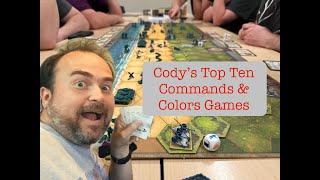
- classic Commands & Colors feel applied to WWI
- artillery events add dramatic prelude to engagements
- plastic components are prone to assembly issues and fragility
- physical quality disappoints relative to other editions
- industrial-era mechanized warfare
- World War I battlefields
- historical tactical simulation with modular scenarios
- Medieval
- Ancients
- Napoleonics
Mechanics (from transcript analysis)
- block-based unit representation — Uses the Commands & Colors block system for moves and combats, with offboard artillery elements influencing early turns.
- offboard artillery at scenario start — Artillery fire is resolved from offboard sources at the opening, creating random carnage before main play begins.
Video topics + discussion points
Quotes (from this video)
- There' s just be some random carnage before the game played out.
- dragon cards... there were like a whole another deck of cards that can throw monkey wrenches into what you know your opponent's trying to do.
- it's such a great system and we ended up playing seven or eight games that night.
- I absolutely love the Napoleonic era, Napoleonic warfare.
- my number one Commands and Colors game of all time. That is Memoir 44 with the Overlord expansion.