
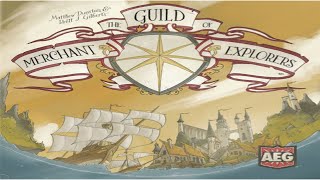





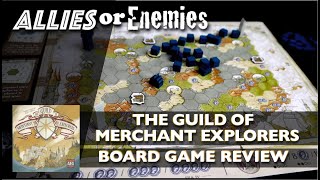














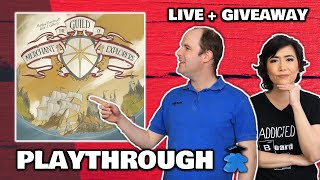












In The Guild of Merchant Explorers, each player starts with one city on their personal map board.
Shuffle the deck of terrain cards, then reveal most of these cards one by one. Based on the terrain revealed, each player places on their board cubes that are connected to their starting city or other cubes. You want to complete areas on your board, cross the seas to new land, and establish new cities on the board. You can explore capsized ships for treasure — which gives you special placement capabilities — and create linked connections between locations to score bonus points. Common objectives can be completed by all players, with those who complete it first scoring more points.
At the end of a round, all cubes are removed from each board, leaving only the cities behind, so if you don't establish new cities, you'll be stuck in the same places.
The Guild of Merchant Explorers contains multiple copies of four different maps, and the game is designed so that you can play remotely with one or more copies.
- surprisingly deep for a largely tile-placement game
- four maps provide substantial variety
- great to teach and appealing to a wide audience
- less mainstream visibility; more niche appeal
- exploration and trade via tile/area expansion
- world map with maps and villages across multiple terrains
- elegant, strategic tile placement with accessible goals
Mechanics (from transcript analysis)
- Cube tower — achieve various objectives like branching around, building towers, etc.
- set of goals / towers — achieve various objectives like branching around, building towers, etc.
- Special ability cards — cards grant flexible abilities that open up new play possibilities each round
- tile placement — place cubes/tiles to build routes, villages, and towers across several maps
- tile placement on world maps — place cubes/tiles to build routes, villages, and towers across several maps
Video topics + discussion points
Quotes (from this video)
- the best part about big shot is that the way you actually gain a territory, the way you have control over it and will therefore score for it is when there are seven cubes present in a territory.
- it's a small game. It doesn't take very long to play.
- This is so deeply tactical. every single decision you're making with especially with having two win conditions in the game is so important but also so fun to engage with.
- the theme and artwork is not at all what I gravitate towards.
- it's a pleasant pleasant surprise from this last year.
- the special ability cards crack the game wide open
- it's surprisingly Cascadia, if I get that's the way to word it.
- rolling hills or rolling rivers, they're addictive and fun
References (from this video)
- Strong faithfulness to the original game feel
- Exciting route options and map interactions
- Requires familiarity with the original to fully appreciate
- Rolling Realms
Mechanics (from transcript analysis)
- map exploration / routes
- Network/route building
Video topics + discussion points
Quotes (from this video)
- it's exactly the same as the original Rolling Realms but there is a bunch of stuff that's different
- I feel like one of the big reasons this game even exists is because it's kind of the big box for Rolling realm
- I will say that it is not waterproof we learned that the hard way
- this is our first one back in London so let's see if this sticks or not
- what we're going to do from now on is I think just mix it in with the rest of the Rolling Realms
- Meadow has this terrific drafting mechanism where you're putting your little number arrows
- Planet Unknown is probably my favorite of all the games represented
- this would have been in the fourth category but we played it just recently again and it grew on me
- I like this one a lot
References (from this video)
- great variety due to different maps and powers
- strong asymmetry that stays balanced
- can be confusing early on due to many moving parts
- city-building with merchants
- medieval/merchant-building maps
- flipping/building with a strong special-cards twist
Mechanics (from transcript analysis)
- flipping cards to place cubes — use a shared pool of cards and maps to build a kingdom.
- one-time super power card per round — each round you use one of six cards that changes gameplay.
Video topics + discussion points
Quotes (from this video)
- it's such a good Gateway game
- the art on the cards looks fantastic
- it's one of those simple flip and write games that you just want to play again and again
- the lazy Susan is genius
- Planet Unknown just knocks our socks off
References (from this video)
- straightforward weight and clean design
- visually appealing
- frustration-to-joy tension
- abstract theme may appeal less to some players
- light weight may not satisfy heavier gamers
- trade networks and exploration with landmark scoring
- abstract exploration and map-building across multiple maps
Mechanics (from transcript analysis)
- flip-and-build — players flip cards to reveal locations and build structures on the map
- map exploration and landmarks — players aim to reach landmarks and trigger scoring via various maps and categories
Video topics + discussion points
Quotes (from this video)
- Daybreak is the most thematic because it connects what you're doing with the goals and the actual mechanics.
- it's a cooperative game and the tension is nail-biting.
- the game scales well for fewer players or more players.
- Guild of Merchant Explorers is nice, straightforward, light, and clean.
- Ticket to Ride Legacy offers a legacy experience that keeps you coming back, with evolving content.
References (from this video)
- Ambitious idea with landscape patterning and route-building
- Extremely fiddly components (tiny hexes, mismatched tokens) hamper play
- Perceived unplayability due to setup fragility and table noise
- building routes and landscapes to maximize value
- Trade and exploration in a guild-structured setting
- Cartographers
Mechanics (from transcript analysis)
- flip_and_fill — Cards pattern reveal landscapes; players fill patterns on their boards accordingly.
- Pattern Building — Fill in a board with landscape patterns that score based on completed shapes and patterns.
- pattern_building — Fill in a board with landscape patterns that score based on completed shapes and patterns.
- placement_and_resource_management — Players place landscapes and manage cubes and tokens to optimize routes.
- Resource management — Players place landscapes and manage cubes and tokens to optimize routes.
Video topics + discussion points
Quotes (from this video)
- it's all about as flat as the leaves in the game box
- two turns into even the first phase I was already over it
- this game is unbelievably light
- the board is only about this big; the hexes are tiny and fiddly
- there you have it those are five more disappointing games
References (from this video)
- therapeutic, satisfying to grow a network
- easy to learn, deep in planning
- thematic clarity can be variable
- endgame decisions can slow down if not careful
- exploration and city-building
- map-building with trade routes
- multi-location exploration with markers
- Resist
Mechanics (from transcript analysis)
- tile/card flip to reveal routes — new locations are revealed and placed to expand routes.
- token/marker placement — place cubes to claim terrains and upgrade routes.
Video topics + discussion points
Quotes (from this video)
- this is a wonderful little puzzle game
- it's easy to get to the table
- I absolutely love this game
- Legacy of You has captured my heart
References (from this video)
- beautiful look and accessible flip-and-place design
- interesting route-building
- aesthetic may be divisive for some
- exploration and commerce across fantasy lands
- flipping and placing cards to extend a trade network
- flippant, card-driven
Mechanics (from transcript analysis)
- cube placement — placing cubes on terrain to connect paths and reach cities
- flip and write / flip and place — cards reveal possible cube placements and routes
- Flip/Roll and Write — cards reveal possible cube placements and routes
Video topics + discussion points
Quotes (from this video)
- I just love Parks so much
- I really enjoyed this one
- this is my favorite game of all time
- the coziest most relaxing just chill game that I really enjoyed
- I would love to stream it on YouTube and like do a little series
References (from this video)
- Simple mechanism with depth; approachable
- Great integration into Redux lineup
- Occasional confusion about adjacency/terrain rules
- exploration and resource gathering
- castle route to hex tiles crossing terrain
- light thematic adventure
Mechanics (from transcript analysis)
- terrain pick and hex-crossing — roll numbers to cross off terrain; use values to gain resources/stars; adjacency matters
Video topics + discussion points
Quotes (from this video)
- This game is so fun.
- This is like one of the games that I often like lose myself in, if that makes sense.
- Rolling Realms Redux is a really good addition.
- I got a score of 41.9.
- Meadow is really fun because you are writing a number one through four on any of these little fences here.
References (from this video)
- bombastic, fast play with strong thematic flavor
- asymmetric cards add spice and variety
- noted as a quick filler; may lack depth for some players
- merchant exploration and collection
- map exploration with cube placement
- light-hearted, fast-paced roll-and-write feel
- Roll-and-write
- Age of Empires-inspired logistics
Mechanics (from transcript analysis)
- area/resource collection — explore map tiles and collect resources through placement
- asymmetric player powers — cards grant disparate abilities that shape play
- card-based asymmetric powers — cards grant disparate abilities that shape play
- Flip/Roll and Write — quick, map-driven actions using dice-led resource generation
- roll-and-write — quick, map-driven actions using dice-led resource generation
Video topics + discussion points
Quotes (from this video)
- I really like that aspect of keeping track of resources with dice
- I thought it was really clever how it was handled in this game
- this game is highly interactive it's hard to appreciate it based off of what you see here
- I would love to see this game get that support and can be more widely available soon
- I really enjoyed it I like the concept of it and I would want to return to it to see if it still holds up mechanically
- this game has a lot of hand management and deck management as well you go through pretty much your entire deck
References (from this video)
- DNA shared with Trails of Tukana; scalable paths to points
- Fiddly maps can become cluttered; setup feels precise
Mechanics (from transcript analysis)
Video topics + discussion points
Quotes (from this video)
- "I find these styles of games quite frustrating because whatever you do somebody else on their terms ends up undoing"
- "I can't seem to understand why these games are so popular"
- "Massively impressed with this one"
- "an absolute joy to play"
- "I adore this game"
References (from this video)
- Fluid and accessible flow of play
- Deck naturally shifts from game to game, offering variety
- Some players may wish for deeper engine-building
- Deck randomness can influence pacing
- Exploration and accumulation of victory points
- Explorers charting new kingdoms for treasures
- Simple, elegant deck-driven exploration with evolving play
- Civolution (for its engine/epic feel and evolving play)
Mechanics (from transcript analysis)
- Deck-driven exploration — Draw and use cards to determine where explorers go and what they do
- Set collection / treasure chasing — Treasure points and exploration outcomes drive scoring
Video topics + discussion points
Quotes (from this video)
- The visually most pleasing board game, Euro game of all time.
- I can't stop thinking about this game and want to play it again and again.
- The box is actually part of the game.
- It's the best character building in board games, period.
- The historic flavor, the politics, the negotiation, the backstabbing makes this an amazing game experience.
References (from this video)
- Strong sense of agency
- Elegant, streamlined asymmetry
- Theme can be abstract for some players
- Exploration and personal power growth
- Exploration and map-building with asymmetric powers
- simplified, accessible
- Cartographers
- Dwellings of Elderval
Mechanics (from transcript analysis)
- asymmetric player powers — Each player starts with unique powers and progressions
- Asymmetric powers — Each player starts with unique powers and progressions
- Resource management — Cubes and tokens used to expand influence on the map
Video topics + discussion points
Quotes (from this video)
- Spirit Island still an absolute Banger
- I love the sense of agency that you have in the game
- Arc Nova absolutely took my heart away
- Kabuto Sumo with 31 plays in a year
- the game that I knew was going to be up here
References (from this video)
- excellent solitaire mode
- works well with any player count
- potentially less interaction in some play modes
- trade routes, exploration, and map advancement
- Maritime exploration and guild-based exploration narrative
- solitaire-friendly exploration with map-building
- Quartermaster General
- Firefly: Deck-Building Game
Mechanics (from transcript analysis)
- set collection / route optimization — collecting routes and resources to score efficiently
- solitaire-ready play — designed to be playable solo and with any player count
Video topics + discussion points
Quotes (from this video)
- this is raw literally
- the whole concept of this show was like hey why don't we just turn on mics
- one reason why that game excels so well is because of the Solitaire nature and it works with any player count
- Quartermaster General is really good with five
- we were asked the Gen Con... Connor from Inside Up Games looked at me and goes what topic would get you excited
References (from this video)
- Fun to play four times; good group dynamic
- Might not be loved by all players
- Trade routes, discovery, engine-building
- Merchant exploration / adventure
- Strategic / exploratory
Mechanics (from transcript analysis)
- Exploration / route building — Players explore and establish routes with potential for branching paths
- Network/route building — Players explore and establish routes with potential for branching paths
Video topics + discussion points
Quotes (from this video)
- it's a euro style game that plays up to six
- it's fully simultaneous
- Concordia Venus ... brings in team play and that lets you play two on two which is a four player game and it also lets you play two versus two which is a six player game
- not a euro game really it's more of a deduction style game where it's one versus many
- I started to work on that video and I'm hoping to make it happen
- Miniatures don't do anything for me
References (from this video)
- easy to teach
- fast-playing
- engaging route-building
- less depth than heavier euros
- port-to-port exploration and route-building
- exploration trade routes
- light
Mechanics (from transcript analysis)
- Compound Scoring — shared scoring track drives decisions
- public_scoring — shared scoring track drives decisions
- set collection — collect cards to complete routes
- set_collection — collect cards to complete routes
- tile_drafting/route_building — draw cards and lay routes between ports
Video topics + discussion points
Quotes (from this video)
- Arc Nova let's go
- we're the older content creators
- it's alive
- roll Dice and taking names
References (from this video)
- solo mode closely mirrors the main game feel
- strong engine-building through investigate cards
- high replayability via maps and eras
- colors muted making terrain hard to distinguish
- solo mode can feel less interactive for some players
- monetary goals through exploration efficiency
- map exploration and village-building across eras
- multiplayer solitaire feel with minimal direct interaction
- Elysium
Mechanics (from transcript analysis)
- exploration cubes on a shared map — place explorer cubes to explore terrain and unlock villages.
- investigate deck (engine-building) — when an error card is pulled, draw two investigate cards enabling unique actions.
- treasure and goal cards — draw treasure cards for immediate or end-game scoring and goals.
- village-building and era progression — build villages to extend reach; end-of-era resets, affecting strategy.
Video topics + discussion points
Quotes (from this video)
- I thought that it was actually a really mechanically sound game
- it's one that I think I'd like to kind of come back to every now and then
- I really really like this game
- the test cards are mandatory like if you don't complete the entire test card by the end of the game then you just Auto lose
- it's a tough game to play
- I love this game I find it to be quite addicting
References (from this video)
- innovative engine-building with customization
- solo and multiple-player modes
- quick play for a heavy Euro feel
- rule complexity can be a learning hurdle
- board setup can feel involved
- exploration, trade, and discovery
- world exploration with map-building and treasure hunting
- engine-building with map-driven scoring
- Tapestry
- Carcassonne
Mechanics (from transcript analysis)
- customizable engine via investigation cards — each player keeps two potential investigation cards to shape their engine
- terrain card & map-building — draw terrain cards to place on a shared map and build trade routes
Video topics + discussion points
Quotes (from this video)
- it's basically discussing our top 10 games that were new to us in 2022
- this is like a podcast today
- Weather Machine ... would have made this list if it came out this year
- it's a pure Euro for sure through and through
- hirelings ... game changer for the two-player Root
References (from this video)
- vibrant table presence and cartography aesthetic
- strong flipping mechanic
- production issues and usability hurdles due to map congestion
- map can become overly congested with components
- merchant exploration and territory claiming
- exploration / cartography themed map
- macro-level exploration with map-based scoring
Mechanics (from transcript analysis)
- area control / hex-map strategy — control territories to earn points and unlock routes
- cube placement — place cubes on a hex-grid to claim regions
- flip-and-write / card reveal — reveal territories and plan routes via marking on a map
- Flip/Roll and Write — reveal territories and plan routes via marking on a map
Video topics + discussion points
Quotes (from this video)
- there's no super Superfluous rules there's no fiddliness so it's quite nice and pure
- this one stays true to what hidden role or hidden movement game should be
- I think this one is still my favorite one as one person takes the role of Jack the Ripper
- I absolutely hated this game I did not like anything about it apart from the visuals very stylish and I'm deluxified looking game
- the colorblind-friendly at all and me and my brother are both quite badly colorblind
- not colorblind friendly at all and me and my brother are both quite badly colorblind
- the ketchup mechanism in this game
- one of the nearest misses I've ever played
- therefore it's just not subtle
References (from this video)
- quick setup
- teaches easily
- plays well at two players
- depth without heaviness
- exploration, trade, lightweight strategy
- medieval/commercial exploration
- elegant, approachable
- Mind MGMT
Mechanics (from transcript analysis)
- Route optimization and set collection — Players connect routes and collect bonuses to maximize points.
- Tile-laying / map exploration — Players lay explorer tiles to uncover routes and bonuses.
Video topics + discussion points
Quotes (from this video)
- we should probably own this
- it's a steal
- it's mind MGMT
- it's a cultural Milestone you have to watch the whole thing like a marathon
- this is Lord of the Rings in a box
- it's a good two-player game
- just buy the base game
- it's our Channel we can do whatever we want
- Ticket to Ride is a great game but you don't think about Ticket to Ride afterwards
- it's definitely an event worth experiencing
- it's that good
- we love you buddy keep buying new games
References (from this video)
- great exploration feel, maps reset to keep replayability high, variability within maps and objectives
- can be fiddly for some players who prefer simpler card draws
- exploration, trade, and village-building across eras.
- A map-driven exploring and village-building world with eras and exploration goals.
- tableau-like exploration with resets that keep the world dynamic
- Rhino Kenya
- Brass
- My City
Mechanics (from transcript analysis)
- deck-driven action selection — Card-driven actions determine which eras and expansions you can explore; the order is known but not fully visible.
- map exploration with resets — The map resets between rounds; progression remains via explored sections and village-building.
Video topics + discussion points
Quotes (from this video)
- this is one of the greatest deck building board games I've ever played
- it's pure joy, pure fun
- the energy in the room when Ready Set Bet is going
- thematic immersion in Thunder Road Vendetta is spot on
- Age of Innovation feels like the definitive evolution of this family of games