











The Hunt Deep Dive
What the Community Thinks About The Hunt
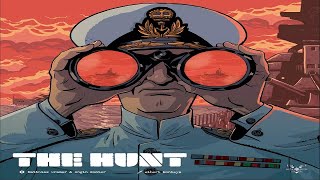
The Hunt is a two-player asymmetric wargame from 2023 about the hunt for the German raider Admiral Graf Spee in 1939, when Kriegsmarine commerce raiding in the South Atlantic pulled the Royal Navy into the Battle of the River Plate. One player commands the German hidden submarine and the other commands the British search force. Reviewers who covered the game generally find the cat-and-mouse premise and the card play engaging, but their praise is consistently tempered by frustration with the dice and with how difficult the British side finds it to locate the German force. The overall verdict is mixed rather than negative. The War Games Unlocked host rated it slightly above average, calling it playable but not a game they wanted to keep on the shelf, while the Rolling Dice & Taking Names hosts described it as a title they enjoyed and planned to keep working through as the British player.
Core Mechanics That Define The Hunt
Hidden Movement and the Search Cycle
The defining system is the German player's secret movement against the British player's attempts to locate it. The German side tracks its submarine off the board, usually on paper, and moves it by spending action points: one point moves one space, two points move two, and four points move three. The British player searches by rolling a single die, and reviewers note that a five or six counts as success. A search can be improved by playing a card or by spending the airplane, which adds two to the roll. Searching is costly because the searching player must reveal their position, and reviewers at War Games Unlocked stressed that the German player's successful attacks on freighters also expose the submarine's location. Hint tokens offer a middle path. A British hint token is placed on the German hex or an adjacent hex, which narrows the search, but hints are removed as soon as the German player moves again, so the British player effectively has one turn to act on what they know.
Card-Driven Action Points
Each side plays from its own deck, and every card can be used for its printed event or for its action points. Rolling Dice & Taking Names compared this decision to the card systems of Twilight Struggle and Watergate, where a player must choose between spending a card for movement and triggering the event printed on it. Hand sizes differ: the British side keeps up to five cards while the German side usually drops to three. Several event cards remove themselves from the game after use, and the highest action point cards are frequently among them, so timing matters. Reviewers describe a final battle that is resolved by playing cards face down, with the highest strength winning, and they point out that the deck composition means the British player often holds the stronger cards in that fight.
The Hunt Experience
Tense Cat-and-Mouse Pressure
Reviewers consistently describe the game as tense, even for the side that appears to be losing. The Rolling Dice & Taking Names reviewer, who had played the German side, described sitting on top of the British player's ships while the outcome depended on one roll, and noted that the final confrontation could go either way regardless of how much the British side had already gathered. This closeness is what reviewers are most willing to praise. The German player's bluffing and the British player's constant recalculation of where the submarine might be create a feeling of a hunt in which neither side can be sure of the outcome until the last roll.
Frustration With Randomness and Uneven Searching
The same tension can turn into frustration when the dice do not cooperate. The War Games Unlocked host argued that the game would be much better if it were not almost entirely decided by the die roll, describing the roll-to-resolve mechanic as feeling like an afterthought. The host also felt that the British search was harder than it needed to be, since the British player must often wait for a German ship to be sunk before there is any realistic chance of finding the submarine. Reviewers agreed that the search penalties and the requirement to reveal the searcher's own position made the British role feel punishing, particularly when a missed search costs a valuable card or action.
What Makes The Hunt Stand Out
Card Play as a Tug of War
The most consistently praised feature is the card play. Reviewers appreciated decisions such as whether to spend a high-value card for its event or hold it for its action points, and they enjoyed the way the removal of cards from the game shapes the endgame. The Rolling Dice & Taking Names reviewer said they enjoy two-player asymmetric games and love the card play in this one, and expressed a determination to learn the British side well enough to win with it. The War Games Unlocked host described the card decisions as a satisfying tug of war in which a player must decide when to spend action points and when to trigger an event, and credited much of that structure to the card-driven design of Watergate.
Bluffing Built Into Asymmetric Hand Sizes
The asymmetric hand sizes and hidden German movement give the German player real room to bluff. A German player can announce a short move while actually moving farther, or can draw fewer cards than the rules allow to hide how many resources remain. The War Games Unlocked host singled this out as one of the game's best ideas, saying that a larger hand for the German side would be too much on top of the ability to lie about movement. For reviewers who enjoy hidden movement, this bluffing layer is the part of the design that most rewards careful play.
Potential Drawbacks
Dice Balance and Weighting
Dice are the most common complaint. The War Games Unlocked host reported rolling ones and twos for much of a session, far below the expected success rate, and concluded that the die was weighted incorrectly. The host also argued that a search requiring a five or higher on a single die is unbalanced and suggested a four-through-six result or a true fifty-fifty chance instead. Reviewers also criticized the combat, which is decided by a single lopsided battle, and the repair action, which can fail on a die roll with no way to spend more action points to improve the odds. Both reviewers agreed that dice of this quality undermine the otherwise strong card decisions.
A Difficult Search Job for the British Player
The British side has a harder time than its larger hand size suggests. Reviewers noted that only one search can be attempted per turn in most situations, that hint tokens disappear once the German player moves, and that searching requires the British player to reveal the target area. The War Games Unlocked host said that the British side often has to wait for the German player to make a mistake, and compared the search unfavorably with the adjacency searches in Leagues from Whitechapel, where a search of a neighboring area is more useful than the Hunt's version. The Rolling Dice & Taking Names reviewer, who had mostly played the German side, also admitted that the British side needed more practice to win.
If You Enjoy The Hunt
Reviewers consistently name Watergate as the closest comparison and the design most players should consider before buying. The War Games Unlocked host recommended Watergate to players who want a head-to-head tug of war with no die roll deciding outcomes, while recommending The Hunt only to players who want the randomness. Players who enjoy the hidden-movement pursuit should also look at Fury of Dracula, which reviewers mention as a benchmark for the genre even though it runs much longer. Leagues from Whitechapel is the other obvious comparison, since reviewers say its hint markers and adjacency searches give the investigating side more control than The Hunt does. Finally, players who want a card-driven action point game with more depth than The Hunt should look at Twilight Struggle, which reviewers describe as having far more going on in each card decision.
What Reviewers Are Saying
"I'd actually like it a lot more if it wasn't basically 100% random on how well one side did versus the other."
— War Games Unlocked
"I really enjoy these two player type asymmetric games too I love the card play in it I just got to get better at playing as the Brits."
— Rolling Dice & Taking Names
"If you're looking for a good kind of tug-of-war head-to-head game get Watergate."
— War Games Unlocked