/pic906495.jpg)
/pic7132021.jpg)
/pic906495.jpg)

























The Lord of the Rings: The Card Game Deep Dive
What the Community Thinks About The Lord of the Rings: The Card Game
The Lord of the Rings: The Card Game holds an almost classic status in the collectible card game space after more than a decade in circulation. Reviewers consistently praise it as a compelling cooperative experience that captures the essence of tactical deck construction. The game resonates strongly with players who seek meaningful challenge alongside thematic immersion, drawing comparisons to Magic: The Gathering while establishing its own identity through Middle-earth storytelling and cooperative mechanics.
Core Mechanics That Define The Lord of the Rings: The Card Game
Cooperative Deck Building
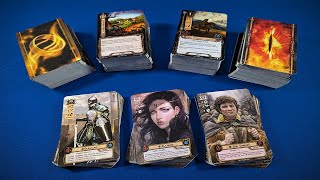
At its heart, The Lord of the Rings employs cooperative deck building as its primary mechanical engine. Players construct personalized decks around hero characters, each with distinct color restrictions that mirror Magic's color pie approach. The Four Spheres of Influence, Leadership, Lore, Spirit, and Tactics, dictate what allies, events, and attachments can be woven together. This system allows for extraordinary deck construction depth and player expression. Solo players often pilot one or two decks simultaneously, spreading resources across complementary color combinations. The beauty of this approach is that deck construction becomes a puzzle itself: determining which hero combinations synergize, which cards work best together, and how to prepare for specific scenarios.
Dynamic Encounter Encounters with Shadow Effects
Combat tension derives from the game's elegant shadow effect system. Each time an enemy attacks, defenders must draw a card from the encounter deck; some cards bear shadow effects that modify combat variables unpredictably. This mechanism transforms combat from a static calculation into a dramatic moment of uncertainty. Additionally, the quest system requires players to allocate their characters' abilities between quest progress and combat defense, creating meaningful turn-by-turn decisions. Players must balance advancing through scenarios against the threat of overwhelming enemy engagement, generating the tense, foreboding atmosphere that defines the experience.
The Lord of the Rings: The Card Game Experience
Thematic Immersion Through Narrative Scenarios
The card game transcends mechanical systems through exceptional thematic design. Each scenario unfolds as a narrative chapter in Middle-earth, complete with flavor text that contextualizes encounters and quest progression. The Dreamchaser campaign, for instance, follows corsair pursuit across perilous waters, with mechanics directly reflecting story beats. Questing, sailing tests, and specific encounter cards reinforce the adventure's texture. Players don't simply move tokens; they embark on journeys that feel narratively consequential, whether pursuing enemies across treacherous coastlines or navigating cursed locations.
Satisfying Engine-Building and Mastery
Experienced players find profound satisfaction in constructing powerful, synergistic decks. The game rewards preparation and pattern recognition, allowing skilled builders to chain combos and generate cascading value across turns. Nulor decks, for example, excel at rapid deployment and card advantage, enabling explosive early turns that feel genuinely rewarding. As players engage with more scenarios and expansions, they develop mastery through experimentation and iterative refinement. The learning curve feels challenging but fair, with victories earned through understanding mechanics rather than pure luck.
What Makes The Lord of the Rings: The Card Game Stand Out
Scenario-Based Replayability and Customization
Unlike campaign games with persistent progression, The Lord of the Rings releases new scenarios as self-contained puzzle boxes. Each scenario demands deck customization, encouraging players to rebuild for specific threats, quest mechanics, and encounter composition. This design eliminates the obligation to commit to long campaign arcs while maintaining exceptional replayability. Players can return to beloved scenarios with new deck ideas, discovering fresh solutions and strategies. The ability to mix and match decks across different scenarios creates nearly limitless variety, ensuring that multiple plays feel distinct and engaging.
Accessibility to Depth Scaling
The game scales gracefully from accessible introduction to formidable challenge. Pre-constructed decks allow immediate entry for new players, while the extensive card pool provides depth for collectors and optimizers. Scenarios themselves offer variable difficulty: some prove approachable with starter decks, while others demand extensive collections and refined strategy. This scaling means a casual player can experience satisfaction with humble collections, while veterans with extensive card pools enjoy maximizing synergies and attempting harder scenarios. The game respects both ends of the spectrum.
Potential Drawbacks
Deck Construction Overhead and Collection Requirements
The game demands substantial investment for optimal play. While pre-constructed products exist, serious engagement requires purchasing multiple expansions to access the card pool necessary for scenario flexibility. Deck building itself requires planning and research; newcomers cannot simply pick random cards and expect success. Setup and teardown add time commitment, and the game's living card game model means earlier expansions eventually fall out of print, complicating access for interested players beginning years after release.
Solo Play Complexity and Two-Handed Management
While highly playable solo, the game demands two-handed play for many scenarios, requiring players to pilot two separate decks and track distinct threat pools. This increases mental overhead and table footprint. The chaos bag mechanic in testing scenarios can feel arbitrary, and some encounters present difficulty spikes that frustrate rather than challenge. Campaign commitment in expansions like Dreamchaser asks players to complete narrative arcs across multiple sessions, which suits some players but excludes those seeking one-off experiences.
If You Enjoy The Lord of the Rings: The Card Game
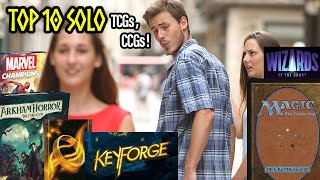
Players who love this game typically gravitate toward similarly complex card games with cooperative structures. Arkham Horror: The Card Game offers comparable deck construction depth with campaign-driven progression and persistent character growth. Marvel Champions provides lighter deck building with faster setup and solo-friendly streamlined rules. Mage Knight delivers extraordinary hand management and puzzle-like decision-making for players seeking pure optimization challenges. Magic: The Gathering remains the spiritual ancestor, sharing color-pie design philosophy but with competitive rather than cooperative focus.
What Reviewers Are Saying
"The Lord of the Rings, the card game. And folks, as far as games that feel the closest to Magic, this is it. And that's due to the fact that the fantasy theme aligns with magic a lot."
— AzureDeath | Solo Board Gaming
"Water card game is almost like a classic game at this point card collecting game and build decks with like Aragorn Legolas and all the other characters and try to defeat different scenarios it's a Cooperative game you fight against Monsters and try to do different quests I'm still playing it after all these years and that's why it's deserving to start out the top 10."
— Board Game Hangover
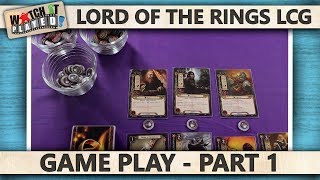
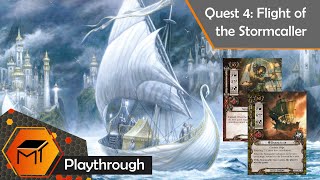
"That feels really good. We'll move this back to being on course. And now let's quest. Are you ready for the insanity? This is so cool. If the Stormaller's current quest stage has progress on it equal to or above the quest points of the actual quest itself, it advances to the next quest stage."
— Meet Me at the Table