/pic4398491.jpg)
/pic6427566.jpg)
In The Palaces of Carrara, players want to buy the marble from this famous region of Italy as cheaply as possible – but any reduction in price will benefit opponents as well. Maybe you'll find it profitable to instead invest in the buildings created from this marble? Maybe it'll be more worthwhile to grab the expensive raw material when bigger buildings in town turn out to be not so lucrative?
The game includes two levels of play: beginner and advanced. Co-designer Wolfgang Kramer says, "To understand the game, it's important that players play the beginner version to learn the game mechanisms and how they mesh together."
This page includes videos and mentions from the whole The Palaces of Carrara family. Drill into a specific game below.
/pic4398491.jpg)


Mechanics (from transcript analysis)
Video topics + discussion points
Quotes (from this video)
- i wish i knew castles of burgundy had a newer release
- it's an absolute cutthroat game
- it's devious but it's light
- oh yeah have a massive stack of battlestar galactica
- i know i haven't got tamsk but it's not technically part of the gift series but i still obviously still want it
- Vegas Showdown's a really good bidding game
- i did want to buy a copy of hero quest which i thought was really good for 20 quid when it was completely out of print and was never getting reprinted again
- i wish i could guarantee i liked that game before i bought it
References (from this video)
- Modernizes a proven Euro game with great changes.
- Adds new layers of strategy.
- Simple mechanics that are quick to learn.
- Quick turns with meaningful decisions.
- Requires adaptability, no single best way to play.
- Balancing money for bricks versus scoring points is a key tension.
- Advanced version offers even harder decisions and more strategic depth.
- Decisions in the advanced version are harder.
- Less planning required compared to other Euro games, more adaptability needed.
- Building cities and monuments
Mechanics (from transcript analysis)
- action selection — Players take turns choosing one of four possible actions.
- Area Majority — Competing for majorities of statues per city in the advanced version for additional points.
- Resource Management — Managing money and blocks to purchase buildings and construct monuments.
- Scoring tracks — Using scoring markers to claim scoring locations on the main board or player board, with bonuses for initiating scoring.
- Set Collection — Collecting sets of decorations in the advanced version for scoring.
- Tile Placement — Placing buildings and monuments on a player board according to the type of blocks used and upgrading existing buildings.
- Variable player powers — Improvement tiles and decorations/statues can be claimed and placed to modify city or action values.
- Wheel building — A rotating wheel with segments that determine the cost and availability of building blocks, which can be rotated or refilled.
Video topics + discussion points
Quotes (from this video)
- This game takes a proven euro game and modernizes it with some great changes.
- The game is strapped with new layers of strategy so that the game can continue to survive in a market that produces so many new board games each year.
- The game mechanics are simple enough to pick up and won't take over 10 minutes to explain how to play.
- The game definitely has many choices for strategy and many times players will need to solely adapt to the game to do well so there is no best way to play the game players have to adapt.
References (from this video)

- includes a revised set of rules
- includes a completely new advanced version
- advanced mode introduces statues for varied scoring
- updated look
- updated gameplay
- Building palaces and structures using marble
- Medieval Florence
Mechanics (from transcript analysis)
- Area Control — Players compete to build structures.
- Resource Management — Players utilize marble to build.
- tile laying — Players place tiles to build structures.
Video topics + discussion points
Quotes (from this video)
- This is a family weight game and it's It's Like a Dungeon Crawl Labyrinth type of a game but one that you can play with you know your your children you know they they say this plays ages seven and up so if you're looking for like a family weight game uh you are leading one of six different characters into a labyrinth all right tile by tile you uncover what the Labyrinth looks like so it'll be different each playthrough and you have to equip yourself with weapons and spells you got to fight monsters you got to collect treasures and then the player with the most treasure at the end wins so yeah that's a nice little family game for you
- So it's basically an escape room a mystery in a box you know it's a it's a one-time use only thing but it's a fun evening you get an escape room in a box and you are trying to figure it out so these Advent calendars we got two of them we got the hunt for The Golden Book and the Mystery of the ice cave they are essentially turning that exit system into just a a game that you're going to Play Over the 24 days or 25 days you're just going to open a uh a spot on the Advent calendar get a new piece of information and try to solve the case over 25 different days so this feels like a fun family activity to do you know you can you can play it over the entire month of December and try to try to figure it out
- So this is kind of a fun refresh to the original game of Azul
- This is a two-player only game takes about 45 minutes to play and it is you are competing with another architect on building a majestic Cathedral so you are competing against each other it is an area control tile laying game set in medieval Florence and it offers a lot of heavy player interaction we are going to be messing with each other but it's also still easy to learn so you know if if you like a two-player game with uh a little bit you know heavier on the strategy but still also heavy on the player interaction than uh Basilica seems like a good one for you
- You are battling and dueling with other drivers in the lawlessness of year 2070.
- So in this game you are you know you're choosing your vehicle your vehicle has weapons and armor and all you know body styles different all that there's a lot of cool stuff to it and you're taking them out on the road and you are fighting against other drivers to uh you know to to destroy their cars and get around a track so that is Car Wars sixth edition
- Between two cities is an interesting game where you are you're building a city but you're doing one city with the player to your right and one city with the player to your left so you're basically semi Cooperative with each of these people and then you only score for your weaker CI so it behooves you to kind of build up each City here and stuff like that so um it is a you know and it's it's one of the nice things about between two cities is it's a it's a strategy game that plays seven players so you can you know a lot of a lot of strategy games just don't play that that high of a player count uh so this one playing 1 to S so in the essential Edition it combines components from the original game and the capitals expansion into one cohesive Hole uh it features a bigger box than the original game different art on some tiles and a Score Pad instead of a board and but there are no new gameplay elements it just combines everything makes it easier for you to store in a bigger box
- In fantasy Realms monarchs are competing to construct the most prosperous kingdom in the realm and this deluxe you know the deluxe box has updated every card with a Sleek intuitive graphic design the base game cards have also been updated to include new art and and it gives the entire game a fresh look so the this fantasy Realms deluxe edition does it it combines it includes the original base game the cursed horde expansion with the two expansion modules the jester and Phoenix Cards and 100 Art sleeves to protect all the cards included so you are playing you know in the game you're playing cards one at a time you collect beasts armies Wizards more so if you're a fan of fantasy Realms well now you got a deluxe edition
- It takes me many many hours I spend 10 hours just emailing everybody and stuff like that trying to figure out what's coming out this month or what's delayed you know I have a I have a spreadsheet I think my November one right now has 60 games that might come out and I just got to follow up with everybody and see what's delayed and what's coming out obviously all the shipping woses continue and things are constantly delayed
References (from this video)
- streamlined euro with crunch
- language independence
- beautiful design and solid mechanics
- availability and price can be problematic
- building palaces, wealth, and endgame objectives
- Italian medieval city-building
- elegant euro, language-independent
Mechanics (from transcript analysis)
- Building Construction — place bricks to build buildings for bonuses
- End Game Bonuses — complete specific end-game goals to trigger end of game
- endgame objective fulfillment — complete specific end-game goals to trigger end of game
- rondelle wheel (pricing wheel) and brick drafting — bricks come from a wheel and their price depends on placement on the wheel
Video topics + discussion points
Quotes (from this video)
- it's one of the most romantic games out there
- it's a cool twist on the whole victory point thing
- it's highly thematic and incredibly interactive
- it's a solid worker placement game that feels streamlined
- it's not a long game per se but with enough players it can stretch to two hours
- it's language independent
- this is a really nice streamlined euro with crunch
References (from this video)
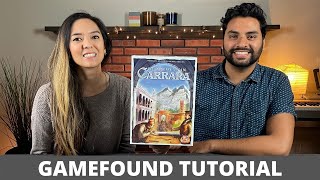
- Clear, illustrative walk-through of base rules and flow
- Good demonstration of wheel market dynamic and block economy
- Two-player setup provides a concise playthrough of core mechanics
- Acknowledgement of prototype status and ongoing Kickstarter campaign
- Component quality and specifics are still in prototype, subject to change
- Scoring system is multi-faceted and could be complex for new players
- urban development, architecture, wealth accumulation through building palaces
- Carrara-inspired Italian city-states with six cities for development
- tile-based placement with market-driven resource costs
Mechanics (from transcript analysis)
- Advanced rules: decorations and statues — Optional components that add new scoring locations and multipliers, increasing strategic depth.
- Color hierarchy and single-step exchanges — If you lack a color, you can exchange two blocks of a lower color for one block of a higher color; no chaining of exchanges.
- Endgame trigger and scoring flow — The game ends when a player uses up all scoring markers and tiles; remaining players get a final turn and then points are tallied.
- Monuments and improvements for scoring multipliers — Monuments can be upgraded and come with improvement tiles that modify scoring multipliers on the player board.
- Resource Management — Blocks and Florins are spent to acquire tiles and build monuments; color matching and exchanges affect available options.
- Resource management using blocks and money — Blocks and Florins are spent to acquire tiles and build monuments; color matching and exchanges affect available options.
- Scoring by cities, building types, and landscapes — Six cities, six building types, and two landscapes provide multiple scoring avenues with multipliers.
- Tile Placement — Players select building tiles and place them into compatible cities based on color requirements and city charts on their boards.
- Tile placement by color-city rules — Players select building tiles and place them into compatible cities based on color requirements and city charts on their boards.
- Wheel-based price market — A market wheel dictates the price of building blocks; players may rotate the wheel to change prices and restock the wheel to 11 blocks.
Video topics + discussion points
Quotes (from this video)
- everything you see here today is going to be prototype which means things are subject to change in the final copy
- the wheel is going to be seated with one of each color of block
- we are going to show you how it plays these second edition rules with the first edition kind of prototype
- the game ends when one person has used up all six of their scoring markers
- this game is currently on kickstarter
References (from this video)
- clean, concise euro feel
- interesting push-pull between wheel timing and scoring
- variable end-game objectives add replayability
- can feel tight or punishing if mismanaging resources
- theme less distinctive than some peers
- resource management with a rotating wheel
- medieval Italian city-building
- economic, tactical
Mechanics (from transcript analysis)
- city-building with layout control — place buildings into cities to score; timing and deals matter due to wheel effects
- resource wheel — rounds load bricks; rarer bricks yield higher multipliers; wheel can be rotated to affect prices for all players
Video topics + discussion points
Quotes (from this video)
- there aren't that many euros that do take an hour or less
- tons of different ways to win this game
- it's a very nice looking game you know nice fantasy feel
- this has a very distinct gamer; nothing else like this in my collection
- Ra has one of the best time-to-depth ratios I've ever seen