/pic487045.jpg)
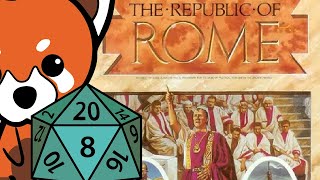
The Republic of Rome is an abstraction of over 250 years of history. It simulates the politics of the Roman Senate during the republic. The players take the part of various factions vying for the control of the senate. They control the various powerful families of the time, who compete for state offices, military command, economic concessions and new adherents. To win the player must get their faction to become the most powerful in Rome. While doing this, however, a balance must be maintained. A hostile world situation, and the vagaries of the public of Rome means that the players must also cooperate so that Rome herself doesn't go down under this pressure. If Rome does not last, neither does the senate, and all players lose!
Players make proposals to the Senate which other players then vote on. A player's ability to make proposals is determined by which Offices his/her Senators hold. A player's influence in votes is determined by the number of Senators they have recruited and the level of influence those Senators have obtained. Proposals may include assigning Senators to govern provinces (generating revenue), recruiting an army to fight an external foe, addressing the concerns of the Roman people, assigning offices or prosecuting previous office holders. Players have to co-operate to overcome the various threats that the game sends against Rome (wars, famine, unrest, bankruptcy) whilst working to build their own Senators' and Generals' positions and undermine that of their opponents. A powerful General or an influential Senator may become Emperor (thus winning the game) but equally may suddenly fall to the plague or an assassin's blade.
- Ongoing game with friends, enjoyable despite infrequent play.
Mechanics (from transcript analysis)
Video topics + discussion points
Quotes (from this video)
- We're not trying to simulate a battle or simulate. We're trying to evoke feelings, right? And we're trying to communicate key points.
- If you're too accurate, you lose the vibe. And if you're very viby and you're going for that authentic feeling, then you can't have too much chrome on it.
- The dangerous part is the video does a really good job... it just gets off the rails and starts to hallucinate when it jumped from the unit being deployed to the UK...
- We have officially reached the point where there's just stuff out there that is slop and you have to follow up.
- I feel like the artists we've worked with have also impacted our design like mechanically even on the when graphic starts to get done.
- the game doesn't exist without all of those people, right?
- I never get to play my favorite games often and I certainly don't get to play my favorite games a lot.
References (from this video)

- Historical theme of Roman politics
- Engaging for players interested in the Senate
- Politics
- Roman Senate
Mechanics (from transcript analysis)
- Influence management — Controlling families in the Senate implies managing influence.
- Political simulation — The theme and setting point to this mechanic.
Video topics + discussion points
Quotes (from this video)
- Eldritch Horror was the first like really serious board game that I got into and just uh blew my mind.
- Magic is is is a rich person's game.
- It's just it's it's I think it's just not exciting for uh people who might even be wondering about the game.
- Our community on Patreon and YouTube members is honestly the reason why we're still doing it.
- We never thought about that. It's It's It always feels great when someone recognizes you, right? On the street or or or an accent.
- I would not trust myself to be 100% impartial if I have a close relationship with the publisher.
- We're we're we feel good if our community feels good, right?
- It's it's more of an art than a science.
- The audience is the most important in all all of this. So, it's important that you uh present the game accurately, cuz they will be the ones then playing that game, right?
- I'm afraid to go buy Lords of Vegas cuz I don't think it'll ever be like that again.
References (from this video)
- Deep political simulation
- Historical flavor
- Long, substantial play with strategic depth
- Very long and heavy
- Swingy via events like assassinations
- Rules can look heavier than they feel in play
- political maneuvering and governance
- Ancient Rome politics; roman senate and governance
- historical political simulation
Mechanics (from transcript analysis)
- assassination affects actions — assassinating other senators reduces actions available
- points-based victory — the winner is the person who gathers the most points by the end
- population tables — population-related mechanics influence decisions and outcomes
- use senators to perform actions — senators are used to take actions like war decisions and internal management
Video topics + discussion points
Quotes (from this video)
- This game is like roller coaster.
- getting non-gamers into it. This is how you play it with some cake, some uh drinks, beverages and have a good time.
- It's modern art.
- Modern Art is Yes. Ryan Kitia's ball game.
References (from this video)
- Ancient Rome
Mechanics (from transcript analysis)
- Card_driven/political_negotiation — Aspects of politics and diplomacy drive actions and scoring.
- Negotiation — Aspects of politics and diplomacy drive actions and scoring.
Video topics + discussion points
Quotes (from this video)
- this weekend was partially cool just because of the people I got to meet
- board gaming will join video games and take its place in Academia
- I really hope to see more work like this happen in the future
- the weekend really filled my cup intellectually
- I got to play Prime Minister and I actually won
- Prime Minister is a mean little game
- it's hard to decide what to do socially in Prime Minister
References (from this video)
- A vintage Avalon Hill presentation with distinctive aesthetics and a tactile punch-board setup
- Potential for a rich, long-form playing experience once learned and organized
- Strong thematic flavor and historical flavor that invites role-play and political maneuvering
- Opportunities for solo or light-guided play via learning on Vassal and potential streaming
- Room for improvement with a counter tray or better sorting to manage a large component set
- Significant age and component fragility; some parts show wear and paste-down quirks
- Punching and sorting are labor-intensive and can be fiddly, especially on older boards
- Rules can be dense; initial learning curve is steep without external guidance
- Coins and some tokens are visually dull or not ideal for modern components
- Storage and organization require extra effort (counter trays, bags) to keep it playable
- Power, intrigue, and political maneuvering within the Roman Republic
- Ancient Rome; factional politics and governance across provinces
- Historical-political simulation with civic intrigue and faction rivalry
- Yahtzee
- Scythe
Mechanics (from transcript analysis)
- card-driven actions and sequence of play — Perforated action cards and a sequence of play structure guide turns and events; a solitaire-oriented back of the rules hints at a structured flow
- Chit-Pulling — Chits determine which senators die, with effects cascading into governance and faction balance
- combat and province management — Province tracking, wars, and combat results influence territorial control and resource flow
- intrigue and assassination mechanics — Intrigue cards and an assassination table influence events and outcomes, injecting risk and narrative drama
- random events and deaths via chits — Chits determine which senators die, with effects cascading into governance and faction balance
- renown and faction leadership — Reputation and leadership dynamics drive political competition and strategic positioning
- setup and organization — Large punch boards and hundreds of tokens require careful assembly and organization; counter management is central to gameplay
- Voting — Votes and influence determine policy and faction power; proximity to Rome affects voting dynamics
- voting and governance — Votes and influence determine policy and faction power; proximity to Rome affects voting dynamics
Video topics + discussion points
Quotes (from this video)
- this is like it's an antique essentially
- it's unusual to find it on punch game that's this old
- it's mine now and hopefully we'll be playing it in the near future on this very Channel
- the opportunity to stab Fred from homologous in the back in yet another way
- it's amazing how much fun you can have with very little if you're willing
- 1990 straight on so let's say 1990 is the year that this thing was printed
- I've actually held onto this for a long time and I just Republic of Rome's a tough game to get into
- the last thing I do want to look at is I want to see if there's a year in here
References (from this video)

- immersive political intrigue
- strong narrative arc
- table talk and interaction
- counting aspects can feel tedious
- political maneuvering, ambition, backstabbing, and governance
- Early Roman Republic with Senate politics and civil competition
- semi-cooperative with intense interpersonal conflict
Mechanics (from transcript analysis)
- military/war components with counting — Counting and siege/war elements contribute to tension and scoring
- offices and political influence — Players vie for offices and leverage power within the Senate
Video topics + discussion points
Quotes (from this video)
- it's dramatic
- it's really really fun
- The rules are very complicated
- it's mean and it's so funny
- I can't wait to play it again