/pic6990829.png)










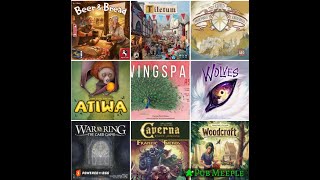

















The Wolves Deep Dive
What the Community Thinks About The Wolves
The Wolves has earned respect within the board gaming community as a thoughtfully designed strategy experience that deserves more recognition. Reviewers consistently highlight its engaging puzzle-like gameplay and interactive mechanics, though opinions diverge on specific design choices. The game has proven compelling enough to appear on underrated game lists and generate sustained discussion among experienced players, suggesting it occupies an interesting space between niche appreciation and broader appeal.
Core Mechanics That Define The Wolves
Pack Building Through Howling and Domination
The heart of The Wolves centers on expanding and managing a wolf pack through two primary mechanisms: howling at lone wolves to recruit them and dominating opponents' wolves through tactical positioning. Players use their alpha wolves to assert dominance across the map, converting lone wolves into their own pack members. This creates a satisfying progression where early game actions directly feed into mid-game positioning advantages. The howling mechanic requires players to calculate range, cost, and strategic timing, making recruitment feel like earned progress rather than automatic advancement. The ability to steal opponents' wolves adds a layer of tension and forces constant vigilance about pack placement.
Terrain Manipulation and Area Control Scoring
The modular board divides into five distinct scoring regions that activate at predetermined intervals throughout the game, forcing players to plan movements several turns in advance. Players build dens and upgrade them to layers, which serve as majority tokens worth significantly more than standard pieces. Area control scoring happens multiple times during play, meaning victory isn't determined by a final tally but by consistent influence across different regions. This creates a dynamic push-and-pull where players must balance recruiting new pack members with establishing territorial presence in the regions that matter most at any given moment.
The Wolves Experience
A Brisk, Puzzle-Driven Rhythm
Despite its strategic depth, The Wolves maintains a surprisingly energetic pace. Turns move quickly when players commit to decisions, and the puzzle nature of pack positioning creates moments of satisfying geometric problem-solving. Players describe the experience as engaging throughout, with meaningful choices at every turn rather than long stretches of downtime. The interaction level remains consistently high because wolf placement affects others' options and opening strategies, keeping all players invested even when it is not their turn.
The Satisfying Engine of Incremental Advancement
Like the best strategy games, The Wolves rewards incremental decision-making through its den-building system. Each den built on the map removes a piece from the player board and reveals new abilities underneath: increased howl range, improved movement speed, or better pack spread. This dual-action payoff turns tile placement into an exciting moment of engine revelation. Players find themselves strategizing which abilities to unlock and when, turning the main board into a canvas for personal engine optimization rather than just area control.
What Makes The Wolves Stand Out
Modular Map Ensures Replayability and Strategic Variance
The Wolves uses a modular board assembled fresh each game, changing which regions appear and where they place relative to one another. This design decision means no two games follow identical positional blueprints. Combined with variable starting positions for different player counts, the map creates genuine strategic variance from play to play. Players cannot simply execute a memorized winning strategy but must adapt their pack management approach to the specific geography presented each session.
High Interactivity Through Forced Player Interaction
The game excels at creating meaningful player interaction without requiring explicit negotiation or complex social dynamics. Domination mechanics, area control battles, and territorial positioning all emerge naturally from the rules rather than feeling forced. Players find themselves constantly looking over their shoulders at where others position themselves, checking which territories are about to score, and deciding whether to fight for control or pivot toward easier victories elsewhere. This sustained tension around table presence distinguishes The Wolves from more solitary puzzle games.
Potential Drawbacks
Terrain Tile Flipping Creates Analysis Paralysis in Person
The most frequently cited concern involves the terrain tile mechanic on individual player boards. To activate certain actions, players must flip terrain tiles face-down, which restricts where wolves can move on future turns. In digital implementations, this overhead disappears, but in physical play, the need to calculate optimal flipping sequences can extend turns significantly. Some experienced players find the mental math required for multi-turn lookahead gets in the way of executing their broader territorial strategies. The mechanic creates legitimate strategic depth but at a cost to table flow that not all groups welcome equally.
Dominance Mechanic Feels Thematically Detached
While most game systems feel integral to the pack-building fantasy, the ability to dominate opponent wolves based on terrain type can feel mechanically arbitrary. Players note that this system requires tracking which player controls which terrain specialty and evaluating distance to potential victims at the end of each turn. For some, the mechanism succeeds as a balance tool; for others, it reads as a shoehorned restriction rather than an emergent pack behavior. The tension between mechanical function and thematic coherence occasionally surfaces in player discussions about the game's overall elegance.
If You Enjoy The Wolves
Players who gravitate toward The Wolves often find similar satisfaction in Hansonica, which shares the incremental power-building and territorial management without the terrain tile overhead. Dinosaur Island appeals to the same designer studio fans and offers variable engine paths through different decisions. Splendor delivers similar brisk-paced economic puzzle satisfaction for those drawn to the quick-playing, crunchy decision-making side of The Wolves. For area control devotees, Concordia and Root provide deeper territorial and asymmetric variants. Honey Buzz shares the modular board design and variable setup, while Tap Tap Tap offers the same satisfying spatial puzzle without the social dominance layer.
What Reviewers Are Saying
"This game has caught quite a unique mechanic which you will soon find out so I'll review the game and then we do a full playthrough of the game. This has a really straightforward puzzle about positioning your pack and managing your wolves, and the area control is relatively slow, maybe 30 percent of the game."
— Meeple University
"This is a very interactive game. You are always looking over your shoulder to see where other people or other players are at and trying to keep your wolves together but also spread out. The area of the board scores at different times and so you are moving your animals around consistently. There is a lot of good puzzle here and I have really enjoyed my plays of it."
— The Board Gaming Doctor
"The best parts of this game were really good. It just felt like it kind of shot itself in the foot with the whole terrain thing. The satisfying part about it is when you are upgrading your powers and the way that you are maneuvering your wolves and going for which territories are going to score on that specific round. That is fun and actually ended up enjoying it more than I thought as it went on."
— All You Can Board