
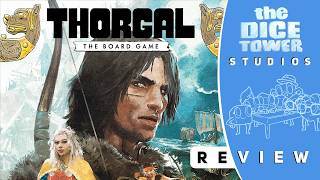
Thorgal: The Board Game is a cooperative storybook adventure game. Players take on the roles of Thorgal, his wife Aaricia, their son Jolan, and Kriss —a deadly female warrior—, and go on a series of adventures. The game consists of 7 stand-alone scenarios, each taking roughly 90-120 minutes of play. Scenarios do not form a campaign nor have any legacy features, so they can be played by different playgroups and over an extended period of time.
Thorgal: The Board Game comes with a book of maps. Each scenario is played on a different map that players explore while fulfilling scenario goals and promises completely different adventures, hidden opportunities, side quests, and vivid characters. Players are free to choose whether they travel in one group or split to cover more areas at the same time. Each character gains experience during the game and advances their abilities. Characters gather resources and craft objects to help them survive in the dangerous world.
There is a storybook containing narrative descriptions of the encounters that Characters make in each scenario. The adventures described in the book are specific to each scenario and Character, with randomized elements offering higher replayability and allowing for repeated play. There are also Side Plots players can pursue to gain benefits and reveal additional pieces of the story.
Thorgal: The Board Game also has a unique action selection mechanism. In this new mechanism, actions have varying power depending on which other actions have already been taken. Players must carefully plan their strategy and sequence of actions taken, as this directly impacts the strength of the effect of each action.
—description from the publisher
The Gamefound edition has more content.

Images


- Original action-selection system with dynamic card/token interaction
- Strong puzzle-like feel; tense planning and sequencing
- Polyomino integration is central and varied across mechanisms
- Engaging tension and replayability across multiple scenarios
- Clear moments of intrigue and discovery during gameplay
- Theme integration can be lacking or unclear for some players
- Rules readability and some ambiguities may require FAQs
- Notable weight and pace can feel punishing or fiddly for new players
- Two-player experience is strongly emphasized; broader player counts feel reduced
- cooperative exploration with resource management and puzzle-solving
- Norse/Viking adventure world inspired by the Thorgal graphic novels
- book-of-tales flavor with brief story blurbs; outcome driven by player choices and objectives
- Robinson Crusoe
- Legends of Andor
- Spirit Island
Mechanics (from transcript analysis)
- action selection with tokens — Four action tokens per round; you place and flip tokens to activate abilities; tokens shift between rounds.
- combat with dice — Combat uses dice with outcomes determined by skill and card requirements; hearts must be covered to win.
- Combat: Dice — Combat uses dice with outcomes determined by skill and card requirements; hearts must be covered to win.
- journey exploration — Journey cards are revealed along a track; placing polyominoes forms a journey and yields resources.
- location interaction with enemies — Locations can be occupied or blocked by enemies; interaction depends on proximity and enemy presence.
- Neighbor Interaction — Locations can be occupied or blocked by enemies; interaction depends on proximity and enemy presence.
- Polyomino — Using polyomino-shaped tokens to place on the map to gain bonuses, take wounds, or affect journeys.
- polyomino placement — Using polyomino-shaped tokens to place on the map to gain bonuses, take wounds, or affect journeys.
- Resource collection and spending — Collect resources via tokens, spend to activate effects or move on the board.
- Resource Management — Collect resources via tokens, spend to activate effects or move on the board.
- scenario-based setup — Atlas of Adventure with multiple scenarios; setup depends on chosen scenario and pre-drawn decks.
- wound grid and peril — Wounds require placing polyomino pieces into a grid; inability to place results in peril and potential defeat.
Video topics + discussion points
Quotes (from this video)
- This is not a choose your own adventure game. This is a puzzle game first and foremost.
- There's a lot of moving parts in this game.
- The action selection locations will change throughout the game.
- Two-player only game, period.
- I’m going to come down on this one at a seven out of 10.
References (from this video)

- cooperative package
- integration of theme with polyomino exploration
- esoteric for players without comics background
- requires some familiarity with the source material
Mechanics (from transcript analysis)
Video topics + discussion points
Quotes (from this video)
- It is an excellent production. It is everything you've come to maybe know and love about Neuroshima Hex.
- Outstanding, man. I love this trick-T game that also includes set collection.
- Disappointing. This is basically Forbidden Island, the card game with too few spaces and a little too much swinginess.
References (from this video)
- Innovative shaping mechanic
- Thematic and engaging despite potential complexity
- May appear more complex than expected
- Viking/Norse adventures with mythic beasts
- Norse myth/graphic novel-inspired campaign journeys
- story-driven campaign with puzzle-like combat
- Various polyomino-based combat games
Mechanics (from transcript analysis)
- damage placement/pool management — When the board cannot place more damage, a character is knocked out.
- Polyomino — Monsters and damage are tracked via polyomino shapes that players place on a personal board.
- polyomino placement — Monsters and damage are tracked via polyomino shapes that players place on a personal board.
Video topics + discussion points
Quotes (from this video)
- My number 10 is Bomb Busters.
- It's a cooperative game where you are all bomb diffusing agents and you're trying to go in and work together to diffuse this bomb.
- You're going to be able to recognize the mechanisms from the pandemic system by the time you finish, but it feels thematic by then.
- This is a great one if you're a Christian and you enjoy Tableau Builders more than anything else.