/pic115300.jpg)
In Thurn & Taxis, players build post office routes across Bavaria and the regions around, collecting bonus points in various ways. The board shows a map of all the cities, with roads leading from each one to some of its neighbors. There are various colored regions around the board, most with two or three cities, and a large region with all the Bavarian cities in the center.
Players build postal routes from city to city to city so that each city is adjacent to the next city on the route and there is a road connecting these two cities. Each route must consist of at least three cities. Players may build only one route at a time. Routes are represented by melded city cards arranged in the order of the route.
Players start with a supply of 20 post offices in their color, a carriage house card, and a player aid card. The board is populated with bonus tiles, carriage cards and city cards. On a turn, a player will draw a card from a display of six, face-up city cards (or the top of the face-down deck) and meld one card, either starting a new route or adding to the current one. If after adding to the route, the length of the route is at least three cities, the player may declare it finished and score it. The player may, depending on the length of the route and which cities are in the route, place post offices in the cities, collect bonus tiles, and acquire a higher value carriage. Optionally, the player may receive support from one postal official in the form of drawing a second card, melding a second card, refreshing the six city card display, or acquiring a higher value carriage than the route length when finishing a route. Once a route is scored, the city cards of that route are discarded, and the player begins a new route on their next turn.
When a player exhausts their supply of post offices or acquires a value 7 carriage, the end of the game is triggered. Play continues until the player who is last in turn order finishes their turn, and the game ends. Players score points for their highest valued carriage and bonus tiles, then lose points for unplaced post offices. The player with the most points wins.
The fact that you *must* add at least one city to your route each turn or lose the whole route gives the game an enjoyable planning element.


Mechanics (from transcript analysis)
Video topics + discussion points
Quotes (from this video)
- I absolutely love playing Bonney Kingdom
- Bunny Kingdom is a fantastic game
- regular castles of burgundy not like deluxe editions you don't have to sort anything out
- Sea Salt and Paper I think that works brilliantly on board game arena
- Planet Unknown I also play this on sovereignty but on board game arena there's just an ease of play
- the last two are Stone Age which is a great game and I think the implementation on board game arena is brilliant
- and kassan the reason I put kassan on is because I love playing kassan in person
- No Thanks on BGA I want to play No Thanks in person around the table with my friends to see their faces their agony
- that's turn and taxes I want to play turn and taxes in person I don't know why I just love that game in person
References (from this video)

- Beautiful board artwork
- Enjoyable solo mode
- Nostalgic memories
- Not soloable out of the box.
- creating mail routes
- Carcassonne
Mechanics (from transcript analysis)
- Puzzle solving — The solo mode requires managing multiple player colors to create routes.
- Route Building — Players create mail routes on the board.
Video topics + discussion points
Quotes (from this video)
- cozy for me though I'm looking at something that obviously I enjoy but it's something where the setup is quick playtime is quick there's not a lot of components the rules are easy for me to relearn
- it is just it's a nice sort of like a visit with an old friend there's not really much to talk about there's nothing new here necessarily but it is just a nice time
- boring so when you see reviews for some of these games there's going to be some people who call it cozy great and some people who say that's too repetitive there's it's not exciting it's not interesting it's it's just it's just boring and both are correct
- the stakes there's no Stakes involved and I'm not talking about Stakes to eat I'm talking about the stakes involved in winning or losing in some games you know you have characters who if you lost your character died which is it's not so cozy
- I love that one the only thing with Meadow even just the base game does take a bit of time to play I think this usually clocks in around 40 minutes for me just the base game which is a little lengthy for a cozy game because again I'm looking for something that is fairly quick to play usually when I want something cozy not always though
References (from this video)

- Took a perpetually out of print game
- Put it in a smaller, more affordable box
- Brought back into the market in a smaller package
Mechanics (from transcript analysis)
Video topics + discussion points
Quotes (from this video)
- If there was a Mount Rushmore of game designers he'd be on it, Mr. Richard Garfield.
- Well, the uh the original inspiration I was walking uh around Portland and saw some birds uh seagulls jockeying for posts and uh I began to um fantasize that uh that the birds were choosing the better posts and uh acquiring them based on the pecking order because one would fly up and either be pushed off or manage to take the post they were trying to land on.
- And uh I thought it might be an interesting opportunity to make a game like Strateggo, but only one person showed uh showed their piece and the other one said who won, thereby keeping some of the the mystery in the game and uh that's what I applied to this idea of pecking order.
- You kind of like take something that's typically done and you completely turn it on its head.
- I try a lot and uh and uh many many don't make it past uh casual play.
- In my opinion, there's been some recent good examples of what to do with the reprint.
- I don't typically do a lot of negative reviews. That game got a negative review for me.
- I feel like publishers try to do too much. I feel like they don't listen to what the people actually want.
- Old games uh games in general when they reach a certain quality level just stand up to a lifetime of replay and they there's no logical reason why they should expire.
- It's not that I don't care about themes. I do. Um I I don't uh but but I I I want them to resonate with whatever the mechanics are.
- I totally approve of that as a as as a way to play. That's the way I play. I find it very enjoyable to have those deductions on the table rather than to have to memorize them.
- The game the game worked really well, but it was positioned as sort of a heavier game than it should have been. It came in a in a bigger box than it needed to.
- With uh Spyet, I actually presented they they said they wanted to uh with Shadow Blades, they wanted to change the flavor to being uh instead of spies sort of set in a modern context, they changed it to uh Asian warriors uh Korean Asian warriors. And I I actually redesigned the entire game based on that.
- With uh Vanguard Exiles? It's on Steam with uh as in early release, so there's a long way to go, but uh but you can play head-to-head.
- I've tried to make auto battlers myself. Uh and uh they always felt when when I was working on them, they always felt like uh I I I they always stalled at this point where I said, "Oh, this is kind of fun, but you know what? It would be better on computer."
- Recently I played uh zombie kids with uh with my seven-year-old twins. And and this worked this worked really well is getting a legacy experience which was a you know which which worked for that age was marvelous.
References (from this video)

- really good
- good game
Mechanics (from transcript analysis)
Video topics + discussion points
Quotes (from this video)
- Movie Tricks is really good. Movie Tricks is from Chitty Fox Games. It's a trick taker, but it's got a bit of a kick and I really like that.
- Severton is a game from Vlades Shaattle. You may have heard of Vlad Shaattle, but he's got a new game this year called Severton. It's the first time he's had a new game published for about 10 years. And a little bit like Dutch Resistance: Orange Shall Overcome, it's a cooperative game where you're trying to complete missions. And it's really, really good. And not many people are talking about it.
- The new version for me is an improved version of the game. So, if you like Ingenious or Genal, whatever you want to call it, then have a look at the 3D version. That was really good.
- we played this game called drop alter and I absolutely blitzed it. I mean I think I won I think I won six of five of the six rounds that we played or something like that.
- In general, I don't play abstract games. But there are certain ones which I do play and I do like.
- Project L is another really really good game and I really like Project L and uh and that is a completely abstract game.
- I dread the day when I have to play on Mars again because I don't have the time, mental energy, everything else to go back and relearn on Mars.
- Talisman. 34 year gap between playing it.
- as much as A Trespass Odyssey was the most complicated game that I've ever played and some of the rules were extremely confusing and we weren't sure of some of the rules after 25 games, that game had things in it which I have never had that experience from any other game ever.
- And I've heard that Kingdoms for Lawn offers a similar experience.
- But when I'm playing it solo, if I'm not live streaming it, my brain because of the weird memory issues that I have, literally gets to a point and I go up and it just stops and my short-term memory disappears and I'm like, I have no idea not only what I was doing, but where we are, what phase we're on, or anything like that.
- live streaming it and talking to the audience and keeping things going is the only way that I can actually get my brain to, you know, work and be able to cope with playing the actual game itself.
References (from this video)
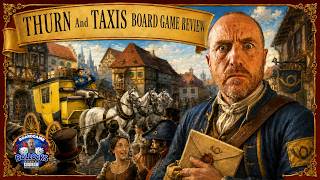
- Takes the core route building of Ticket to Ride and adds layers of strategy.
- Adds a decent push-your-luck element.
- Requires strategic planning to avoid being blocked.
- Postal officials offer necessary mitigation.
- Despite being dated, it's a gem that still gets played.
- Considered a better game than Ticket to Ride due to added strategy.
- Can end up with nothing when the draw deck runs low and needed cards are missed.
- Frustrating if card luck issues happen multiple times.
- Can feel limiting due to balancing lucrative routes with obtaining carriage cards.
- Dated visuals and presentation.
- Postal service
- Ticket to Ride
Mechanics (from transcript analysis)
- Area Control (limited) — Players can place post offices on route spots, but only one per spot, and other players can also use those spots.
- Bonus objectives — Achieving specific route lengths (5, 6, or 7 cities) or filling regions with post offices to gain bonus tiles.
- Hand Management — Players have a hand limit of three cards, requiring them to manage their hand effectively.
- Push Your Luck — Deciding whether to complete shorter routes or risk waiting for longer routes for potentially higher scores.
- Route Building — Players take cards, play them to build routes connecting cities, and place post offices to score points.
- Set Collection — Collecting sets of city cards to mirror routes on the board.
Video topics + discussion points
Quotes (from this video)
- It adds a really, really decent push-your-luck element, yeah.
- The postal officials had a much-needed or essential level of mitigation, yeah?
- Let's be honest, it looks like complete and utter dog [__] yeah?
- Ticket to Ride Taxis is a fantastic Ticket to Ride style route building game that adds several layers of strategy, making this the better game.
- It looks and smells like a gents pub toilet on a Saturday night.
- This ancient gem still finds its way to the table time and time again.
References (from this video)

- tight, map-driven euro mechanics
- historic flavor and elegant gameplay
- difficult to print at times; perceived as heavy by some players
- route-building and logistics
- German postal network in the Enlightenment era
- systematic route-building with regional depth
- Ticket to Ride
- Kramer games
- Puerto Rico
Mechanics (from transcript analysis)
- Area Control — control of cities through network expansion scores points
- area_control — control of cities through network expansion scores points
- route_building — players create and optimize postal routes across Bavaria
Video topics + discussion points
Quotes (from this video)
- the biggest one ever in the history of the modern board gaming possibly the biggest one ever
- Ticket to Ride is a hand management game that's what it is
- Dominion... it's the deck building game
- Bear Park feeling
- it's essentially root building right it's a root building game, much like Ticket to Ride in some way
- Treat yourself
References (from this video)

- unique, thematic routing challenge
- expansions add scope
- some players find it dry
- complexity may deter casual gamers
- infrastructure and routes
- historic German postal network
- historical simulation
Mechanics (from transcript analysis)
- route building / network growth — Players lay out routes and grow the postal network.
- Tile Placement — Tiles and routes are placed to expand the network.
Video topics + discussion points
Quotes (from this video)
- This is not an exhaustive top 10 list that we are giving you—the bottom half of the Spiel winners.
- Keep on playing games. Even if they're light, they're still games.
References (from this video)

- interesting thematic flavor
- tight, concise play for experts and casual players
- rules can be dense for newcomers
- logistics and route optimization
- historical transport routes
- light strategy
Mechanics (from transcript analysis)
- card-driven / action drafting — select actions to manage routes and logistics
- Pattern Building — arrange routes to maximize efficiency
- set collection / routing — build routes and earn points
Video topics + discussion points
Quotes (from this video)
- find your people find your community
- the Discord is amazing
- it's a tornado at Pax
- we've doubled the amount of people we've played with
- this year focusing on doing what you love and surrounding yourself with your people
References (from this video)
- interesting thematic flavor
- tight, concise play for experts and casual players
- rules can be dense for newcomers
- logistics and route optimization
- historical transport routes
- light strategy
Mechanics (from transcript analysis)
- card-driven / action drafting — select actions to manage routes and logistics
- set collection / routing — build routes and earn points
Video topics + discussion points
Quotes (from this video)
- find your people find your community
- the Discord is amazing
- it's a tornado at Pax
- we've doubled the amount of people we've played with
- this year focusing on doing what you love and surrounding yourself with your people