/pic1419207.jpg)
/pic7108036.jpg)
/pic8286833.png)
/pic5872050.jpg)
/pic1419207.jpg)
/pic8286827.png)
/pic8286823.png)
/pic2433579.jpg)
/pic2635907.jpg)
/pic2815954.jpg)
/pic4239141.png)






















Timeline Deep Dive
What the Community Thinks About Timeline
Timeline stands as a rare trivia-adjacent game that reviewers consistently describe as refreshingly accessible. Unlike traditional knowledge-check games that punish players for not knowing specific facts, Timeline transforms the trivia experience into something remarkably forgiving. The game has earned recognition across gaming circles not as a heavyweight strategic challenge, but as a beloved filler, one that works equally well at a casual dinner table, on an airplane, or as a wedding reception activity. Reviewers highlight its remarkable reach: the game engages players of vastly different ages and gaming experience levels without feeling condescending to either group.
Core Mechanics That Define Timeline
Chronological Placement and Progressive Difficulty
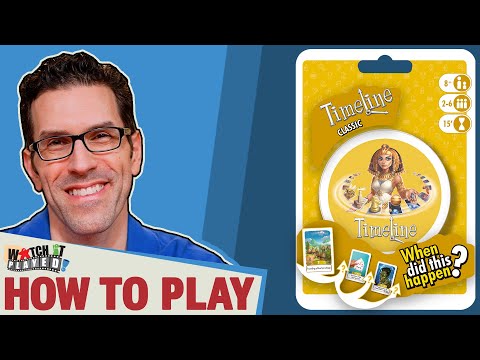
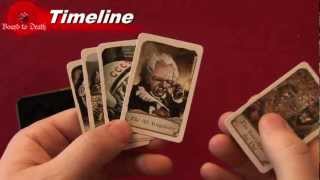
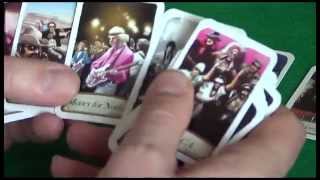
At its mechanical heart, Timeline asks players to arrange historical events, inventions, or discoveries in chronological order. Each turn, a player draws a card depicting a single event, the cork, the accordion, the blue jeans, the crossbow, and must place it in relation to cards already on the table. The year remains hidden until placement is finalized. What makes this elegant is that players don't need encyclopedic knowledge; they merely need to reason about relative ordering. Did the toothbrush arrive before or after perfume? Before or after the pyramids? The timeline grows progressively longer, creating natural escalation: early placements offer wide windows for guessing, but as the sequence lengthens, gaps narrow and precision demands increase. Players who successfully place a card keep it; those who err discard and draw fresh cards. First to empty their hand wins.
Trivia Without Gatekeeping
Timeline succeeds where traditional trivia games falter because it doesn't demand exact dates. A player might have no idea whether the barometer was invented in 1643 or 1843, but can still reason "after the invention of fire, before 50 Cent released his seminal classic candy shop online." This mechanics-driven approach to knowledge creates a fundamental shift: instead of failing at knowing the answer, players can succeed by making an educated guess and occasionally getting lucky. Reviewers emphasize that this encourages participation from non-experts, makes the game rewarding for hunch-players, and keeps everyone engaged regardless of their historical foundation.
The Timeline Experience
Breezy, Quick-Paced Sessions
Timeline delivers rapid, energetic gameplay. Individual plays take ten to twenty minutes, fitting neatly into the spaces between meals at social gatherings, between flights, or as a warm-up before heavier games. The game's simplicity means new players grasp the rules almost instantly, often by watching a single round rather than through explanation. Production across various versions comes in compact tins, making it genuinely portable. One reviewer noted having multiple copies at their wedding and watching guests play it casually on tables and at the bar throughout the evening, with neither winners nor losers caring deeply about the outcome, just enjoying the trivia and the small surprises when dates reveal themselves.
Genuine Replay Value and Hidden Learning
Because cards appear in different combinations each session, Timeline doesn't suffer from the "I've memorized all the dates now" problem that can plague trivia games. Even players with exceptional memory report continued surprise and engagement across multiple plays, thanks to the unpredictable card order and the relational nature of the puzzles. Reviewers mention discovering new perspectives on historical events, realizing a technology they assumed was modern appeared centuries earlier, or vice versa. There's a reward built into the game itself: that satisfying moment when a seemingly random guess proves correct, or when a logical deduction is validated by the card flip.
What Makes Timeline Stand Out
Inclusive Accessibility Without Dilution
Timeline bridges a notable gap in gaming. Many "simple" games feel designed for children; many "strategic" games demand heavy rules or player knowledge. Timeline manages to be genuinely easy to teach while remaining intellectually interesting for adults. The game scales gracefully across experience levels, a five-year-old and a university history professor can sit at the same table and both find meaningful play. Reviewers across different channels describe introducing the game to family members, professional colleagues, theatre performers, and elderly relatives, consistently finding that it engages all groups. The game has been featured at celebrations, used in educational contexts, and suggested for travel specifically because it requires no electronic component and minimal setup.
Modularity and Theme Variety
Timeline exists in dozens of themed versions: British History, Inventions, Science and Discoveries, Music and Film, Cinema releases, Star Wars, and more. This modularity allows players to select editions matching their interests or the composition of their group. While most reviewers own one or two versions, the existence of so many variants speaks to the game's successful core formula. Whether a group wants to explore historical events or focus purely on cinematic releases, the mechanics remain unchanged but the flavor shifts entirely.
Potential Drawbacks
Trivia Aversion and Discomfort with Guessing
Players who dislike trivia games on principle may struggle with Timeline despite its gentler approach. If a player sees any knowledge-based question as a test to be failed, the game's premise loses appeal. Additionally, some players prefer games where perfect information or perfect play leads to victory; Timeline's reliance on educated guessing and occasional luck undermines the satisfaction of mastery for this audience. Reviewers noting the trivia barrier acknowledge that while Timeline makes trivia more approachable than Trivial Pursuit, it doesn't fundamentally solve the problem for players who simply dislike that genre.
Limited Tactical Depth and Repetition Concerns
Timeline is, at heart, a filler game, lightweight on strategy and heavy on luck. While reviewers praise this simplicity in the right context, they acknowledge that it offers minimal agency or meaningful decision-making. A player's options each turn are straightforward: place a card left or right of existing cards. Beyond the educated guess itself, there's little to optimize. For gaming groups seeking games where decisions compound across multiple turns or where player interaction involves blocking opponents' strategies, Timeline provides neither.
If You Enjoy Timeline
Players who love Timeline should explore similar light-fixture fillers with an intellectual bent: Illusion offers visual-ordering puzzles with quick judgement calls; Cockroach Poker delivers deduction mechanics in a social context; Sushi Go provides quick rounds and elegant hand management. For those wanting historical immersion without Timeline's fast pace, Ticket to Ride offers strategic placement with a geographic theme and slightly longer playtime. Zoo Loretto, which uses the same core collection mechanic in a larger tile-laying format, appeals to players wanting Timeline's drafting spirit with more complexity.
What Reviewers Are Saying
"Timeline levels the playing field by encouraging guessing on your telling. You have to add one of your event cards to the timeline in the sense of keeping in chronological order. If you're right, the card stays; if you're wrong, it's removed and you have to pick up a new card. The first person to get rid of all their cards wins. It's a fascinating game, really great concept, highly recommended."
— Adam in Wales (All Killer, All Filler)
"Timeline is like the perfect game to play with your husband or wife or play with your family. There are 50 versions of it with different themes, animal events, science history, diversity. Buy one and play it. Check it out. Great fun if you're into education. Simple, fun, cheap. This is a good one. Buy one and then you can worry about buying the other 50."
— Gaming with Edo & Jessica
"It's a really good filler. Anyone I've found players of all different ages, young players, elderly people, I found this is a really really popular game. In fact, I had multiple copies at my wedding and people were just playing it on the tables. It's so simple that anyone can get involved. They can watch and join in. That's great for a filler, a game you can jump in and out of. Nobody really cares who wins, but it's really interesting just because the trivia is interesting and it surprises you all the time."
— Adam in Wales (Top 100)