










Tiny Epic Mechs Deep Dive
What the Community Thinks About Tiny Epic Mechs
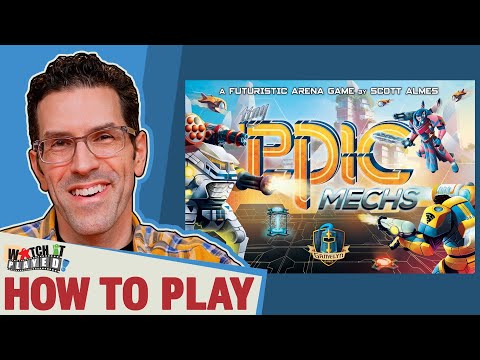
Reviewers generally treat Tiny Epic Mechs as a programming game with a strong sense of spectacle. Watch It Played introduces it through its science fiction premise, in which athletic mech pilots compete in a televised arena and the mighty mech suit becomes the prize every pilot wants. John Gates Games runs a full three-player session and shows how points come from both area control and combat, so no single strategy dominates the whole game.
Opinions diverge mainly on how much weight the fighting carries. Allies or Enemies places it near the bottom of its ranking of the Tiny Epic series, arguing that combat feels underdeveloped and that most scoring comes from leaving mines and turrets on the board rather than from defeating opponents. The same channel still praises the mech suits as visually striking. Board Game Coffee and Pair of Dice Paradise are more enthusiastic, with the latter describing the game as an approachable first step into programmable movement. Across these channels, the shared view is that the game is accessible, compact, and visually rewarding, while its tactical depth is a matter of taste.
Core Mechanics That Define Tiny Epic Mechs
Programming
Programming is the mechanic reviewers explain most often. Each round, players secretly choose four program cards from their hand of eight and arrange them in the order they want to execute them. As Watch It Played demonstrates, every card has a movement arrow that is always resolved first, followed by an optional action printed on the card's edge. Because the arrows are read relative to each pilot's position at the table, a single card can send opposing pilots in very different directions. Reveals then proceed in turn order, so players constantly adjust their plans to whatever their opponents have already done. Watch It Played also notes that a pilot knocked out mid-round enters ad hoc mode, where the player can freely choose any of the eight program cards for the rest of the round, which is how a ruined plan turns into a new opportunity.
Area Control
The second core mechanic is area control, which reviewers link closely to the programming. Players place hidden mines and face-up turrets in arena zones, and each zone has a value that determines how many points it contributes when the round ends. Turrets score double their zone value, while mines score the value once, and a pilot standing in a zone adds its value as well. Collect actions reward players for controlling these zones with energy and credits, so early positioning can fuel later purchases. John Gates Games describes this as building an engine of zone control, and points out that the area control and combat sides of scoring are impossible to separate because the arena is so small.
The Tiny Epic Mechs Experience
Intense and Confrontational Arena Tension
The game feels tense because almost every plan can be disrupted. John Gates Games shows a mine detonating on a pilot before combat even begins, instantly knocking that player out and awarding a point to the opponent. Combat itself is quick and back-and-forth, with weapons exhausting after use and counter-matching between melee, area, and ranged attacks deciding whether a blow is powerful or weak. Reviewers describe the experience as fast and aggressive, which some enjoy and others find unforgiving. The arena stays crowded, so most rounds end with pilots bumping into one another and recalculating.
Tactile and Sensory Mech Assembly
The physical experience is a significant part of the appeal. Pilots begin as small figures, and players upgrade them into power armor by spending credits, then climb into the central mighty mech suit by meeting strict conditions, including full health and the power armor already equipped. Allies or Enemies notes that it is very enjoyable to place a meeple into the suit and attach weapons to it. The plastic pieces, color-coded resources, and mines with hidden values all contribute to a tactile table presence that reviewers consistently mention as memorable.
What Makes Tiny Epic Mechs Stand Out
Mech Suits as Physical Progression
Reviewers repeatedly single out the mech suits as the game's signature feature. Allies or Enemies calls the suits the selling point and says they look amazing once upgraded. Rolling Dice and Taking Names highlights the way every pilot starts small and works toward the suit, with the central mighty mech acting as a king-of-the-hill objective that every player wants to reach. The result is a clear visual goal that gives the components a role beyond decoration.
A Full Game in a Small Box
Reviewers also value how much the game delivers for its footprint. Rolling Dice and Taking Names says the game feels bigger than its box, with production that looks strong on the mechs and meatball-style pilots. Board Game Coffee praises it as an affordable and accessible programming game, contrasting it with Nexus Ops vs Minions, which is harder to obtain and more expensive to ship. This combination of depth and compact size is one of the main reasons reviewers recommend it to newcomers.
Potential Drawbacks
Thin Combat and Scoring Imbalance
Allies or Enemies argues that the combat does not carry enough weight. The channel found that players earn most of their points from mines and turrets already on the board, and that defeating a mech pilot should be worth more. John Gates Games reached a similar conclusion from a different angle, noting that players tended to prioritize turrets, which score strongly but are easily removed, while mines were underused even though they deal more damage. Reviewers who value a high-tension brawl may find the balance between these scoring routes less satisfying.
Fiddly Components and Repeated Assembly
The same components that make the game appealing can also create friction. Allies or Enemies says that after a while it feels like players are constantly assembling and disassembling their mech suits and attaching weapons, which becomes tiresome over several sessions. Reviewers who prefer fewer setup steps may see this as a recurring cost of the upgrade system.
If You Enjoy Tiny Epic Mechs
Players who enjoy the programming in Tiny Epic Mechs will find similar satisfaction in Robo Rally, which Rolling Dice and Taking Names names as a comparison point for the same kind of planning under uncertainty. Robo Rally has a more direct race structure, so the shared appeal is watching simultaneous plans collide. Players who want a more head-to-head arena experience with programmed movement can also look at Nexus Ops vs Minions, which Rolling Dice and Taking Names mentions as another programming game. That comparison is useful because it is cooperative in a different way, while Tiny Epic Mechs is clearly head-to-head.
What Reviewers Are Saying
"In the future virtual reality has been replaced by actual reality, no longer on video screens. Now highly-trained athletic mech pilots enter an arena for sport and entertainment wielding weapons mechanized armor and if they're lucky the mighty mech suit the crowds are keen for an epic battle."
— Watch It Played
"In tiny epic Mech it's turn programming so you lay out what directions your your meeples are going to go and so it leads to chaos as you end up stumbling into each other."
— Allies or Enemies
"It's the whole idea of these games that it's not so punishing that you're just like oh this is awful and this game does that really really well because there's a lot of things that you can do even if your program goes off the rails."
— Rolling Dice and Taking Names