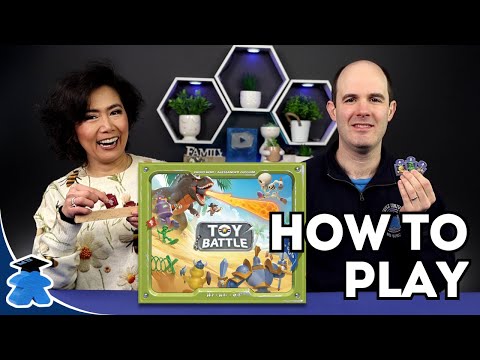




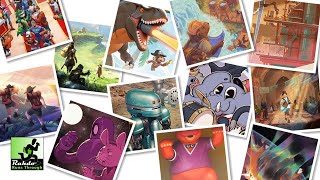








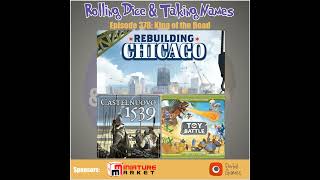
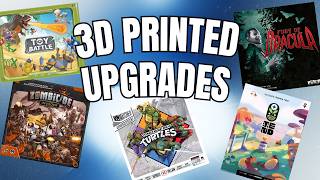
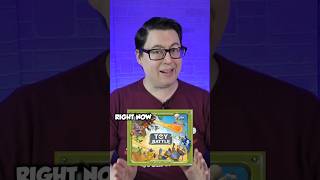
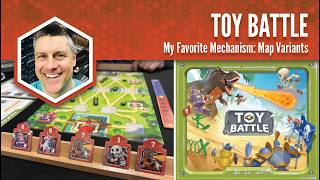
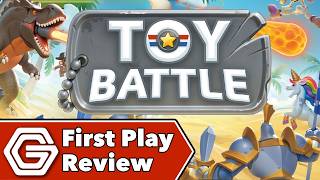
On land, on sea, in clouds, and even in space, battles are breaking out between toys. Your troops need your tactical talent to lead them to victory. Your mission? Be the first to reach the enemy headquarters or control more territories than your opponent.
On your turn in Toy Battle, you either draw two toy troops or place a troop on the board and apply its effect. When you place a troop, you can place it on an empty base, a base that you control, a base that the enemy controls with a lower-valued troop than the one you're placing, or the enemy's headquarters; however, in all cases you must place on a location that has a continuous path to your own headquarters through bases that you occupy, that is, that have your troop on top. If you occupy bases that form a continuous path around a region, you claim the medals within this region. (You don't lose these medals if the enemy later occupies one of these bases.)
The game ends as soon as you occupy your opponent's headquarters or win the required number of medals based on the current game board. If a player cannot draw or place a troop, the game ends, and whoever has the most medals wins.
—description from the publisher
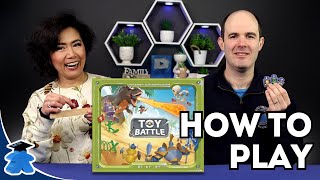
How to Play Toy Battle
Dice Tower Arena - Agent Avenue, Yinsh, Tag Team
- Strength and abilities are evenly distributed across troops, creating a balancing mechanic.
- Abundant terrain options (no fewer than six) out of the box, increasing map variety.
- Beautiful wooden racks and high perceived value for a cheap game.
- Excellent price point (under 20 quid) for a substantive two-player skirmish game.
- Lack of faction asymmetry in the base game (identical pieces on both sides).
- Limited to two players; absence of scalable multiplayer modes is a drawback.
- Tile-draw order can strongly affect outcome, reducing fairness in some runs.
- Expansion potential is uncertain in the base box; expansions are not included and not clearly defined.
- Array
- Abstract/arena skirmish with toy-figures on a modular terrain board
- Abstract
- Blitz Creek
- Memoir 44
Mechanics (from transcript analysis)
- Area Control — Regions are won by surrounding them with troops, with victory conditions tied to occupying specific regions or obtaining required tokens.
- Asymmetric Abilities / Terrain Powers — Different terrains grant unique abilities when troops are placed on them, adding strategic depth and variety.
- asymmetric player powers — Different terrains grant unique abilities when troops are placed on them, adding strategic depth and variety.
- Capture / Combat — Troops can capture or replace enemy troops if their strength is higher than the defender; placement rules govern combat outcomes.
- Line of Supply / HQ Connection — Troops must be connected to the player's HQ via a continuous line to be valid; the HQ acts as a supply anchor for placement.
- tile placement — Terrain tiles are drawn and placed on a rack and then deployed onto the board to create the playing field, with each terrain providing unique effects.
Video topics + discussion points
Quotes (from this video)
- Toy Battle is a big box skirmish experience, and it still works.
- There are a lot of terrain options in the box.
- This is one of the best two-player games to have come out last year.
- The game would have spiced up if each faction had at least one unique character.
References (from this video)
- Compact, quick to learn
- Tight supply-line puzzle when it works
- Aesthetically whimsical components
- Severe memory/visibility issues with stacked units
- Dominant randomness in short play times
- Poor 4-player mode; not a good party game
- light, whimsical toy warriors theme
- Small-box, fast two-player duel focused on territory control via tile placement
- puzzle-like, memory-driven, push-your-luck
- Shot and Totten
- Battle Line
- Hive
Mechanics (from transcript analysis)
- random_draws — Draw tiles with certain pieces (Roxy/jumbo/ducks) which drives luck
- stack_visibility_challenge — Stacking pieces obscures lower units, making planning and visibility difficult
- supply_line — Continuous path from HQ to a spot is required to place troops
- tile placement — Players draw or place tiles to extend supply lines and control territory
- tile_placement — Players draw or place tiles to extend supply lines and control territory
Video topics + discussion points
Quotes (from this video)
- The table presence of Battle of Hoth is undeniable.
- The campaign mode that carry damage over is brilliant.
- Toy Battle is getting donated.
References (from this video)
- highly tactical despite a playful theme
- multiple maps keep the game fresh
- great balance of strategy and quick play
- theme/arts are not to everyone's taste; could deter some players
- some players may not expect depth from a childlike theme
- childlike theme paired with deep tactical decisions
- toy chest battlefield with two-player combat
- players commanding toy factions in a compact duel
- Via Magika
Mechanics (from transcript analysis)
- lane-based interaction and map-wide decision points — multiple lanes with map-specific dynamics and power cards that alter flow
- multi-map variability — eight maps provide varied strategies and pacing
- two-win-condition design — you can win by controlling spaces via two distinct routes and by pressuring the opponent near their HQ
- variable map — eight maps provide varied strategies and pacing
Video topics + discussion points
Quotes (from this video)
- the best part about big shot is that the way you actually gain a territory, the way you have control over it and will therefore score for it is when there are seven cubes present in a territory.
- it's a small game. It doesn't take very long to play.
- This is so deeply tactical. every single decision you're making with especially with having two win conditions in the game is so important but also so fun to engage with.
- the theme and artwork is not at all what I gravitate towards.
- it's a pleasant pleasant surprise from this last year.
- the special ability cards crack the game wide open
- it's surprisingly Cascadia, if I get that's the way to word it.
- rolling hills or rolling rivers, they're addictive and fun
References (from this video)
Mechanics (from transcript analysis)
Video topics + discussion points
Quotes (from this video)
- optimization is the death of discovery and exploration in board games.
- We don't accept gatekeeping.
- Gloom Haven sized box.
- Don't think you have to back day one.
- This is going to be a standalone game. This isn't meant to be combined.
- You can't please everyone.
References (from this video)
- Excellent replay value with eight maps
- Value for money and accessibility
- Patterns
- Innovation
Mechanics (from transcript analysis)
- Multi-map head-to-head — Eight maps in a single two-player box; map variance drives strategy.
- variable map — Eight maps in a single two-player box; map variance drives strategy.
Video topics + discussion points
Quotes (from this video)
- two players, not enough time
- steal someone's donkey
- bang for your buck
- eight maps in the base box
- you can draw from the deck. Each card has its own way of like yes, you can use it as an item, but it's also one of the endgame conditions
References (from this video)
- Compact, two-player abstract with clear area-control goals.
- Multiple victory paths (medals central region, medals objective on terrain, headquarters capture).
- Terrain-specific base rules increase replayability and strategic variety.
- Stacking mechanics add depth by enabling tactical superiority when you outrank an opponent piece.
- Accessible rule set that remains strategically rich for sustained play.
- Toy soldiers vying for territorial control and medals through strategic placement and stacking.
- Abstract two-player arena featuring land, sea, clouds, and space-themed toy battlefields with variable terrains.
- Array
Mechanics (from transcript analysis)
Video topics + discussion points
Quotes (from this video)
- This is a great game.
- On land, on sea, in clouds, and even space, battles are breaking out between toys.
- Toy Battle is a two-player game of area control.
- When you place a troop on the map, you'll need to ensure that it's connected to your headquarter via continuous path.
- Each of the different troop pieces that you have have different abilities.
References (from this video)
- Clear, structured rule explanations and demonstrated deployment scenarios
- Fast-paced, two-player tactical decision-making with meaningful choices
- Emphasizes strategic concepts like connectivity, positioning, and region control
- Use of themed terrain and distinct toy-troop abilities adds flavor
- Rule density can be challenging for beginners
- Tracking multiple stacks and terrain abilities may require careful bookkeeping
- Tactical skirmish and strategic area control in a toy-themed warzone. Players manage a growing chain of bases connected back to their headquarters, balancing aggression with protection while leveraging unique unit abilities to gain positional advantages over their opponent.
- A compact two-player tabletop battlefield where toy troops maneuver on a modular terrain board, featuring castle-like structures and metal markers representing control points. The setup invites players to choose a terrain map (Castlefield is recommended for beginners) and place a starting landscape that shapes early decisions and future expansions of influence across the board.
- Instructional, rule-focused tutorial designed to teach setup, deployment, stacking, and special-ability interactions through direct demonstration and descriptive narration.
Mechanics (from transcript analysis)
- Connectivity — A valid placement must maintain a continuous chain from your headquarters to the newly placed base; gaps break the chain and block further placement until reconnected.
- DeploymentRules — Troops may be placed on an empty base, on a base with friendly troops, on an enemy base with a lower-strength troop, or directly onto the opponent's headquarters, with the caveat that the troop must be connected back to your headquarters.
- end game bonuses — The game ends immediately when a troop occupies the enemy's headquarters or when a terrain objective medal count is reached; or if a player can no longer draw or place troops, medals determine the winner.
- EndConditions — The game ends immediately when a troop occupies the enemy's headquarters or when a terrain objective medal count is reached; or if a player can no longer draw or place troops, medals determine the winner.
- Once-Per-Game Abilities — Each toy unit provides a unique ability when placed (examples include wild cards, extra draws, targeted discards, or direct placement effects).
- RackCapacity — The rack holds up to eight troops; if full, drawing additional troops is not possible.
- RegionControl — Occupying all bases surrounding a region grants control of that region and medals, which influence end-game scoring or victory conditions.
- ReserveDraw — On a turn, a player either draws two troops from their reserve to replenish their rack or deploys a troop from the rack onto the board.
- SpecialAbilities — Each toy unit provides a unique ability when placed (examples include wild cards, extra draws, targeted discards, or direct placement effects).
- Stacking — When placing a troop on an occupied base, it is stacked on top of existing troops; only the topmost troop controls the location, though all troops in the stack are visible.
- Stacking and Balancing — When placing a troop on an occupied base, it is stacked on top of existing troops; only the topmost troop controls the location, though all troops in the stack are visible.
- TerrainAbility — Terrain effects (e.g., Castle field) can alter play by enabling maneuvers like returning a troop to your rack, repositioning key forces, or enabling region-based actions.
- TopTroopControl — Only the visible (top) troop in a stack currently exerts control over a base location.
Video topics + discussion points
Quotes (from this video)
- The object of the game is to defeat your opponent by either capturing their headquarters or collecting the number of medals required by their terrain's objective.
- Your troops must stay connected to your headquarters.
- Only visible troops can be affected, meaning units covered in a stack cannot be targeted.
- Whenever you occupy all bases surrounding a region, you immediately take control of that region.
- When placing onto an occupied base, stack your troop on top.
- And that's how you play toy battle.
References (from this video)
- compact and quick dueling experience
- highly interactive with meaningful choices
- easy to teach and quick to set up
- two-player only, limiting flexibility for groups
- board layout can feel tight for larger players
- miniaturized combat and strategic positioning
- two-player dueling with area-control and territorial objectives
- tight, tactical, two-player focus
Mechanics (from transcript analysis)
- Area Control — players place troops to control territories and push toward the opponent's headquarters.
- line connectivity rule — new troops must connect to your headquarters; breaking the line limits further placement.
- tempo and timing — decision timing is crucial as line breaks and territory expansion create pressure.
- trooper abilities — individual troopers have abilities that can add draws, extra troops, or special placements.
Video topics + discussion points
Quotes (from this video)
- The game itself at face value feels very simple, but there's a lot of different nuances you want to be thinking about as each location has its own abilities.
- And the person who gets to trigger that actual effect is the one who has majority at that location.
- I've really enjoyed my time with Silos, and this is a game I'd really pull out only for three to four player groups.
- This is Moon Colony Bloodbath—engine-building survival with a communal deck that creates constant tension.
References (from this video)
- Thematic and accessible two-player abstract
- Each board layout feels distinct with varied strategies
- Fast and tactical with clear interaction
- Thematic flavor may not appeal to everyone
- toy battle with unique piece abilities
- Toy Story-inspired battle skirmish with themed spaces and bases.
- thematic, playful
Mechanics (from transcript analysis)
- piece-based powers — Each piece has a unique power that can bump, draw, or discard to influence play.
- placement and movement — Pieces are placed and moved along paths with spaces affecting play.
Video topics + discussion points
Quotes (from this video)
- Flip Tunes is a game that I thought looked really cool.
- For a 20-minute game, there's a lot packed into it, which I really appreciate.
- There's so much clever card play in here.
- Iliad is such a good two-player only game.
- Toy Battle is so, so good.
References (from this video)
- two-player fast-paced tactical play
Mechanics (from transcript analysis)
- two_player_tactics — Fast-paced tactical skirmish for two players.
Video topics + discussion points
Quotes (from this video)
- a simple but tricky area control game.
- a ladder climbing game, but with a fun little twist.
- a fast-paced word game.
- simple but hilarious betting game.
- Moon Colony Bloodbath, a deck building game about survival, and woo, so good.
References (from this video)
- Quick, accessible, and family-friendly
- Diverse tile abilities add variety each play
- Fun parallel to video-game-style battlegrounds
- Noticeable randomness can affect outcomes
- May feel less strategic for experienced euro players
- quick skirmish combat
- Lane battler; drawing troops toward the opponent's HQ
- light, arcade-like warfare
- Challengers
- Clash Royale
Mechanics (from transcript analysis)
- linear route to victory — Create a continuous line from your HQ to the enemy HQ to win.
- tile-drafting and troop placement — Draft different troops and place them to advance along a lane.
- varied tiles with unique abilities — Tiles grant different actions and buffs, increasing variety per game.
Video topics + discussion points
Quotes (from this video)
- My first impression was kind of lukewarm with this game.
- There is a lot of randomness in what tiles you are grabbing.
- I really enjoyed the synergies of mechanisms that are featured in this game.
- it's not something that immediately screams replayability to me.
- I did enjoy this game and would happily play it as someone else suggested it.
- Easy to learn and teach.
- This game has offered a lot of fun and replayability.
- The artwork is really nice.
References (from this video)
- Most complex and feature-rich of the six, offering depth for players who enjoy engine-building and dice strategy
- Interwoven resource management and tableau-building create interesting decision points
- Higher complexity may deter casual players seeking quick light play
- Prototype art and some balance considerations may shift before release
- dice-drafting, contract fulfillment, and tableau-building in a festive competition
- elves in a Santa workshop building toys
- busily chaotic, humorous, competitive
Mechanics (from transcript analysis)
- cocoa card mechanic (resource/ability coin) — Cocoa cards grant special abilities or wildcard effects, with a flip mechanic to regulate usage.
- contract fulfillment — Toys and actions fulfill predefined contracts to earn victory points.
- contracts — Toys and actions fulfill predefined contracts to earn victory points.
- Dice rolling — Players roll a set of dice to generate resources or actions needed to craft toys.
- Multi-use cards — Cocoa cards grant special abilities or wildcard effects, with a flip mechanic to regulate usage.
- tableau building — As toys are built, players create a tableau of abilities and effects to influence future turns.
- wrap/dice-die interaction — Wrap icons on dice determine how many toys can be wrapped to gain points; wrapping uses dice outcomes strategically.
Video topics + discussion points
Quotes (from this video)
- These are six different easy to learn, easy to get to the table family weight games that are in Christmas ornaments.
- The race is on. Can you beat all of the other reindeer to Santa's sleigh? Press your luck in this racing game to see who will lead the sleigh tonight.
- a word game. It is a matching and rhyming game. Oddball toys are scattered about. Spot the rhyming parts first to win.
- This is Snowman Shuffle, a pure drafting game. You are going to be building snowmen, and you have to roll a snowball first to move top cards.
- you are trying to sing songs. You are trying to create the different patterns that each of these carols want.
- Rap Battle is actually a dice rolling, contract fulfillment, and tableau building game, which is kind of crazy that you can get all of that within this little Christmas ornament.
References (from this video)
- Pure, joyful fun with accessible rules
- Simple, elegant head-to-head mechanics with depth via map variants
- Accessible to families and casual players, yet surprisingly strategic
- As a two-player abstract/arena, may lack variety for larger groups
- Some players may wish for more asymmetry or varied rules per map
- playful, family-friendly combat
- head-to-head battle using toy figures on a small map
- light, arcade-like
- Camel Up
- Ready, Set, Bet
Mechanics (from transcript analysis)
- deck-driven movement — cards dictate track progression and can be used to modify a racer’s position.
- head-to-head combat with miniatures — two-player skirmish where units must form an unbroken line to their HQ or capture objectives.
- tile/board manipulation — tiles with special abilities drive movement and effects; some tiles can draw or remove pieces.
- Tile/Map Shifting — tiles with special abilities drive movement and effects; some tiles can draw or remove pieces.
Video topics + discussion points
Quotes (from this video)
- This is a living website, which one we really like about it.
- The list is a snapshot in time; it will morph over time as people rate more games.
- BG is this living website; the community can contribute their own photos, their own feelings about a game.
References (from this video)
- clean mechanics
- highly replayable with multiple maps
- map variety correlates with character themes
- frequent play appeal
- toys
- battles
Mechanics (from transcript analysis)
Video topics + discussion points
Quotes (from this video)
- This is my most played game of the year
- It is the perfect engine builder
- absolutely adore this game
- one that instantly I fell really hard for it
- would absolutely watch Oathsworn the HBO series
- the story and the setting is that rich
- for me the epitome of what a thematic game can be
- every click of the clock matters
References (from this video)
- compact two-player experience with varied maps
- quick to set up and learn
- aesthetic may look like a kids' game
- limited player count (two players only)
- miniature battle-style tactics
- fantasy dueling
Mechanics (from transcript analysis)
- two-player skirmish — head-to-head battle with modular boards and unit placement
Video topics + discussion points
Quotes (from this video)
- it's yatsi with monsters fighting
- open it up, play right away
- this is one game that I will sort of put any wager on
- Just One is a guaranteed winner
- Star Wars and Memoir 44 together
References (from this video)
- Compact and quick gameplay
- Two-player focus aligns with casual play
- Possibly limited replayability if only two players
- Short, tactical duels
- Two-player duel
- Abstract competition with quick play
Mechanics (from transcript analysis)
- Two-player duel — Short, head-to-head battles designed for quick play sessions.
Video topics + discussion points
Quotes (from this video)
- There's no solving it.
- It's a waiting game.
- We love her. She's great and she's going to grow out of this.
- Please let us know what you've been playing and what games you're looking forward to that are releasing this year.
References (from this video)
- easy to teach and quick to play
- fun, whimsical theme that players enjoy
- great for a light, filler matchup or a tiebreaker
- depth is light; some gamers may want more complex strategy
- random tile/draft results can swing outcomes
- table impact depends on component quality and setup
- light, chaotic skirmish with toy figures and humorous abilities
- Playful pool-table/arcade fight theme with cute miniatures
- flavorful cartoonish combat with fast, chaotic turns
- Palamorei
Mechanics (from transcript analysis)
- Line of sight — Strategic positioning can block or open lines for attacks across the pool board.
- line-of-sight and blocking interactions — Strategic positioning can block or open lines for attacks across the pool board.
- randomized deck drafting/adaptation — Players draft or choose from among different character cards and abilities, then slot them into the duel sequence.
- tile placement — Players place tokens or tiles on a board resembling a pool/patio setup, with special rules about where and how they can place or move.
- tile/board placement with pool-like pool — Players place tokens or tiles on a board resembling a pool/patio setup, with special rules about where and how they can place or move.
Video topics + discussion points
Quotes (from this video)
- it's been a few months since I've taught the game, but I do remember I like to emphasize the different types of cards to new players
- this is one of my absolute favorite bluffing games
- Instant Mind Games. You didn't even ease us into this. You're just like, 'Hey, you want this garbage or the secret one?'
References (from this video)
- fast, tense duels with clean rules
- great for head-to-head play
- longevity depends on player appetite for abstract games
- tiny army skirmish/abstract strategy
- two-player toy battle with blocky minis
- compact, tactical, arcade-like
- Caesar-like duels
- Other abstract two-player titles
Mechanics (from transcript analysis)
- two-player abstract strategy — players race to achieve victory via minimal but sharp moves.
Video topics + discussion points
Quotes (from this video)
- This one's very quick. It's very quick to play and to teach.
- There are player interactions, but it doesn't feel mean.
- The narrative is so well written. The actual boss battling part is gripping.
- Above and Below Haunted gave it a little more oomph. Ghosts add consequence.
- It feels like a video game in board game form; very smooth and substantial.
References (from this video)
- Unique war game concept
- Unicorn pieces
- Territorial war with toy figures
- Toy battlefield
Mechanics (from transcript analysis)
- Area Control — Place pieces on opponent's units to control victory points
Video topics + discussion points
Quotes (from this video)
- Let's talk about the hottest and most sought after games
- We're going to pitch them to you so you're going to find out everything that you need to know
References (from this video)
- Very quick plays (roughly 10–15 minutes per game) that support fast session repetition
- Accessible rule set with a surprisingly deep strategic ceiling for a light, two-player game
- Charming toy-theme visuals that are disarming and inviting
- Distinct two-player niche that doesn't resemble tug-of-war or the Lost City archetypes
- Heavy replayability through map variety (base game reportedly includes eight maps) and future expansions
- Might feel lightweight compared to heavier two-player games for some players
- Depth emerges with multiple plays and map exploration, which may deter first-time players seeking immediate payoff
- Limited public publication details (publisher/year) may hinder discovery for new buyers
- Playful toy combat with strategic depth
- Toy battlefield across modular maps
- Light, approachable, with an under-the-hood depth that reveals itself with play
- Match of the Century
- Caesar sees Rome
- Blitz Creek
Mechanics (from transcript analysis)
- Area Control — Win conditions include reaching the opponent's base or accumulating stars to win instantly
- area-control / base reach — Win conditions include reaching the opponent's base or accumulating stars to win instantly
- back-to-back turns and draw enhancement — Some tiles or units grant bundles of turns or passive tile draws, influencing pace
- sudden-death win conditions — Two independent instant-win mechanisms (base reach or stars) create dynamic tension
- tile placement — Tiles are placed to occupy map spaces, build routes, and shape control opportunities
- tile removal / disruption — Certain units can remove or disrupt opponent tiles, adding strategic tempo and resource management
- tile-placement — Tiles are placed to occupy map spaces, build routes, and shape control opportunities
- top-on-bottom capture — A higher-valued piece can be placed on top of a lower-valued opponent's piece to win that encounter
- two-action system — On your turn you either draw tiles or place a tile, creating a tight tempo and forcing timing decisions
- variable-strength pieces with special abilities — Each toy tile has a strength value and a unique ability that affects play on that map
Video topics + discussion points
Quotes (from this video)
- And I have to say, Palo Mori and Aleandro Zucchini have really hit their stride recently.
- Toy Battle is a step down in terms of the complexity if I'm to compare it to those other games.
- There is certainly some hidden depth and some hidden layers here that you will start to discover the more you play this game.
- The rule ceiling is so low and it's easy to understand because all you're doing is you're either drawing tiles or you're placing tiles onto the map.
- The game is lightning quick. You're only talking around 10 to 15 minutes per game.
- The tempo is disarming and the speed itself also is disarming because, you know, although you are buttin' heads with your opponent, the game's over so quick that if you do make a mistake, you don't really punish yourself too much and you can just rerack and go again.
- The more I play this game, the more I'm starting to find little meta rules that will start to develop or little wrinkles that I didn't quite consider before.
- If you give this game a fair shot, maybe try a couple of those maps, play around with some of the different units, then I think the penny will drop and you'll see there's actually something quite special about this game.
- Two thumbs up from me. Highly recommend it.
References (from this video)
- multiplayer friendly
- varied boards add variety
- learning curve for new players
- not a heavy strategy title
- toy/combat clash
- Clash Royale-inspired vibes
Mechanics (from transcript analysis)
- light strategy with modular boards — Four double-sided boards with varying map layouts; you manage units and score via simple combat mechanics.
Video topics + discussion points
Quotes (from this video)
- This is our top 10 games that are 30 minutes or less.
- The undisputed king of quick games.
- It's a pub game you can take to a restaurant and play while you're waiting for your food.
- Do it.
- My number one is Nar Vikings.
References (from this video)
- large variety of maps and strategies
- balanced maps enable fair competition
- predominantly two-player head-to-head play
- map-driven tactical combat with evolving power dynamics
- battle maps with character revival/penalties and powers
- competitive strategic play with wide map variety
Mechanics (from transcript analysis)
- balancing maps — each map is carefully tuned to maintain balance
- Combat: Damage Based — combat decisions are driven by different maps with unique dynamics
- map-based combat — combat decisions are driven by different maps with unique dynamics
- revive/lose power mechanics — certain maps alter character powers or allow revival, changing strategy
Video topics + discussion points
Quotes (from this video)
- There is a ton of theme involved.
- The theme is super there. And if you love this idea of a game, go for it.
- it's cozy. It's one of those games that has some cool thinkiness to it.
- placing a number in between two other numbers and collecting one of those numbers that you placed in between of.
- I think that it offers a nice balance between thinking and social interaction.
- the balance and the cool synergies of the engine
- this is one of those cozy games where you can hang out and talk with people
References (from this video)
- Fun two-player duel
- Accessible entry point for casual players
- Good price point
- Limited player count to two
- toy-duel
- Two-player toy battleground
- abstract
Mechanics (from transcript analysis)
- Combat: Deck/Hand — Two players engage in a direct confrontation using toy chits with special abilities to attack, defend, and overwhelm the opponent.
- duel / head-to-head — Two players engage in a direct confrontation using toy chits with special abilities to attack, defend, and overwhelm the opponent.
Video topics + discussion points
Quotes (from this video)
- Posture is important and these have great ergonomical backs.
- This is their biggest sale of the year, so grab yours while it lasts.
- If you've never been to a convention before, I recommend that you go because they're super fun and there's so many to choose from.
- Let's just learn as we go.
- It's a two-player exclusively for the most part.