/pic6772212.jpg)
















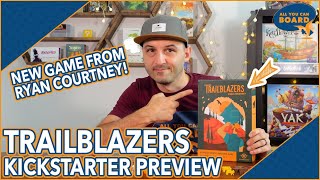







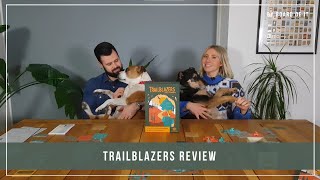







Trailblazers Deep Dive
What the Community Thinks About Trailblazers
Trailblazers, designed by Ryan Courtney and published by Bitewing Games, draws a consistently warm response from the channels that have put it on the table. Board Of It calls it "a wonderful distillation of root building and spatial puzzling" and treats it as the natural conclusion to Courtney's earlier pipe-laying games. Board Game Buzzz places it high on a countdown of favorite games, with one host naming it a favorite solo title and another praising the way covering old tiles lets a player adjust course mid-round. The Board Game Garden calls it "such a fantastic game" and points to a fantastic solo mode and the wide one to eight player range as the reasons it stayed on a want list, while Board Game Garden keeps coming back to the puzzle despite admitting to being bad at it, and calls the production fantastic.
Not every take is uncomplicated praise. Beyond Solitaire's Liz Davidson enjoys the pacing and presentation but comes away unconvinced that the puzzle rewards mastery the way Davidson wants it to, landing on a mixed verdict despite genuine appreciation for the design. No Pun Included frames the whole review around the gap between how cute the box looks and how unforgiving the actual puzzle is, joking that the cards will "destroy you" even as the review recommends the game. Where the channels diverge most is on player count: several enjoy the game most at two to four players and question why a title that plays up to eight would ever be chosen over a game built for a crowd.
Core Mechanics That Define Trailblazers
Drafting and Passing Trail Cards
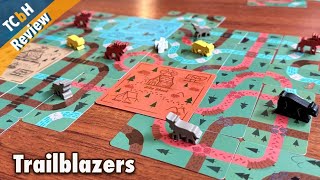
Each round begins with a hand of eight trail cards. Board Game Buzzz describes the flow plainly: players choose two of those cards, add them to their personal area, and pass the rest to a neighbor, repeating until the hand runs out. Beyond Solitaire walks through the same structure from the solo side, where unchosen cards are discarded rather than passed, and notes that cards must be placed orthogonally adjacent to what is already down, though overlapping is allowed. Board Of It adds that players are "completely free to overbuild," covering a card they regret with a new one rather than being stuck with a bad earlier placement.
Loop Scoring and Objectives
Trails only score once they loop all the way back to the matching campsite of the same trail type, whether hiking, biking, or kayaking. Beyond Solitaire explains that a beautifully built trail earns nothing if it never closes the loop back to its origin, and that scoring runs through the number of features, or trail markers, printed along a completed loop. Board Of It highlights the in-game and end-game goals layered on top of that, noting that claiming a goal earlier is worth more, which pushes players to weigh a safe, steady loop against a riskier one that might pay off first.
The Trailblazers Experience
A Tense, Ticking-Clock Puzzle
Board Of It describes the spatial puzzle at the center of Trailblazers as intense, and Beyond Solitaire agrees, describing a "brutal draft" where players never know what trail pieces will come up next and have to decide, card by card, what to prioritize. No Pun Included frames the same tension differently, joking that the cute art and simple rules give way to a game that "will destroy you" once the drafted hands start running thin and a loop that looked easy suddenly needs pieces that never show up.
A Reliable Solo Companion
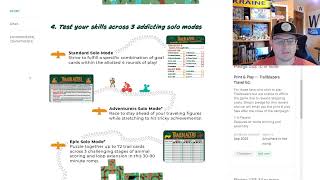
Solo play draws some of the most enthusiastic reactions across the channels. Beyond Solitaire walks through a tiered difficulty system, Tenderfoot, Voyager, and Blazer, where the solo player chases increasingly demanding in-game and end-game goals in the same four rounds multiplayer uses. Board Game Buzzz goes further, calling Trailblazers "my favorite solo player game" and describing pulling it out while waiting for game night to start or playing it repeatedly online. The Board Game Garden echoes that solo strength directly, citing the wide one to eight player range and a genuinely fun solo mode as the reason the game stayed on a want list.
What Makes Trailblazers Stand Out
A Well-Designed Animal Expansion
Several channels single out the animal expansion as more than a bolt-on add-on. Board Of It calls it "a natural fit" that pushes players toward playing a variety of trail shapes, since scoring rewards unique animals along one completed loop and each animal card can never be covered up once an animal token is placed there. No Pun Included walks through the scoring curve in detail, from a single animal being worth one point up to a full set being worth twenty-one, and calls the expansion a near must-have for how it sharpens the base game's decisions.
Built to Travel
The range of physical editions comes up again and again as a genuine strength. Beyond Solitaire likes the small clamshell travel edition specifically because it matches the length of a real play session, something to pull out of a backpack while waiting at a restaurant or killing a few minutes at a desk. Neon Gorilla brought the travel deluxe edition on an actual camping trip, praising the durable PVC cards and the carabiner clip built for a hiking pack, and calls it a game that will always stay in the collection even if it never actually gets clipped to a trail pack.
Potential Drawbacks
Simultaneous Play Undercuts High Player Counts
Board Of It raises the biggest complaint directly: even though the box supports up to eight players, the game plays almost entirely simultaneously, so there is little real interaction and no strong reason to actually field a full table. No Pun Included lands on the same conclusion from a different angle, arguing that at eight players it takes about as long as at a smaller count but questioning why anyone would pick Trailblazers over a game actually designed for a large group.
Drafting Can Feel Like Gambling
Beyond Solitaire's central criticism is that the drafting, not the placement puzzle, ends up deciding too many outcomes. Davidson describes the game as being "too much like gambling and not enough like puzzling," adding that there was never a feeling of cleverness when a loop worked out and never a sense of personal fault when one did not. No Pun Included raises a related worry about the animal expansion specifically, warning that passing along a card with an animal on it, or choosing to protect one, "can and will make you regret your decisions later" once the drafted hand moves on.
If You Enjoy Trailblazers
Board Of It and No Pun Included both point directly back to designer Ryan Courtney's earlier games, Pipeline and Curious Cargo, describing Trailblazers as the same route-building and pipe-laying puzzle stripped down to its purest form. No Pun Included specifically named Pipeline its game of the year for 2019 and frames Trailblazers as what remains once the extra mechanisms built on top of that piping system are removed. Beyond Solitaire draws a different comparison, naming Sprawlopolis as the most natural point of reference since both games hand players a hand of cards to lay out into a growing shape, though that review ultimately favors Sprawlopolis for making success feel more earned.
What Reviewers Are Saying
"If you really like spatial puzzles or you loved the pipe mania elements of Pipeline or Curious Cargo, then this is an easy recommendation. Trailblazers is a wonderful distillation of root building and spatial puzzling, all in a lovely package with great art and production."
— Board Of It
"This may really perfectly suit you and you may love it, but for me this felt too much like gambling and not enough like puzzling. I never felt clever enough when I did something right, and I never felt like it was my fault when I did something wrong."
— Liz Davidson, Beyond Solitaire
"We like Pipeline a lot, it was our game of the year for 2019. Both of those leveraged other mechanisms against pipes, whereas here it's just pure piping."
— No Pun Included