







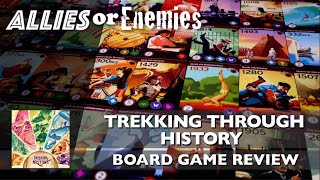
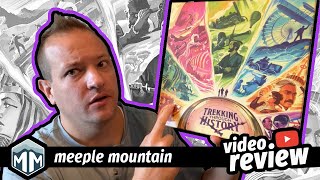









We designed Trekking through History for gamers and non-gamers to play together. The goal was to make a game inviting for non-gamers, but with a little subtlety under the hood for gamers.
In the game, you go on a three-day tour of human history, traveling thousands of years in a time machine to experience great moments from our past.
The game takes place over three rounds, each representing one day of your trip. Each day, you visit a series of historical events, spending a different number of hours at each.
On each turn, you choose to visit one historical event, and spend a certain number of hours doing it. Doing so will yield benefits, like checking off items on your itinerary for points, and earning Time Crystals so you can bend the space-time continuum on future turns.
Along the way, you’ll also score points for visiting historical events in chronological order.
The player with the most points after three rounds wins.
—description from the publisher
- Gorgeous production and approachable for families
- Good gateway game with a nice sense of urgency
- Swingy endgame with potential for big swings
- If you fall behind, catch-up can be difficult
- Array
- Historical chronology and timeline-building
- light, time-management driven with time and wild tokens
- Trekking Through Time
- Baron Park
- Patchwork
Mechanics (from transcript analysis)
- Pressure / pacing mechanic — Numbers of cards available and the swingy nature create urgency and shifting plans.
- set collection — Collect cards in chronological order to maximize points and time efficiency.
- Set collection / sequence building — Collect cards in chronological order to maximize points and time efficiency.
- Time token management — Tokens that affect how efficiently you can take turns and use wild tokens.
Video topics + discussion points
Quotes (from this video)
- This shelf had six games on it.
- This is staying in the collection until we finish our last two.
- I love New York Zoo. So, it\'s getting kept.
- Obsession stays. It\'s an evergreen in our collection.
- I think Trekking Through History is absolutely gorgeous, but it is time to say goodbye for us.
References (from this video)
- Educational content about a wide range of events
- Flavor text adds flavor without hindering gameplay
- History education with flavor text on cards
- Various historical events across different eras
- Event-driven narrative with flavor text
Mechanics (from transcript analysis)
Video topics + discussion points
Quotes (from this video)
- accidental learning games.
- these are games that are just awesome to play, but you can also learn some really cool stuff if you're into that.
- Trekking through history is my personal favorite
- I would love to know what games do you think fit into that category.
References (from this video)
- Gorgeous artwork by Eric Hibbler
- High-quality components including neoprene board and weighted pocket watches
- Educational touches on card backs
- Replayable and approachable as a gateway game
- Solid production and clever token economy
- Time warp cards may not reach the quality level of other components
- As a light game, might not hold heavier gamers' attention
- Occasional waiting times with larger player counts
- Time travel and exploration of historical moments
- Various historical periods across time
- Educational storytelling through historical vignettes and card backstories
- Ninja Turtles Last Game
Mechanics (from transcript analysis)
- Card selection from deck — Each round players choose from six cards (including the deck's top) to add to their trek, spending time to acquire them.
- Departure row and events — Advancing may force starting a new track if the event's time is earlier than the previous card.
- Educational back of cards — Backs of cards provide insights into historical figures or moments.
- Itinerary and track rows — Players build itineraries with rows that fill to earn points; cards placed in chronological order contribute to different tracks.
- Time crystals and cost reduction — Gaining time crystals allows players to decrease future time costs on cards.
- Time track — Players move along a shared time track; the furthest-behind player selects from available cards and advances time by paying the card's cost.
Video topics + discussion points
Quotes (from this video)
- This game is gorgeous.
- Eric Hibbler's art is absolutely stunning.
- This is a gateway game we can see this being a hit with new gamers or especially gamer families who want to expose their kids to some important moments in history and impart a bit of fun learning.
- This is still a light game and it may not be enough to keep the attention of those that trend toward the heavier end of the game spectrum.
References (from this video)
- gateway-friendly
- beautiful production and art
- accessible yet interesting for seasoned players
- potentially light for players seeking heavy Euro gameplay
- event names and themes may blur over time
- timeline construction and historical literacy
- historical periods across history
- educational, light-hearted
Mechanics (from transcript analysis)
- set collection — collect moments and people from history to build a sequence of timelines.
- timeline construction — assemble historical moments into a coherent timeline as the game progresses.
Video topics + discussion points
Quotes (from this video)
- it's such a good Gateway game
- the art on the cards looks fantastic
- it's one of those simple flip and write games that you just want to play again and again
- the lazy Susan is genius
- Planet Unknown just knocks our socks off
References (from this video)
- Beautiful production and components
- Engaging solo mode
- Satisfying time/pace management
- AI behavior can be unpredictable
- Rule complexity for first-time players
- History, chronology, exploration
- World history timeline across eras
- Educational puzzle
Mechanics (from transcript analysis)
- card drafting — Draft historical event cards to build a chronological Trek
- Compound Scoring — Place experiences into a chronological itinerary and score by duration and ordering
- time tokens — Spend time tokens to discount clock advancement during drafting
- timeline/itinerary scoring — Place experiences into a chronological itinerary and score by duration and ordering
Video topics + discussion points
Quotes (from this video)
- The look of this game is absolutely stunning
- I love the look of these green tokens
- it's very satisfying to place the chips onto your itinerary
- I am really excited to play this
- the components are absolutely fantastic
- I loved drawing in all of the rooms on this little like vellum sheet
- I did not do well at all in blueprints of Mad King Ludwig
- I ended up with a score of 226 which is not amazing
References (from this video)
- Easy to learn, approachable for families
- Limited depth for non-family players
- 4-player scaling can feel chaotic
- Historical progression and chronology
- Three-year historical track with events
- Light, instructional
Mechanics (from transcript analysis)
- Chronological ordering — Scoring depends on maintaining or achieving a proper timeline.
- set collection — Players collect event cards to assemble a chronological sequence.
- Time/value track — Cards have time values that influence scoring and timing.
Video topics + discussion points
Quotes (from this video)
- it's only a game
- New Zealand is definitely my factor
- I would give it a six out of ten
- Horse steak was surprisingly nice
References (from this video)
- artwork is great
- strong historical scope
- family-friendly and engaging
- can be complex for newcomers
- box size
- history, exploration, and cultural exchange
- historical world travel; time travel theme
- educational, adventure
Mechanics (from transcript analysis)
- card/experience-based scoring — Gain points by events/people visited with different itineraries
- Time crystals — Spend crystals to discount hours
- time travel with pocket watches — Each player has a pocket watch track of 12 hours
Video topics + discussion points
Quotes (from this video)
- our goal here at orpg voices is to make this world a better place one board gamer at a time
- Love yourself love the time that you put into your game and Trust that the people who have helped you and joined you on your journey also put something special into your game just by giving you time and feedback
- There is more than enough room for your game to exist even if you see something similar
- the art is really great
- Black history truly is American history
- our game is not just this skeleton that you've created
References (from this video)
- Easy to teach and learn, especially for two players
- Solid two-player experience with clear teaching moments on camera
- Prototype visuals are appealing and components feel solid
- High replayability through varied itineraries and evolving tracks
- Prototype readability issues (e.g., card titles and small text) that the designers plan to fix
- Some players may find the scoring and math-heavy late-game decisions dense
- Readability of certain numbers on the board can be hard from an angle
- Historical exploration, personal progress, and narrative weaving through itineraries and tracks.
- A three-day, time-travel tour through historical moments and people, presented as a museum tour with time-based events.
- Segmented moments across a timeline with ancestorial wild cards and evolving itineraries; the history becomes a personal trek.
- Feudum
Mechanics (from transcript analysis)
- Ancestors / wild tokens — Ancestor cards act as wilds for time, duplicating the time value they sit on; only a single wild is earned per ancestor, and they do not go on tracks.
- Deck management / itineraries — Decks are refreshed at the end of each day; players draw, place, and resolve cards in a structured, stepwise flow.
- deck manipulation — Decks are refreshed at the end of each day; players draw, place, and resolve cards in a structured, stepwise flow.
- Itineraries and rewards — Itineraries on the board determine where tokens and rewards go; filling slots yields points and resources.
- Time crystals — Crystals reduce the cost of an action but cannot reduce a single action to less than one hour; crystals are scarce and strategic to save for key moves.
- Time currency / hour-tracking — Players spend hours (on a clock track) to visit events, advance their trek, and trigger rewards.
- Time track — Players spend hours (on a clock track) to visit events, advance their trek, and trigger rewards.
- Tracks and scoring — Cards form one or more tracks; length and stacking determine end-of-game scoring, with longer, continuous tracks yielding more points.
Video topics + discussion points
Quotes (from this video)
- this is a prototype
- it's a prototype so it doesn't necessarily represent the final look of the game
- it's a pretty good looking prototype
- it's a fairly simple game
- i really like this as a two-player game
- it's easy to teach
- Replayability seems good; i would play this again
References (from this video)
- Engaging blend of history education and playful strategy.
- Large variety of historical figures and events create rich talking points.
- Time Warp and time-crystal mechanics introduce fun strategic depth.
- Group dynamism and banter elevate the entertainment value.
- Rules surface is complex; new players may need time to grok mechanics.
- Pacing can become hectic as players chase points across many categories.
- Some historical references may feel dense or dense for casual players.
- Historical exploration and education through playful competition and collaboration.
- Multiple historical eras explored through time travel as a social board game.
- Lighthearted, documentary-meets-game-show flavor with humorous anachronisms and banter.
- Timeline (in spirit) - historical event sequencing
- Other history-themed abstracts with time manipulation (implied)
Mechanics (from transcript analysis)
- Chronological trek / timeline ordering — Players move along a time dial, collecting experiences and artifacts, with bonuses for chronological accuracy.
- Event/innovation system — Certain actions grant event tokens or innovations that unlock bonuses or alter future choices.
- Events — Certain actions grant event tokens or innovations that unlock bonuses or alter future choices.
- Itinerary track and rewards — Cards and tracks yield points based on day-by-day itineraries and the sequence of discoveries.
- Resource management — Players spend Time Crystal tokens to reduce the hours needed for actions, shaping tempo and scoring opportunities.
- Time resource management — Players spend Time Crystal tokens to reduce the hours needed for actions, shaping tempo and scoring opportunities.
- Time track — Players move along a time dial, collecting experiences and artifacts, with bonuses for chronological accuracy.
- Time Warp cards — Special day-long effects that can modify costs and grant ongoing benefits for the day.
- Token-driven turn economy — Use of Human Experience, Innovation, Time Crystal, and Progress tokens to gain rewards and advance on boards.
Video topics + discussion points
Quotes (from this video)
- May the best tourist win
- Time Crystal can take off one hour from the required cost
- Crossing the Rubicon with Julius Caesar takes less time than just putting a handprint on the wall
- Time Warp cards add new challenges and opportunities for time tourists
- This game caused this game yes I love five that's my favorite kind of thing
References (from this video)
- Beautiful production with deluxe feel
- Strong, thematic progression through history
- Some players may find time tracking and timing aspects complex
Mechanics (from transcript analysis)
- chronological sequencing — Play cards in historical order to score, maintaining timeline integrity
- set collection / drafting — Draft cards representing historical events across ages
Video topics + discussion points
Quotes (from this video)
- top 10 chilled board games now for me
- it's such a relaxing game in my opinion
- the production really does help it because it's a lovely lavish Deluxe feeling game
- think Wordle but the Twist on this game
- cooperative game ... very relaxing
References (from this video)
- Accessible and intuitive
- Engaging tension to maintain chaining for scoring
- May become predictable or less exciting after several plays
- Historical progression through dated events
- Date-card driven set collection
- Casual yet strategic
- Patchwork
- Downforce
Mechanics (from transcript analysis)
- card drafting — Drafting event/date cards with scoring potential
- Chronological chains — Maintain contiguous dating chains for higher points
- Date-card drafting — Drafting event/date cards with scoring potential
Video topics + discussion points
Quotes (from this video)
- this is one of many games i'm talking about here that i did purchase at the uk games expo
- i think i can give it a 7 out of 10
- it's a very neat game
- it's multiplayer solitaire with a race aspect
- one of the all-time classics
- this is a very well-rounded game
References (from this video)
- Beautiful gift
- Really great game
- Super simple to play
- Theme wins people over
- Easy to introduce to new players
- Engrossing challenge
- Historical events and time travel
- Time travel through historical moments
- Timeline-based card drafting
Mechanics (from transcript analysis)
- card drafting — Players draft cards representing historical moments
- Itinerary Completion — Players work to complete their itinerary with specific historical figures
- Risk-reward — Balance between getting needed cards and maintaining chronological order
- Timeline Creation — Players build personal timelines by visiting history in chronological order
Video topics + discussion points
Quotes (from this video)
- It isn't Christmas without some board games.
- It's you that will be playing it with them.
- It's such a simple idea, but it just works.
- These are the Ferrari of board game accessories.
- We are a species of gamers.
- Board games are beautiful.
- If you want to buy a present for a board gamer, you can't buy them a game.
References (from this video)
- Lovely family-friendly design
- Accessible and lightly strategic
- Limited depth for heavy gamers
- Historical collection and objectives through time
- Family-friendly set-collection with yearly progression
- Casual, accessible family-weight pacing
Mechanics (from transcript analysis)
- set collection — Build a column of cars by year and complete objective cards
Video topics + discussion points
Quotes (from this video)
- "I am learning to love this game more and more as I become more familiar with it."
- "this game struck a really nice balance of making the cards important but not making it entirely card driven."
- "this is a pretty wild bidding game"
- "some really cool swings, some good kind of guer manipulation"
- "not a tug-of-war game... it's more of a traditional euro"
- "it's a really good one. very mass appeal and I'd highly recommend Push."
References (from this video)
- great educational value
- fast setup with good insert
- downtime between turns
- history education through cards
- Historical events timeline
Mechanics (from transcript analysis)
- card-driven — cards contain events with descriptions
- timeline drafting — build a historical timeline by choosing cards
Video topics + discussion points
Quotes (from this video)
- when we all do better we all will do better
- our goal is to make this world a better place one board gamer at a time
- the history and the education is in the game but it doesn't beat you over the head with it
References (from this video)
- Strong thematic alignment with mechanics
- Rewarding and challenging, yet accessible
- Nice components and educational angle
- Historical progression and chronology
- Historical eras traced through time
- educational yet accessible, family-friendly
- Skymines (discussed alongside as a contrasting heavy title)
Mechanics (from transcript analysis)
- card drafting — Draft cards to form chronological sequences and trigger scoring opportunities.
- set collection / chronology — Collect cards in temporal order to maximize points and align with player boards.
- variable player boards — Each player board has unique scoring opportunities and interactions.
Video topics + discussion points
Quotes (from this video)
- the rules are quick and easy to get through
- my daughter really likes birds
- the game uses the game trays making it a lot better easier to set up and take down
- one of the best components that I've ever seen
References (from this video)
- Promising concept captured during a live prototype session, suggesting engaging topic material for future content
- Energetic host dynamics and relatable banter that can attract casual board game audiences
- Clear intent to develop and publish additional content surrounding the prototype, indicating ongoing commitment
- Accessible tone that can bridge educational history themes with light competition
- Prototype status means rules, balance, components, and production details are not yet defined
- Lack of concrete publisher/designer attribution in the transcript limits pedigree and provenance
- Minimal explicit gameplay mechanics described, making it difficult to assess long-term replayability
- History education, curiosity, and friendly competition during a live prototype playtest.
- A historical exploration across multiple eras framed as a on-camera prototype session, inviting discussion and real-time interpretation of events as players move through eras.
- Casual, conversation-driven commentary with on-camera banter, behind-the-scenes notes, and iterative design feedback woven into gameplay.
Mechanics (from transcript analysis)
- Cooperative/competitive interaction — Players interact through dialogue and decisions with playful rivalry implied by phrases like crushing the opponent and competitive framing.
- Narrative framing during playtest — Comments indicate a narrative, observational style during prototype testing rather than a fixed storytelling mechanic.
- Unknown prototype mechanics — The transcript does not specify concrete mechanics or rules; the discussion centers on concept, playtesting, and future content rather than a formal mechanical description.
Video topics + discussion points
Quotes (from this video)
- trekking through history the way i've got my camera i'm not even sure you can see this correctly
- this game is rather interesting
- i quite enjoy it it's a prototype that we have that we'll be doing some content
- and i crushed him i crushed him it was close it was looking good
- for him in the beginning but i took it
- in the end but you did well
- paul knight do whatever you want when you're old
- it's not the same it's not the same