
Trickerion is a competitive Euro-style strategy game set in a fictional world inspired by the late 19th century urban life and culture, spiced with a pinch of supernatural.
Players take on the roles of rival stage illusionists, each with their own strengths and characteristics. They are striving for fortune and fame in a competition hosted by a legendary magician, looking for a successor worthy of the mighty Trickerion Stone, which is fabled to grant supernatural power to its owner.
Using worker placement and simultaneous action selection mechanisms, the Illusionists and their teams of helpers — the Engineer, the Assistant, the Manager, and a handful of Apprentices – obtain blueprints and components for increasingly complex magic tricks, expand the team and set up performances by visiting the Downtown, Dark Alley, Market Row and Theater locations on the main game board depicting a late 19th century cityscape.
The tricks are stored and prepared on the Magician's own Workshop game board, while the performances themselves take place at the Theater in the form of a tile placement mini-game with lots of player interaction. The performances yield Fame points and Coins to their owners based on the tricks they consist of. Fame points have multiple uses, but they also serve as a win condition - After turn 7, when the last Performance card is revealed, the game ends and the illusionist with the most Fame points wins.
The game offers 48 different Tricks to be learned from the Optical, Spiritual, Mechanical and Escape categories, over 90 character abilities, and 40 Special Assignment cards that influence the actions taken at the various game locations. The base game can be expanded with two optional rule modules to add further strategic depth to the game.
The "Dark Alley" expansion included in the base game adds a new location to the game. It also comes with 48 new Special Assignment cards, a new tier of Tricks, and 27 Prophecy tokens that can alter certain game rules turn by turn, giving the game additional variety.


Images


Mechanics (from transcript analysis)
Video topics + discussion points
Quotes (from this video)
- Basically, I think this is the third maybe fourth. I think it's the fourth time I've done a top 10 overrated games list, hence more. And I called it you have been warned.
- But actually, surprisingly, despite somebody sharing it on Facebook, which I was not happy about really, cuz I mean I I don't know. I I like my content being shared on Facebook and I do say do it, but that list is a dangerous one to put on Facebook because, you know, we do have this problem in the hobby of toxic positivity.
- No, shut off. It is really is not. I'm doing it because I enjoy it.
- There's certainly examples of this you see in real life and it's just gez, how closed is your bubble that you have to think that that argument still works?
- Do not be misled thinking that you look at this game and it's going to be a charming little farming game. It is everything but.
- This game isn't really a game about cultivating roses. This is a game about debt management.
- This game is multiplayer solitaire through and through.
- This is a solo puzzle.
- Hated this.
- The hobby has become very elitist and very clicky.
- Shame on you if you do it.
- If you are done with the table and you're not playing something next, then get off the freaking table and let someone else use it. Honestly, it is selfish and irresponsible.
- If you are the sort of people who leave your games on a table for hours on end just to hog the table and stop anybody else playing on it. And you essentially don't return to the table for hours on end. [...] If you're doing that to gaming tables, then shame on you.
- For a hobby that is meant to be about, oh, let's be inclusive and let's uh get new people in and stuff like that, it doesn't half do a pretty damn good job of excluding a lot and, you know, being very elitist.
- It's not a good feeling and it is something that is hurting, you know, conventions in general and I think that's the biggest reason that conventions sometimes don't work.
References (from this video)
- New magician powers offer cool abilities.
- Expansion improves the 2-player experience.
- Component upgrades like magician meeples are nice.
- The rip-strip on card decks makes them easier to open.
- Some card packaging is difficult to open without damage.
- The expansion might require playing with the Dark Alley side of the board, making the game even longer.
- Magicians competing for the love of a retiring magician, Dahlgaard.
Mechanics (from transcript analysis)
- Card Play — The expansion includes new decks of cards for magician powers and theatre actions.
- Player mat abilities — New cards are added to the player mats, providing additional abilities.
- Resource Management — The expansion introduces Trickerion shards as a currency to acquire magician powers.
- Set Collection — The concept of trick links is mentioned in relation to theatre cards.
- Track Advancement — Some powers allow players to advance on the Fame Track.
- Worker Placement — The reviewer mentions placing character tokens on a board during the 'Place Characters' phase.
Video topics + discussion points
Quotes (from this video)
- Dahlgaard is a creepy old magician in Trickerion, and the whole plot of Trickerion is that he's retiring, and you and your fellow magicians are competing to win his favour, and eventually get all the stuff that he has, um, when he... croaks?
- When you - ahhh! - you go to unlock a little Ziploc® baggie and you tear it?
- The reviewer mentions, 'it's a really long game, like that's not a light game at all.'
- So that almost dissuades you from going to the Dark Alley.
- If I know Trickerion at all, I know the designers tend towards complexity, so I would bet dollars to donuts that you go through these during a 2-player Duel of Magicians game, and the blocked-off spots are constantly changing.
References (from this video)
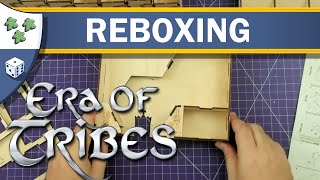
- Thrilled to open up game trays and fit everything so snugly and neatly inside them.
Mechanics (from transcript analysis)
Video topics + discussion points
Quotes (from this video)
- This is not the video for you if that's the case, because i myself know nothing about this game at the moment, but i've been commissioned to make a how to play video.
- And this game - i'm not gonna lie - this game's kind of terrifying me right now, because it seems very very heavy, and the rulebook is incredibly involved.
- Whoo doggie! i hope you like cardboard tokens! There's certainly enough of them in this game.
- It's a perfect fit! It's like me trying to get into a pair of blue jeans!
- Well there it is: a complete reboxing of Era of Tribes, with the extra player expansions and the modular board and that balsa (pine wood?) ...that wood insert by Laserox, who i believe is a gigantic ox who cuts all these things out with his LASER VISION!!
References (from this video)
- Wicked, cool, and loved by the host
- High production values, especially the collector's edition
- Can have 'too much going on' for some players
- Magic and illusion
Mechanics (from transcript analysis)
- Worker Placement — Implied by the comparison to Anachrony where players 'pledge with their location cards to send workers to different locations.'
Video topics + discussion points
Quotes (from this video)
- mind clash is all about making their games just over just overboard with production values and just making them cool cool cool
- the art is neat it's original um like i say it's hard a lot of these games you look at it and you're like oh well that's that's back to the future you look at this you're like oh that's star trek but this one it's hard hard to put a finger on it isn't it
- if you know trickerion you know what's what's happening and then they did something really really smart and really really sneaky
- the components are amazing i like them i really like the feel them
- my first live stream thank you for joining me
- i'm a storage nerd
- this is a kickstarter product if you couldn't tell
- it's a loan but it's a fun loan
- the future is a scary place folks
- whoa what happens when you need to burp or fart on a live stream do you know
- Look at this thing this is crazy
- Mineclash is all about making their games just overboard with production values and just making them cool cool cool
- The vision, the artistic vision, is so weird, it's so funky and out there
- If you're a geek and I know you probably are this game is for you
- These are the coolest things, and they'll look better once I get them out of the bag
- I was so disappointed when I bought it... and then I played it and it's wicked, I loved it, it's so cool.
- It's like kitchen sink game design and people have faulted it for that.
- Perseverance is like Lost meets Jurassic Park
- It seemed like a really unique concept to me but weird, is that weird?
- and they said this will never be available at retail and then they released a version of it at retail I was like damn you
- they said we will we're not going to do gollum versions of these other games and then they released them
- Spacious and component-heavy
- The host notes that Nemesis requires more space than the Anachrony Infinity Box, and mentions a friend's extensive collection of 'Too Many Bones' components.
- Expansive and modular
- The game consists of a base game and numerous expansions, allowing players to customize their experience.
- Audacious (Collector's Edition)
- Social Deduction
- The host compares it to 'werewolf' and questions if it includes a literal clock tower.
References (from this video)

Mechanics (from transcript analysis)
Video topics + discussion points
Quotes (from this video)
- it's Dominoes Ah
- based on reviewing the Wikipedia for dominoes um that doesn't that seem that year seems wrong. That seems way late.
- but anything that is like a Domino's game we would recognize doesn't occur until the very end of the 18th or beginning of the 19th century.
- and tomorrow night at 7:00 p.m., we're finishing up with Antiquity, which is pictured behind Ken's head over there.
- Of our 402 games, only 13 are published before 1990.
- So you got Spirit Island, you got Lizboa, you got Quest for Elorado, and 22 other games that are on one person's list.
- 2019, PAX Premiere, Crystal Palace, and 24 other games.
- 2015, Gallerist, Trickarion, Food Chain Magnate, 16 other games.
- Brass, Birmingham, Obsession, Root.
- John Company, sure. Weather Machine, Carnegi, 19 other games from 2022.
- Age of steam. Age of steam, right? Yeah. Yeah. Obviously, right. Yeah.
- Like trying to narrow it down is a hard thing when you when you have maybe the newer you are, the less hard that is.
- there's going to be another one tomorrow where we go through tutorial number four of Atlantic Chase.
- I might have a latest greatest version of Crossrox. I'm so excited about this game after hearing you guys talk about it.
- Every game that you guys play, you're playing. It's oath.
References (from this video)
- The expansion adds opportunities and changes up the game.
- The game is described as having 'delicious' choices when the expansion is added.
- The game has strategic depth with decisions about where to place workers and how to manage resources.
- The game can be 'heavy' and requires thinking ahead, especially in later rounds.
- There's a lot to do and opportunities can be missed if not managed well.
- rival magicians putting on illusions in a theater for money and fame after the old master retired.
Mechanics (from transcript analysis)
- Action Point Allowance — Players spend action points to purchase materials, order new materials, prep tricks, and perform actions at various locations.
- Hand Management — Players select cards to assign to their pieces.
- Set Collection — Players set up tricks by placing tiles on performance cards, aiming to make matches with other tiles from the same school of magic.
- Tableau Building — Players acquire tricks and place them on their workshop board.
- Worker Placement — Players assign cards secretly to their pieces, which determine the locations those pieces will visit. Then, in turn order, players use one of their pieces at the assigned location.
Video topics + discussion points
Quotes (from this video)
- We are men of science and we are now real magic with this archinist who's bringing some real enchantments and stuff to blend science and magic once and for all.
- Players hope to manage their resources, learn higher level tricks, and perform as much as possible in either of their own shows or shows performed by opponents.
- Players will blend science and real magic as they strive to be even more famous and legends like the magic practitioners of old.
- The decision because one thing like when you kind of get into it the actions are not super complicated but like how you have to work them gets well you know and bonkers pants and thinking for the future you know.
- This is technically like the advanced game. Play with the dark alley.
- I was like, 'Oh, I should have done this instead. Yeah, to prepare the trick.'
- We're being mean today, y'all.
- It feels ugly. It feels mean. Feels mean.
- You think I can afford it, man?
- It's tough, man. This is a tough I'm not sure what tough, dude.
- So, it's like, 'Oh my gosh, there's only so many turns.'
- We don't want to mess around and become like a sorcerer of the dark magic. So, like just like we're we're just going to just tip our toes into the water, the pool of the arcaneness of the universe, man.
References (from this video)
- Heavy game.
- Brain crunching in the second half.
Mechanics (from transcript analysis)
- Decision making — The weight of decisions increases significantly in the latter half of the game.
Video topics + discussion points
Quotes (from this video)
- So, we're going for maximum psychological damage.
- Um, so to start, I got to do it. I got to start big. I got to start big.
- So, we're go with Deal with the Devil, a big chunky Euro game that is tough to play even for experienced gamers.
- I'm going to then crack open the rule book for the first time, sit there and read the rules in front of them, and then try my best to then explain the game, which will require several more references to that rule book. And I think that will really add to the uh torture factor.
- And now we have sand timers and you have to be quick and you have to yell and stuff and I think that will be such a wild shift in the other direction.
- We're going to play this game to completion. You cannot end the game once you start the game until the game ends.
- It's the same thing like the entire box. The entirety of Oath Sword at the end of the night. Huge campaign game. Really complicated. Tough to learn. Tough to play. Great game.
- So, down in the comments, let us know who had the best worst game day for new gamers.
- We want more board gamers, not less. So, don't do this to anybody, but have a thought about what you would if you did do it to somebody you didn't like.
- Hamlet. Um, Mike does not like this game. Hate to say it. Hate to say it. It's not a good game.
References (from this video)
- Innovative trick-taking mechanics
- Strategic risk management
- Thematic integration of 'Icarus' concept
- Magicians / Illusions
Mechanics (from transcript analysis)
- dual-sided cards — Cards have a 'daytime' and 'nighttime' side that can change, altering card values, suits, and trick winners.
- Push Your Luck — Players must decide when to win tricks and advance on the track versus when to hold back to avoid the penalty.
- Track Advancement — Winning tricks moves players up a track, but reaching the end triggers a penalty.
- Trick-Taking — A must-follow suit trick-taking game.
Video topics + discussion points
Quotes (from this video)
- If you are interested in new board games that are coming to stores, to friendly local game stores, and other places right now, and you don't have to wait like 18 months to get the game, then this is the video for you.
- I always try to include about 25 different games in this video, and I want there to be something for everybody, right?
- So, if you are looking for like an introduction to worker placement, uh I think this is a good one for that.
- So, yeah. And I love penguins. Love penguins.
- This is intentionally a weird game. Uh it's leaning into It's weird.
- This is a game that combines dice and deduction in a pirate theme.
- This is another one I couldn't really find a lot of information on, so I don't know exactly how it plays.
- So, yeah. And I hope you found something that you like.
References (from this video)
Mechanics (from transcript analysis)
- heavy euro with prophecies — long, complex planning; teaching to new players; reference to the 'prophecies' variant.
Video topics + discussion points
Quotes (from this video)
- It's not really a game, but a chat tonight.
- It's an extended family reunion.
- Don't be a douche canoe.
- Gathering of Friends is not a convention. It's a gathering.
- There is nothing in existence that is like this game.
References (from this video)
- On the way up in rankings.
Mechanics (from transcript analysis)
Video topics + discussion points
Quotes (from this video)
- If I wanted to play the same game but be really stressed, Silver Frost would be my go-to.
- I argue I'd almost argue that it's the best artwork of any of the Everdale games.
- Whereas normal Everdale, you can kind of chill and just be like, 'Yeah, let's build these fun things and look at my little critters.'
- the landlord's game was the basic blueprint for Monopoly.
- and arguably the best game ever made. So really what we've ranked is completely wrong.
- that is quite dull. Let's say you're rolling. The only so I feel like the boring bit about it is that you're just rolling dice and you land where the dice tells you.
- Monopoly Legacy.
- The board state changes. Buildings go into disrepair and crumble around you.
- There are elections. Hire one of you becomes a mayor of the city. You can control other people's turns and what properties they're going to buy.
- How do you improve Cludo Legacy?
- Well, just dying over and over again.
References (from this video)
- Thematic setting is a dark, vaguely steampunky Victorian era.
- The game has layers of complexity, with an 'expansion' inside the box for different difficulty levels.
- Specialists provide unique abilities and actions.
- The core mechanic of preparing and staging tricks for performance is engaging.
- Player interaction is high, with opportunities to hinder opponents.
- The expansion adds significant new content and complexity.
- Confusing terminology and counterintuitive rules.
- Overwhelming setup with many decisions before understanding the game.
- Components are not spent when prepping tricks, which is counterintuitive.
- The expansion adds even more complexity to an already hairy game.
- Rival magicians proving themselves to a retiring famous magician to inherit his possessions, including a supernatural stone.
- A dark, vaguely steampunky vision of the Victorian era.
- The Prestige
Mechanics (from transcript analysis)
- Action Point Allowance — Character disks have numbers representing Action Points, determining how much a player can do at a location. More Action Points allow for more actions.
- Area Control — Placing characters in the Theatre locks down specific days, preventing other players from placing characters on those days.
- Dice Rolling — Dice are rolled at the beginning of each week and influence available actions, such as learning tricks or withdrawing money. Players can reroll dice or force them to show specific faces.
- Engine Building — Players prepare tricks, which can then be performed for Fame points and coins, building an engine for scoring.
- Hand Management — Players receive an identical hand of 9 Assignment cards, which are used to pre-program character placement.
- Set Collection — Players need to collect specific components to prepare tricks.
- Simultaneous action selection — Players assign Assignment cards face-down beneath their Character Disks simultaneously and secretly before revealing them.
- Variable player powers — Each magician character prefers a specific category of illusion, and specialists offer unique abilities and actions.
- Worker Placement — Described as a worker placement game at its heart, where players place character disks (workers) in different locations to perform actions.
Video topics + discussion points
Quotes (from this video)
- This is the video that I wish I had when I was learning how to play Trickerion.
- In Trickerion, you and your friends play rival magicians in a sort of dark, vaguely steampunky vision of the Victorian era that may remind you of the 2006 Christopher Nolan movie The Prestige, except that it sort of makes sense.
- This is one of those games that has an "expansion" inside the box, which is kind of the developers' way of saying "ehh... this game got a little too hairy."
- Okay. Here we go: this is possibly the biggest rule gremlin in the game: when you prep a trick, you do not spend your components.
- The Dark Alley pumps the game up to 7 weeks instead of 5.
References (from this video)
- The premise of rival magicians competing for Fame points is interesting.
- Rival magicians competing to inherit the legacy of a retiring famous magician, Dahlgaard.
- A dark, vaguely steampunky vision of the Victorian era
Mechanics (from transcript analysis)
- Worker Placement — Trickerion is described as a worker placement game.
Video topics + discussion points
Quotes (from this video)
- It's Ryan from Nights Around a Table, and this is Trickerion: Legends of Illusion, a worker placement game for 2-4 players.
- Well, does it sound interesting?
- If you want to learn more about the rules of the game, click the link at the end of this video or in the description below to watch my complete How to Play video, which includes the overview segment you just watched.
References (from this video)
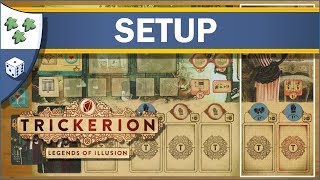
- Magic illusions
Mechanics (from transcript analysis)
- Card Drafting — Players choose magician cards, then starting trick cards and specialist co-workers.
- Set Collection — Components for practicing tricks and trick/symbol markers are collected.
- Worker Placement — Cylinders representing characters are placed on turn order spots.
Video topics + discussion points
Quotes (from this video)
- Here's how you set up Trickerion: Legends of Illusion.
- And now, we dance!
References (from this video)
- Includes mechanics that allow for shady dealings and backstabbing.
- Competing magicians
Mechanics (from transcript analysis)
- Take That — Allows players to 'hose' rival magicians.
Video topics + discussion points
Quotes (from this video)
- 5 Things i Love About Board games.
- It's the reason why i don't play games like Dominion as much as i might, because i just don't like the card shuffling.
- i like that kind of thing! i recently played a game called Caravan which has, as part of the game, thief tokens, and you can use those tokens to steal goods from other people's camels, and two of the players - it was a four player game - two of the players got really mad that i was use - i DARED to use these thief tokens that are part of the game because thieving is not nice!
- pay attentio, board game publishers - when i turn a box over and i see die-cut bits that fit together, i think "i need to get that game!"
- i find that board games - playing board games - is one pastime that exercises my brain in a delightful way that feels really good.
- The #1 Thing That i Love About Board Games... is when they light up my brain like a Christmas tree!
References (from this video)

- Fantastic game with a high BGG rating.
- Thematically rich progression of tricks.
- Beautiful collector's edition components.
- Engaging mechanics and strategic depth.
- The solo mode provides a challenging and thematic opponent.
- Can be heavy and rarely makes it to the table due to complexity.
- Information overload, especially with expansions like 'Duel of Magicians'.
- The 'magician powers' cards are complex and require significant text interpretation.
- The solo mode rulebook is very dense and difficult to internalize.
- The theater phase is the hardest part of the game to 'grok'.
- Magicians performing tricks, blending magic and supernatural elements
- A city full of people who like magic
- As the game progresses, the tricks become more serious, supernatural, and spooky.
- Voidfall
- Cerebria
- Perseverance
- Anachrony
- Caverna
- Terraforming Mars Collector's Edition
- The Seventh Continent
- Agricola
- Explorers
- Goonies
- Ghostbusters: Afterlife
- Patchwork Christmas Edition
Mechanics (from transcript analysis)
- action programming — Players pre-program their actions, similar to controlling a robot.
- Area Control — The academy has different rooms that become available as the game progresses, influencing available actions.
- Drafting — Players can draft cards from different decks, such as magician powers or dark alley cards.
- Hand Management — Players manage cards that represent sending workers to different areas, with bonus effects.
- Resource Management — Players manage money, shards, and components to perform actions and tricks.
- Set Collection — Players collect components needed for magic tricks.
- Worker Placement — Players use worker disks with different numbers of action points to take actions on the main board or their home board.
Video topics + discussion points
Quotes (from this video)
- This ain't going to be that stream today. This is going to be a riding the rulebook hard stream.
- Mine clash I think is one of these clever publishers who sees value and nights around the table.
- The collector's edition, I think, was the third Trikarian related Kickstarter and what that did was it put it in this gorgeous gorgeous box.
- It's a game changer right here if you've ever played this game you usually have to like stack all this nonsense and it sucks and like setting it up and tearing it down is total balls.
- I'd be happy if I didn't play the magician powers cards again because it's just it's it's a lot.
- The theater is the hardest to grok.
- I think I might have accidentally put my cards in this stack because it looks suspiciously taller than the rest of them.
- Sticky-tack Ryan pretty pretty please.
- My magician's power is that one of my hands gets an extra action point when I place it.
- The air always advertises and always and never pays money for it and always gets always gets the fame for it.
- The bad guy always advertises and always and never pays money for it and always gets always gets the fame for it.
- When the bad guy goes to the workshop nothing happens.
- I think I might have screwed up that initial thing.
- The decision space starts like this right like every turn in a four player game takes an hour.
- My people are all tired and I have to pay them.
- I've lost the plot what am I doing.
- My machine flips over because it's powered up fully.
- My poor family is upset with me.
- I don't think it's a bad gambit.
- It's like a lego model in order to get my camera attached to it.
- My camera will just start swinging like a like a pendulum.
- My patrons only secret.
- My magician's power is that one of my hands gets an extra action point.
- My math mind can't figure out which is better of these three.
- My my my my my.
- My word that was a close one.
- My dad's a nerd.
- My good friend who good friend I had a friend she wasn't a good friend but she wasn't a close friend.
- My favorite pizza is pineapple green olives and Italian sausage.
- My favorite gift you know what it is is that the one with the guy in the rubber with no no.
- My mouth hurts it hurts so bad I've been sitting for eight hours straight.
- My bad.
- My old eyes.
- My eyes are bad.
- My own eyes.
- My own eyes
- I might have met my match this time.
- It's a weedsy bit on the heavy side.
- People who have never played the game... they rate it really high because I spent 300 on it.
- The tricks get more and more serious and supernatural and spooky as the game goes on.
- This is going to be a riding the rulebook hard stream.
- The rulebook for the solo mode of Tricarion... it is 14 pages long.
- Mine clash likes me hopefully maybe if they're interested in seeing voidfall get covered on the channel they'll later on send me a review copy.
- Mine clash doesn't wall stuff off or they just parcel it, cost more later.
- The collector's edition is hard to find, selling used for 250, is it worth it?
- Most of the game is pretty easy, the theater is the hardest to grok.
- The game is about magicians running around in a city full of like people really like magic.
- The game is going to be really hard to clean up.
References (from this video)
- Appeals to players who enjoy complex, finicky games
- Very high complexity and finicky component management
- Extremely long playtime, especially when played digitally
- Victorian-era magic performances
- The Crew
Mechanics (from transcript analysis)
- action selection — Players choose actions from a variety of options.
- Engine Building — Players develop capabilities over time.
- Worker Placement — Players place workers to perform actions.
Video topics + discussion points
Quotes (from this video)
- it's not meant to be an entertaining experience whatsoever
- i have like a memory like a sieve
- it's the kind of game where you're bouncing around like duh i gotta do this and i gotta flip that and i gotta roll that die but i gotta do this at the same time it's one of those where you're bouncing all over the place certain brains thrive on that kind of chaos
- if you thought paint drying was exciting wait till you see board game photography
- this is tough man it's hard tough to film not tough to do
- my recent paid job i had by the way i'm wearing i'm wearing pants right now i don't know why i mentioned that right because i'm talking about being employed by other people where you have to wear pants
- I don't know if this looks nice no it looks about as nice as it's gonna look because it's prototype
- you think for a guy trying to lose weight gee sure is drinking a lot of dr pepper
- it's not rocket surgery
References (from this video)

- It's a great game.
- It's really cool.
- It's got weird little rules.
- It does things in a way that maybe you don't expect.
- The way components are handled is counterintuitive.
- It's odd.
- You need a spare eight hours to get through it.
- Illusionists and stage magic
Mechanics (from transcript analysis)
- Marketplace — Discussed how items in the market are representations and not directly taken, with purchases involving tokens taken from a supply next to the board.
- Resource Management — Resources on player boards are kept and not spent on tricks, representing an abstract concept of availability rather than consumption.
Video topics + discussion points
Quotes (from this video)
- It's a great game, but it does things in a way that maybe you don't expect.
- If that's how you were playing, and you were grabbing stuff from the market, grabbing those tokens that were on display, I hate to break it to you. You're playing Trickerion all wrong.
- I mean, you got to have a spare eight hours to get through it, but, I think it's really cool.
References (from this video)

Mechanics (from transcript analysis)
Video topics + discussion points
Quotes (from this video)
- magicians attempting to earn the most fame by learning tricks and then performing them with other players on common play bills
- the retail version of trickery and also comes with an expansion module the dark alley which expands the game introducing more elements and extending the game to seven rounds instead of five
- this is maple university's how to play the carrion intra carrion
- preparing a trick which essentially means making a hat with a rabbit in it means placing one of these tokens onto this card
- other players will be placing their tricks onto the same playbills making it a common play bill
- once a magician comes along and performs this play bill all of the tricks from all players on that play bill will be performed and the magician will earn the benefits for that trick as well as the performer earning some additional benefits
- the assignment phase and place character phase are the main worker placement steps and this will occupy most of the game
- for each action point that a player spends bargaining at the market bro the total cost of a purchase is reduced by one coin
- there are two prerequisites that that trick must meet firstly there must be no current preparation markers on that trick and secondly the player must have in his or her possession the components necessary to prepare the trick
- the major feature of the dark alley expansion is the prophecies
- if you manage these endgame objectives right you should be able to get somewhere between 7 to 12 points out of an average objective although some of them can be worth more
References (from this video)
- The game has aged very well over 10 years.
- The mechanics are thematic and interconnected.
- The theme of stage magicians is unique and engaging.
- The collector's edition has excellent storage.
- The magician's workbook expansion is a great aid for new players.
- The Dark Alley expansion is highly recommended and feels integral.
- The game is solid, clean, and thematic.
- The iconography for resources can be a bit weird (stacked instead of numerical).
- The play bill system and performing on different days can be slightly confusing or disconnect.
- The Arcane Arts expansion is fine but not essential, and the reviewer is unlikely to use it often.
- The reviewer can't explain why Thursday performance modifiers carry over to other players' turns on different days.
- Stage magicians acquiring items and practicing tricks to perform them for fame.
- Anacrony
- Valarda
- Voidfall
- Castles of Burgundy
Mechanics (from transcript analysis)
- Programming — Players program their magician, assistant, and specialist by placing cards face down, which determines where they go when revealed.
- Resource Management — Players acquire and manage resources needed for performing tricks, with some abilities allowing resources to count as more than their face value.
- Set Collection — Players acquire resources (wood, metal, locks) to perform tricks, which have specific material requirements.
- Tableau Building — Players assign tokens to their tricks on a play bill, and the spatial arrangement of these tokens can provide benefits.
- Variable player powers — Players choose a school of magic and can gain specialized abilities through different magicians and assistants.
- Worker Placement — Workers have action points to spend at locations, with bonuses for going to the first spot.
Video topics + discussion points
Quotes (from this video)
- Maybe just because I don't have it hit the table all that much, but it's still a nine and it's phenomenal.
References (from this video)
- Beautiful, thematic art and components
- Deep, heavy puzzle with meaningful strategic decisions
- Flexible options from expansions (Arcane Arts and Academy)
- Rulebook dense and intimidating
- Expansions can dilute core game flow and increase downtime
- Balance and learning curve can be challenging for new players
- Array
- Theatre illusion world
- Narrative conveyed through play and mechanics
- Dawn of Technology
- Magician's Powers
Mechanics (from transcript analysis)
- Deck Manipulation — Enchantments substitute for components when preparing tricks and provide ongoing bonuses
- Deck/enchantment interaction — Enchantments substitute for components when preparing tricks and provide ongoing bonuses
- Enchantment resource management — Charged shards and arcane shards change how actions yield points or points per turn
- End Game Bonuses — Endgame scoring includes flags from renovated rooms and majorities on practice rooms/classrooms
- Endgame area majority via renovations — Endgame scoring includes flags from renovated rooms and majorities on practice rooms/classrooms
- Trick-Taking — Acquire and renovate tricks, teach or retire them, and place enchantments to modify cost and rewards
- Trick/Trick preparation management — Acquire and renovate tricks, teach or retire them, and place enchantments to modify cost and rewards
- Worker Placement — Program workers, send them to locations to perform actions and gain resources/points
Video topics + discussion points
Quotes (from this video)
- The goal of the game is victory points.
- This is an action programming worker placement game where all the players are going to program their workers, then they're going to send them out to do things.
- Arcane Arts is a traveling wagon... move anticlockwise between locations.
- This is two different games.
- This is heavy puzzle, not for casual players.
- Don't play with the dark alley.
References (from this video)
- Real magic integration via Arcane Arts expansion
- Faster access to higher level tricks
- New followers and workers increase strategic depth
- Dynamic arcane wagon mechanic improves pacing and planning
- Two-player linking remains weaker without Dogren's Gifts expansion
- Arcane expansion can lengthen games when combined with Dark Alley
- Balancing may hinge on expansion content and player count
- theatrical illusion, backstage magic, competition among rival magicians
- Victorian-era city theater and magical performances
- thematic, meta-theatrical
- Trickerion (base game)
- Dogren's Gifts (expansion)
- Academy (expansion)
Mechanics (from transcript analysis)
- arcane_wagon_and_location_timing — An arcane wagon moves around the board and determines where you can buy enchanted materials or hire helpers in a given round.
- backstage_rewards_and_followers — Special orders, followers, and backstage rewards grant bonuses that intensify the competition and enable more powerful performances.
- dice_based_show_effects — Show outcomes and prophecies are influenced by dice rolls, with possibilities to modify results through arcane cards and back-end decisions.
- resource_and_trick_creation — Materials like cloth, lumber, metal, etc. are gathered and spent to prepare tricks, with prerequisites and sequencing affecting efficiency.
- Worker Placement — Players allocate workers to various locations to gather resources, hire help, and stage shows. Energy costs drive action choices.
- worker_placement — Players allocate workers to various locations to gather resources, hire help, and stage shows. Energy costs drive action choices.
Video topics + discussion points
Quotes (from this video)
- Arcane Arts expansion brings real magic now.
- The arcane wagon is real magic.
- This speeds the game up and gets you into the heavier stuff faster.
- Two-player linking in Trickerion is weak without Dogren's Gifts expansion.
- I would rate this as one of the most important influential games of the last decade.
References (from this video)
Mechanics (from transcript analysis)
Video topics + discussion points
Quotes (from this video)
- the first time where I thought of the whole idea of form over function where you could not figure out how to play because they just wanted to look so pretty that they didn't actually put on the board how to play.
- It's you move you you you turn over a piece, something shows up in the grid, you move over. There's multiple game plays. It's just such a satisfying, entertaining game.
References (from this video)
- deep, exploratory
- varied strategies
- long playtime
- heavy rules to learn
- illusion and showmanship
- magicians performing shows
- thematic, orchestral
Mechanics (from transcript analysis)
- Action Drafting — Players schedule actions to run shows and improve their acts.
- worker/action selection — Players schedule actions to run shows and improve their acts.
Video topics + discussion points
Quotes (from this video)
- the Mind by itself is a fantastic game it's so the concept is so cool
- it's a filler it only takes a couple minutes to play
- I Lov when we're playing this at a big party
- the artwork is so cool with all these cats just having a party
- it's extremely challenging to do well
- oh my God I fell in love with this game
- it's nonsense it's yeah it's a great
References (from this video)

- rich action selection and worker placement tension
- highly thematic and involved
- very long and mentally taxing
- magician performance and tricks
- magical theater and illusion economy
- heavy thematic engine/worker interaction
Mechanics (from transcript analysis)
- Secret action selection — simultaneous reveal of worker placements to form the action plan
- trick construction / engine-building — hunt for tricks and hire assistants to perform acts
- trick-building / engine-building — learn tricks and hire assistants to perform acts
- worker placement / action placement — secretly assign workers to board locations, then reveal
Video topics + discussion points
Quotes (from this video)
- it's like a TV show, you're going from one episode to the next
- this is my number one game of all time
- it's a true point salad game
- money equals points
- the life cycle of everything
- the auction phase and the multiplayer solitaire space