/pic7197652.jpg)
Trolls are not big and stupid, as many would have you believe. Not long ago they lived among us and they used their cunning magic to look like us humans.
They lived with their cattle in the mountains. Their caves were beautiful and luxurious with a lot of silver, gold, gems, and a table full of delicious food. In Sweden, there is an expression for this “Rich as a troll”.
Trolls were not evil if you didn’t treat them badly, they could even be helpful to those who treated them well. But they often played tricks on humans. Their magic power (trollkraft) could distort the vision of humans so the troll looked like a human, an animal, a log, and a stone and even become invisible. But they also had some weaknesses. They couldn’t stand the sounds of church bells or steel, not to mention the sight of sun.
Trolls & Princesses is a “worker movement” game. You play as one of four troll clans and to get the mountains king’s favour, you try to impress him. The players get favour (in the form of victory points) when they do what trolls usually do: swap changelings, “hire” humans, tear down church bells, kidnap princesses, build their cave, and use troll magic. To succeed, the players must collect resources and move around their trolls to do different actions. The player with the most victory points at the end can crown himself the ultimate troll clan leader.
—description from publisher


Trolls & Princesses - Learn While Playing!

Mechanics (from transcript analysis)
Video topics + discussion points
Quotes (from this video)
- it's just a really exciting experience to pitch these games
- Jessica did all of the graphic design
- I believe in these games
- I don't think I'm ever going to make money off of these maybe I will who knows
- Spiel felt like Disneyland for five days
References (from this video)

- Clever worker movement
- Quickly graspable strategy
- Nice production value (deluxe edition)
- Interesting theme
- Took two years to get to the table
- Company went belly up
- Mismatched punch boards in the box required replacement tiles
- Wacky and weird troll cave building
- Nordic regions
- Treasure Mountain
Mechanics (from transcript analysis)
- action selection — Trying to plan out each turn to have the right number of workers to do all the cool things that you can do, but you're always moving workers and there aren't enough workers to have everything always powered up.
- Tableau Building — You're building out your cave system, making new rooms, which reminds me a lot of one of our favorites, Treasure Mountain, as you're just kind of building off into the side.
- worker movement — It's a worker movement game because you put all your workers, they're out there and they can be on your personal board that has a couple different caves that do different things or you can send them into the town.
Video topics + discussion points
Quotes (from this video)
- Try new things. That's my wisdom.
- Be conscious of that in gaming and in life.
- I I need I need those whiskey barrels. That's that's a need.
- There's a little bit of take that in the sense that other players get to move these guys.
- It's one of those weird dry games that's just very satisfying.
- Each clan has some kind of benefit that you're going to get. And you have to lean into whatever it is that your clan can do.
- It's just that's that's tongue and cheek. But no, I don't I don't really have complaints about this game.
References (from this video)
- Thoroughly enjoyed
- Fun modular board building
- Engaging player interaction
- Charming components and theme
- Out of print, hard to acquire
- Trolls and princesses, building caves
- Scandinavia
Mechanics (from transcript analysis)
- Action Drafting — Choosing from three cards each turn.
- Area Majority — The more trolls you have in an area, the stronger the ability.
- Modular Board — Building out your cave by adding rooms.
- Worker Placement — Sending trolls to different locations.
Video topics + discussion points
Quotes (from this video)
- That game makes me happy every single time.
- I enjoy what's going on because the little stories and the stories are just my kind of kind of weird and whimsical and silly.
- I have a lot of joy teaching that game and so it was the most joyful to say, listen, I love these newspapers and we put the um my favorite critic is the Chimera because it brings two critics.
- It's definitely a top five game for me. I will never not play it.
- I want to say that if Mark Dainty, Luke Lori, and Will Brown had not had not gone through this procedure to bring recall to a table, there is no way I would have picked this game up.
- Kudos to whoever like the rule book is 16 pages.
- This game blew me away.
- I mean just smashed it and it was like two days before the con and I was like well here we go. And I loved it.
- It's just a joy. It's always a joy to get to the table and playing with the new expansion content was a lot of fun.
- The amazing thing that happens with games is how much they grow over time and how much fun I had playing on TTS. That is not a fun medium, people!
- This is not I mean it is it is a baguer and it is uh probably up there with the weight of people have been debating if Andromeda's Edge is heavier or Whisperwood's heavier.
- It has turned out to be uh the best moment of the year. Uh I I just appreciate that that gaming time with some friends.
References (from this video)

Mechanics (from transcript analysis)
Video topics + discussion points
Quotes (from this video)
- I know it has its own little like um uh you know sub cult of people who enjoy it.
- I don't particularly like it because I think it has a very strong rich get richer.
- If you start winning an Outpost you were going to continue winning because if your engine gets going faster than mine there's not much I can do about it.
- But yeah this one does not This one is one I wanted to like a lot more than I did.
- it's a good back and forth two-player game.
- I like the theme of it a lot. Seems like most music games I play aren't very good.
- I I find this one amusing.
- It almost feels like you could play it randomly and have the same amount of fun, but it's a nice way to pass some time.
- It's a great little filler.
- I don't think a lot of people have played this one.
- It was replaced by Nobody is Perfect, too, because they didn't get it right the first time.
- This is what a lot of people were talking about.
- It was one of those games that I saw a little bit of buzz and I was like, "Ooh, I'll have to play that sometime." and then never heard anything else about it.
- I think that's just a really solid two-player game from Catalia.
References (from this video)
- attractive theme that playfully subverts classic monster tropes
- lighthearted tone suitable for a casual session
- rule complexity and depth not yet tested in this context
- unknown replay length
- light-hearted fantasy monsters, abducting princesses as a whimsical trope
- fantasy world where trolls strive to live their troll lives
- cute and playful
- Oak
Mechanics (from transcript analysis)
- Worker Placement — players place workers to take actions and advance their plans
Video topics + discussion points
Quotes (from this video)
- I've decided not to do paid Kickstarter previews. we want to hear about what reviewers actually think of games.
- the first one is Trolls and Princesses... I thought it was a cute theme.
- Beacon Patrol is a Cooperative tile placing game.
- it's a draft and write records a game about building a band.
- I don't like trading mechanic but here's the thing when you're trading to a Cooperative end we had a really fun time with it.
- the White Castle is a dice worker placement game which I love. I love engine building.
- Praga Caput Regni... it's messy. teaching it... not fun.
References (from this video)
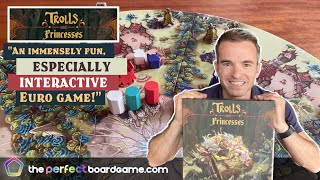
- High level of interaction and the ability to influence other players' plans
- Clear round progression with King Troll providing foresight into game length
- Engaging player dynamics and opportunities to disrupt opponents
- Tile market luck can disproportionately influence strategic decisions
- Theme is not strongly integrated; mechanics-driven design
- Relatively light complexity for a Euro game with a longer teaching time
- Trolls vs Princesses with capture/steal dynamics
- Fairy-tale village where trolls roam, kidnapping princesses and humans
- Abstracted fairy-tale setting with minimal narrative
Mechanics (from transcript analysis)
- Action Points — Players accumulate and spend action points to perform actions; other players' trolls can augment or limit available actions.
- Scoring tiles / market-driven luck — Refreshing tiles can yield useful or junk tiles, introducing luck into scoring opportunities.
- Tile market / tile placement — Tiles can be refreshed to draw new options; tile placement and scoring tiles drive strategy and luck.
- Tile Placement — Tiles can be refreshed to draw new options; tile placement and scoring tiles drive strategy and luck.
- Troll cards and king troll — Troll cards modify actions; king troll provides an extra action point and influences pacing.
- Village actions with interaction — Opponents' actions in the village affect your options, creating direct player interaction and disruption.
Video topics + discussion points
Quotes (from this video)
- I think this is a game with that started with a great idea for game mechanics and then the theme was added to that
- the degree of interaction for a game like this and how much your choices influence other players
- I was initially a little bit more excited about this game's theme
- this is really just a tile placing Euro game with a lot of abstract scoring
References (from this video)
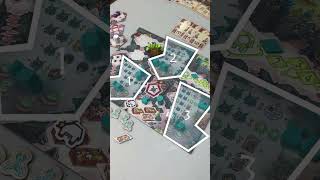
- A robust, emergent action economy where the number of actions is not fixed but depends on spatial troll density, which rewards careful positioning and timing.
- Rich synergy between core mechanics and augmentation options (humans, outposts, Troll King) that creates a dynamic decision tree for players across every turn.
- Clear hook in the theme and components that makes the cave expansion feel tangible and consequential, giving players a strong sense of agency over their in-game footprint.
- High replay potential due to variable objectives (tile scoring and set collection) and the possibility of strategy shifting as players pursue different augmentations and combinations.
- Tension and negotiation are baked into the design, as exploiting opponents and leveraging shared spaces can yield powerful, game-changing plays when timed correctly.
- The interaction heavy design can create analysis paralysis for some players, especially new ones who must wrap their heads around how those extra modifiers change action economy from turn to turn.
- Rules complexity and the number of potential scoring paths may make initial learning curve steep; players require patience and a willingness to digest a broad set of contingencies.
- Balancing concerns may arise around how augmentation options become too cheap or too powerful, potentially diminishing the value of traditional worker-placement choices.
- Expansion and exploitation of a living cave economy where action economy and direct interaction determine who wins.
- Fantasy cave network inhabited by trolls. Players expand their cave systems, recruit humans, place outposts, and vie for influence in a shared arena.
- Analytical commentary focused on how the mechanisms create emergent strategy; examines cause-and-effect relationships between worker placement, augmentation, and scoring.
Mechanics (from transcript analysis)
- Action point economy — The sum of all trolls in the chosen space establishes how many actions a player may perform on that turn; this creates a flexible, potentially exponential increase in action capability as trolls accumulate in a space or as players gather helpers.
- Augmented actions — Players can enhance basic actions by deploying humans, outposts, the Troll King, or even interaction with other players; these modifiers add layers of strategic planning and interaction, encouraging players to weigh efficiency against risks of giving rivals big turns.
- Tile-based scoring / set collection — The game uses special scoring tiles that can be claimed or triggered to provide end-game points, rewarding players for planning sequences and collecting matching components; this mechanic synchronizes with the core engine to create a coherent victory path.
- Worker Placement — Players move one or more troll workers to action spaces; the key twist is that the number of actions available in a space scales with the total trolls present there, creating a dynamic resource for the player's turn.
Video topics + discussion points
Quotes (from this video)
- What makes this game stand out though is how the worker movement mechanic
- actions are performed in one of four areas either on your own player board or on the shared board on a player's turn they move one troll to an action and have action points equal to the sum of all trolls in the space
- I can even perform as many actions as I can afford
- that's not all I can augment my actions with the help of the humans I've brought into my cave
- or it can even augment with outposts the troll King and even other players for super powerful actions
- therein lies the strategy of this game maximizing your effect by exploiting your opponents and expanding your influence making every turn of this game significant and exciting
References (from this video)
- Deep engine with multiple action paths and synergies
- Strong two-player optimization opportunities
- Cavern tiling system yields varied, emergent layouts and diverse end-game scoring
- Rule set can be fiddly and state-heavy, risking dead-ends with certain tile layouts
- End-game scoring tables and king-card interactions can be complex
- Balance can vary with card/t tile draws in different runs
- trolls, bells, changelings, outposts, and princesses competing for points in a skein of actions and tile-building
- fantasy world where trolls vie for favor with the Troll King, manipulating villages and cavern networks
- humorous, tongue-in-cheek, fantasy-themed exploration of mischievous troll politics
- Skeleton Legend
Mechanics (from transcript analysis)
- King tiles / King’s cards — King tiles grant extra AP or special effects; King’s cards provide additional scoring or powerful actions.
- Resource Management — Three main resources (obsidian, diamonds, gold); resources enable actions, outposts, and end-game scoring.
- Set collection / end-game scoring — Score is driven by completing sets of bells, changelings, and outposts; princesses contribute major points.
- Tile drafting / cavern tiling — Players draft cave tiles to place in their cavern networks, unlocking new actions and scoring opportunities.
- Village actions / beds for princesses — Villages provide actions; beds are required to house princesses, influencing which actions can be taken.
- Worker movement / AP allocation — Trolls move to different locations, and actions cost action points; the Troll King provides additional AP in some cases.
Video topics + discussion points
Quotes (from this video)
- This game is based off of a Skeleton Legend
- This is a medium weight strategy game that features worker movement as well as action point allowance
- Everything you're basically going to be able to do twice on your turn
- Befriend the princess in both villages
- There are a lot of things going on in this game
- The end game scoring is all detailed on the back of your player aid
References (from this video)
- Strong thematic flavor with a playful mischief motif between trolls and humans
- Deep strategic depth with multiple paths to score and interact with opponents
- Good emphasis on player interaction via shared resources and crowding strategies
- Tutorial format demonstrates play through concrete turns and decisions
- Rule complexity can be intimidating for new players
- Prototype components may differ from final production quality
- Games may have longer play times, requiring patience and commitment
- Trolls build caverns, employ tricks on humans, and capture princesses to enhance their caverns and scoring potential.
- A fantasy world with trolls and humans living in a mountain, caves, and villages; trolls aim to build luxurious caverns, lure humans, and capture princesses.
- Tutorial narrative with thematic flavor and host commentary
Mechanics (from transcript analysis)
- Action point allocation — Each turn grants action points from trolls in a cavern and from the Troll King; these points are spent to perform actions.
- Action Points — Each turn grants action points from trolls in a cavern and from the Troll King; these points are spent to perform actions.
- Deck-driven events / endgame timer — Reveal a top card each turn that drives village events and indicates when the game ends.
- Events — Reveal a top card each turn that drives village events and indicates when the game ends.
- King tile activation — King tiles provide special actions; players gain more king tiles and can activate them to influence play.
- Mobility and cauldrons — Move trolls between cauldrons and board areas to enable actions; placement on cauldrons determines available actions.
- Resource Management — Track and manage resources like obsidian, gold bars, diamonds, cows, bells, and other tokens to enable actions and scoring.
- Tile Placement — Place cave tiles to the left of your area or on the village board to expand the caverns and unlock new resource spots.
- Tile placement / network expansion — Place cave tiles to the left of your area or on the village board to expand the caverns and unlock new resource spots.
- Tile/Map Shifting — King tiles provide special actions; players gain more king tiles and can activate them to influence play.
Video topics + discussion points
Quotes (from this video)
- we are not evil trolls we just want to build out luxurious Caverns
- this card shows a Roman numeral two at the top and then it shows a human in the middle
- it's time to stop playing through the game for the tutorial and instead talk about what happens once the game is over