
/pic3727516.jpg)
/pic4128153.jpg)
/pic1246187.jpg)








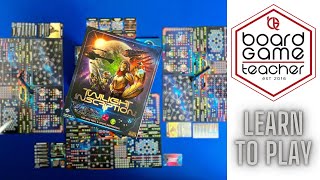
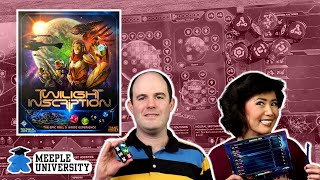


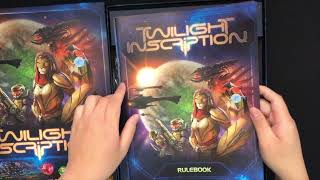













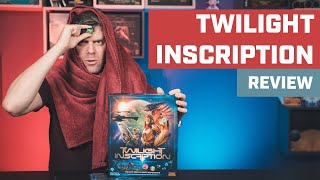
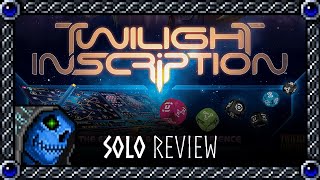











Twilight Inscription Deep Dive
What the Community Thinks About Twilight Inscription
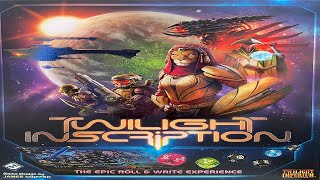
Twilight Inscription generates excitement across the board gaming community as an ambitious roll-and-write that transcends the genre's typical brevity and simplicity. Reviewers consistently praise it as a standout achievement in the space, with enthusiasm for both its mechanical depth and execution. The game has established itself as something special in a landscape of lighter roll-and-writes, attracting players who crave meaningful choices and interconnected systems despite its longer playtime.
Core Mechanics That Define Twilight Inscription
Roll and Write with Strategic Depth
At its heart, Twilight Inscription is a fully realized 4X roll-and-write experience. Each round begins with a card flip that determines available resources, followed by a dice roll that provides additional inputs. Players simultaneously mark their sheets by choosing how to spend those resources. The genius lies in the simultaneity combined with meaningful asymmetry—each player maintains control over their own sheet choices while the shared dice pool creates common reference points. This design ensures accessibility without sacrificing decision weight.
Four Interconnected Sheets with Compound Scoring
The game's architecture centers on four player sheets representing Navigation, Expansion, Industry, and Warfare. These boards are not modular choices but rather aspects of an integrated empire-building system. Navigation allows exploration and claiming of star systems, earning victory points through control and relics. Expansion leverages claimed planets to unlock focus dice and build infrastructure. Industry focuses on grid-based expansion through claiming and scrapping, generating commodities that fuel voting power. Warfare builds military strength through accumulated units placed on a grid. The brilliance emerges in how actions on one sheet influence capacity on others, gaining population on Expansion opens victory point paths on the same sheet, while technologies unlock new capabilities across the board.
The Twilight Inscription Experience
Epic in Scope, Satisfying in Execution
Reviewers describe Twilight Inscription as delivering a genuinely epic experience despite using a single die roll each round as its core input mechanism. The "epic" quality stems from the sheer volume of meaningful choices, the interconnectedness of four distinct systems, and the sense of building something substantial across five stages of play. Players report feeling like rulers of expanding galactic empires, managing exploration, resource networks, industrial capacity, and military might simultaneously. The game creates narrative tension through its architecture rather than explicit storytelling, the high choice density naturally produces emergent narratives of strategic triumph and near-misses.
Highly Replayable with Asymmetric Factions
The inclusion of multiple double-sided player sheets and asymmetric faction cards ensures that no two games feel remotely similar. Each faction carries special passive and active abilities that manifest differently depending on which sheet is active, fundamentally altering turn priorities and strategic paths. The double-sided objectives provide similar variety, flipping to lower-value versions once claimed. Reviewers emphasize that after numerous plays, the games remain distinct because the interaction of faction powers, available objectives, and random card order creates genuine strategic variation. This depth justifies the investment in learning and teaching a heavier roll-and-write.
What Makes Twilight Inscription Stand Out
Exceptional Teaching Design with Play-as-You-Learn
One of Twilight Inscription's most praised aspects is how it manages complexity introduction. The rulebook includes a structured tutorial that introduces sheets one at a time during actual gameplay. Players experience a single turn with just the Navigation sheet, then add the Expansion sheet for the next turn, continuing until all four are in play. This approach avoids the common pitfall of overly theory-heavy rulebooks by grounding learning in immediate play. Reviewers note that players feel engaged and make meaningful choices even during the tutorial phase, rather than simply executing predetermined moves. The complexity never feels imposed but rather organically emerges from playing the game itself.
Tremendous Solo Capability and Accessibility
Solo play is frequently highlighted as a major strength. The game includes straightforward AI mechanics for one- and two-player games using a shared Mecatol Rex board where an AI faction generates competition for objectives and resources. The solo experience feels complete and challenging without excessive bookkeeping. Multiple reviewers express surprise at how well the game translates to solo, noting that despite voting and warfare mechanics that seem designed for multiplayer, the AI handles these competently. The solo mode uses a simple track system to manage voting power and war strength, making solo plays quick to setup and resolve while maintaining meaningful decision points throughout.
Potential Drawbacks
Memory Load and Resource Tracking
A consistent concern across reviews involves the cognitive overhead of tracking which resources have been spent. With six dice producing various resource icons and players often building combo chains across multiple sheets, it becomes easy to forget which of the rolled dice were actually deployed during a turn. Reviewers describe moments of anxiety late in a turn when realizing uncertainty about whether a dice was spent, particularly when factions trigger abilities or when simultaneous actions cascade into complex chains. The physical dice can serve as memory aids, but players report this remains a minor friction point that requires discipline to manage correctly, especially in early plays.
Voting Mechanics Lack Impact and Engagement
While warfare creates direct player interaction and meaningful conflicts, voting mechanics receive more muted response. When council event cards flip, players cast votes using accumulated voting power to determine which of two agenda effects resolves. Reviewers note that out of the available voting cards, players typically care about only two or three outcomes, making most voting rounds feel like mere formalities. The voting system exists but rarely generates the tactical tension of warfare conflicts. Some players describe voting as something that happened rather than something they actively engaged with strategically. This represents the one area where the game's otherwise interconnected systems feel somewhat disconnected from core decision-making.
If You Enjoy Twilight Inscription
Players drawn to Twilight Inscription typically gravitate toward several related experiences. Hadrian's Wall provides similar crunchiness with a different mechanical focus, using workers and resource tracks rather than multiple interconnected sheets, though it concentrates more heavily on combo optimization. Epic Eternity offers comparable scale within a roll-and-write framework with slightly different resource complexity, though with less emphasis on the interconnected systems that make Inscription special. For those seeking the 4X theme without the roll-and-write commitment, the actual Twilight Imperium delivers political intrigue and grand conflict at substantially longer playtime. Roaring Rifles provides a lighter roll-and-write experience with dice drafting and beautiful components but significantly less strategic depth. Players interested in the voting and warfare mechanics might explore Seven Wonders, which features simultaneous warfare and more straightforward resource management but loses the puzzle-like sheet manipulation that makes Inscription distinctive.
What Reviewers Are Saying
"This is an epic rolling right in all senses of this word. Epic dice, epic boards, epic cards, epic price for a rolling right. But each player gets four boards and each of those boards let you do different things, get technologies, score points, get resources, get more dice."
— Board Game Hangover
"It feels like you're playing the game even in the tutorial. It's not just reading a paragraph of text and that's it. The tutorial guides you through those processes but you still make some choices that matter later on."
— The Board Game Garden
"I freaking love this game. It's the perfect version of Twilight Imperium for me where it's not as long, it's not as big, and it is a rolling right which I absolutely love. It's very comboey and everything's very connected."
— The Board Game Garden