/pic3193554.jpg)
Ulm is at its historic heyday: There is a constant hustle and bustle in the prosperous free imperial city. At the beginning of the 16th century, the city has one of the largest municipal territories within the Holy Roman Empire of the German Nation. Success and wealth are not only due to Swabian thriftiness, but mainly the result of the citizens’ business acumen and skilled craftsmanship. Trade in works of art and commercial goods such as wood, wine, salt and textiles is flourishing; for the most part, these goods are shipped by barge or raft on the Danube river. People are busy building the cathedral - the social heart of the city - that will at one time have the tallest church steeple in the world. Everybody of distinction meets around the cathedral. The influential guilds and patricians dominate city life; and if you want to accomplish something, you need to be in the good graces of the right people.
In Ulm, players try to expand their spheres of influence and to make optimal use of the hustle and bustle on the marketplace around the cathedral. The game has one simple basic rule: Push 1 Action tile into the Cathedral area and carry out the 3 associated actions! This way, the Cathedral tower gets taller and taller over the game. The objective of the game is plain and simple: try to accumulate the most victory points through activities in different areas of city life in Ulm and do it before the end of the 10th round, when the construction of the Cathedral is concluded.
Who will make the best use of his means and resources over time and will go down in the annals of the city’s history as an important citizen?


- Excellent for family play; cooperative and lighthearted
- Smooth dice-driven push-your-luck mechanic
Mechanics (from transcript analysis)
- cooperative Yahtzee-style push your luck — Roll dice and try to push luck with cooperative play; players help each other complete sets
Video topics + discussion points
Quotes (from this video)
- "this is a worker placement game"
- "the main economy of the game is money"
- "a simple full drafting combo-tastic style game"
- "engine-building, combo-tastic style game"
- "we solved the puzzles"
References (from this video)
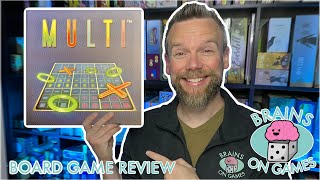
- Accessible and easy to learn
- Visually clear color-coding aligned to times tables
- Engages pattern recognition and mental math
- Encourages strategic planning across multiple boards
- Component organization can require additional bags or storage
- Potential for stalemates leading to tied boards and a wild board
- Multiplication tables visualized through color-coded boards and meta-strategy
- Educational setting; a set of ten tic-tac-toe boards connected as a meta-board using multiplication tables
- Educational demonstration and playthrough with verbal explanations
Mechanics (from transcript analysis)
- Area Control — Players aim to win three boards in a row by placing marks on products across multiple boards
- Area control / meta-board strategy — Players aim to win three boards in a row by placing marks on products across multiple boards
- Blocking / defensive play — Players block opponents by choosing numbers that hinder their potential lines
- Meta-board / multi-board play — Ten tic-tac-toe boards are played simultaneously; one board can become a wild board when blocked
- Pattern Recognition — Players identify products across times tables and place markers on corresponding products
- Player Board | Main Board — Ten tic-tac-toe boards are played simultaneously; one board can become a wild board when blocked
- Product mapping on factor board — Using the factor board, players place markers on all occurrences of a chosen number's times table
Video topics + discussion points
Quotes (from this video)
- multi is a game that's light in terms of its complexity what really what you're doing here is playing tic-tac-toe on 10 different boards
- you're playing them all at the same time
- super simple mechanisms in play here you're doing some area control you're trying to take over these boards on the tic-tac-toe grid
- it's great for the multiplication tables and I think it's great for seeing those relationships
References (from this video)

- World War Hulk and Future Imperfect are considered excellent story arcs.
- Hulk's raw power is a compelling aspect.
- Red Hulk's story arc involving siphoning power and mass killing was deemed cheap and annoying.
- The resurrection of killed characters felt like a cop-out.
- Hulk's rage and power
- Marvel Universe
- Comics
- X-Men
- Captain Marvel
- Juggernaut
- Onslaught
- Silver Surfer
- Doctor Strange
- Galactus
- Thor
Mechanics (from transcript analysis)
Video topics + discussion points
Quotes (from this video)
- why is it that you set up appointments with do with doctors that never keep them?
- I’m sure she’s seen dozens if not a 100 kids at this point getting physicals
- It’s a really solid game. I’ve played it a bunch since it came out.
- It’s a cooperative game where you and your friends are gonna work together to achieve a common goal.
- Terraforming Mars is a game that really rewards long-term planning.
- The engine building in this game is just fantastic. You really feel like you’re building something.
- Wingspan is such a beautiful game. The artwork is just stunning.
References (from this video)

- Strong solo mode
- Beautiful artwork
- Short playtime (~30-40 minutes)
- Engaging path-scoring mechanics
- Limited multiplayer appeal
- Scoring can be dense for new players
- Path-building and dungeon-like layout scoring
- World of Ulos, fantasy world
- Puzzle/abstract with thematic flavor
- Stonespine Architects
Mechanics (from transcript analysis)
- Blueprint and secret path scoring — Connect cards to start/end points for points; secret passes provide hidden connections.
- Drafting and hand management — Draft from market, reserve and acquire cards to build the dungeon.
- Market card economy and scoring — Score based on market card selection and reputation tokens.
- Solo mode with JL AI — Compete against JL to stay ahead and claim market/score cards.
Video topics + discussion points
Quotes (from this video)
- the rule book is very clear
- the setup for stone spine is fairly easy
- it's a drafting game that you then are drafting one you're passing it around
- the components of this game are really nice
- this one is definitely a keeper
- I can't wait to get this to the table again tomorrow and more during the week
- it's a great game... it's a really fun game that I really enjoyed playing
- I would love to get this to the table multiplayer I don't think it's one I Stacy might play but I doubt it
- it's a really good solo mode I really enjoyed my play
References (from this video)

- Available in Canada; under-one-hour game; striking artwork.
Mechanics (from transcript analysis)
- N/A — Not specified.
Video topics + discussion points
Quotes (from this video)
- UKGE is 47 days away and there are some games coming out that I am really excited to see.
- Forest Shuffle Dartmore. This is like a reskin of Forest Shuffle.
- Come Sail Away is available in Canada but if I can manage to with that combo get come sail away for less than 23 British pounds.
References (from this video)

- interesting movement mechanic
- satisfying strategic puzzle
- influencing the city of Ulm
- Medieval Germany
Mechanics (from transcript analysis)
- Set Collection — Collecting sets of goods or influence types.
- Worker Placement — Players use pawns to take actions and gain influence.
Video topics + discussion points
Quotes (from this video)
- There's a lot of designers and company representatives that are there, like GMT Games is there, uh Uwe from Sound of Drums was there coming in from Europe.
- So, if you're looking at a chance to play up-and-coming games with some of the designers that are designing on them, it's quite an experience.
- You really get some insight into the design process, into how historical board games are created as you're playing them and giving feedback to the designers.
- In this game, you take on the role of companies that are trying to win military contracts uh from the US
References (from this video)
- Simple
- Dexterity element
- Portable
- Adorable
- swatting flies
- a picnic table
- Pack-O Games
Mechanics (from transcript analysis)
- dexterity — trying to drop this fly swatter on the flies.
- Set Collection — It's a set collection game ultimately... You're trying to get sets of three colors or three shapes in order to score.
Video topics + discussion points
Quotes (from this video)
- And so sometimes throughout that season, when you're pregnant, um and then you go back to work for like 60 hours, that's Ryan's thing, that's not my thing.
- Um you don't have a lot of brain space to do other things.
- We love playing games, but we just haven't been able to get those big main event style games to the table as much because I just frankly don't have the brain power for it right now.
- Basically, when your brain's gone on vacation, but you still want to play a game.
- This is kind of a placeholder for a number of dexterity games.
- So, that's a game that we have owned for such a long time. We've played so many times. I really understand the ins and outs of this game.
- It's It's one of those things where I feel comfortable teaching the game, and that's how you know that I know a game.
- You can play it unconscious practically. You won't win, but you can play.
- So, yeah, you you can definitely play Deep Dive with minimal brain power.
- it's kind of like a bigger party-style version of Blackjack almost. Gamified.
- Um so, yeah, you you can definitely play Deep Dive with minimal brain power.
- But, you're still going to be able to play a big, satisfying game that you are very familiar with and very comfortable with.
- And so, yeah, you are trying to like go for certain things or flip certain things or you want certain things to happen, but at the end of the day, you're just like, whatever is available is what you're going for.
- And so, this is a game that we play with our girls on the regular because it's just really chill and really fun.
- So, it's a very fun game, and this is a game that we play with our girls on the regular because it's just really chill and really fun.
References (from this video)
- protecting your hands while also eating everybody else's hens
Mechanics (from transcript analysis)
- Drafting — Players are drafting to the hen house to get points.
Video topics + discussion points
Quotes (from this video)
References (from this video)

- Comes in a small, travel-friendly box
- Easy to understand objective on your turn
- Swatting flies
- Picnic table with flies
Mechanics (from transcript analysis)
- dexterity — Players drop a fly swatter onto a board to cover flies.
- Set Collection — Collected fly cards act as scoring parameters, with players trying to get sets of letters, shapes, or colors.
Video topics + discussion points
Quotes (from this video)
- light games are just for a different circumstance they're not better or worse they're just different circumstances
- if I'm introducing a game for the first time to someone I'm not going to hit him with one of my very very involved games I want to make sure they have a good time
- it's basically a checks and balances so somebody can so a small group of people can't make something happen for a game it has to be Collective hold exactly
- gentle rain fits that perfectly
- pitch car is just one of those games where if you can play a convention setting with lots and lots of boards lots lots of people it is an absolute blast
- it calls itself the fastest board game in the world the fastest card game in the world and it is yeah maybe a minute or two each round
- this is probably for both of our girls the first adult game that we taught them because you it's language independent
- they fill a great hole in our collection we play them a lot
References (from this video)
- Monopoly
- Connect 4
- Life
- Risk
- Operation
- Sorry
- Ticket to Ride
- Katon
- Azul
- Domino's
- Clue
Mechanics (from transcript analysis)
Video topics + discussion points
Quotes (from this video)
- Do I say the words Kingdom Death Monster?
- Are these games still good? I guess is the question. Are they worth saving? Are they worth holding on to? Are they worth purchasing?
- It could be that the quality of the games have just increased so dramatically that these really fall into the wayside.
- Monopoly has opened the door for players all around the world to be very comfortable house ruling and playing from a teach and never actually reading the rule book which in some ways is a benefit to our space.
- I don't think they're good games, but I did grow up loving and enjoying gaming because of them.
- Imagine a, you know, uh, deluxified, you know, full, uh, full build operation game produced by like Awaken Realms or something along those lines...
- Driving is the single most dangerous thing basically any of us do on a daily basis.
References (from this video)
- unique blending of set collection and dexterity
- quick, family-friendly play
- might rely heavily on physical dexterity for fun
- set collection paired with dexterity
- picnic with decorative flies
- playful/pattern-driven
Mechanics (from transcript analysis)
- dexterity-based drafting — dropping a segmented ring/tablecloth-style area to cover flies
- Set Collection — draft tiles with different colors/shapes to build sets
Video topics + discussion points
Quotes (from this video)
- this is an adorable game where you're building a quilt to try and attack cats to your quilt
- it's a relaxing mean game
- there's two things I want to talk about there's this worker area of the board where you're able to place some of your meeples in order to take tiles off of the board
- this route connection is you're kind of building your network of trying to collect all these resources so you can sell them
- it's a two-player game only and it's something we played a lot early on and we still play quite a bit because it's just so good and so simple
- it's subtle which is what I like about it
References (from this video)
- engaging hidden information element
- family-friendly with accessible scoring
- compact and replayable
- the fox mechanic can add luck elements
- foraging/resource gathering under pressure
- Travel-sized micro-game collection; set-building with hidden drafting
- playful, family-friendly
Mechanics (from transcript analysis)
- Closed Drafting — Players draft cards face-down into a central area (the hen house).
- Hidden drafting — Players draft cards face-down into a central area (the hen house).
- Set Collection — Points come from forming high-value hen sets; fox threat adds risk.
- set-collection — Points come from forming high-value hen sets; fox threat adds risk.
Video topics + discussion points
Quotes (from this video)
- eight full board games in this one little pouch
- this set is absolutely brilliant absolutely genius
- we were blown away with how much you can do in such a little package
- the cards are two-sided one is positive one is negative feel upside down
- in Sly you're drafting these cards face down into the hen house
- this is a horse racing game
References (from this video)

- Rich, thematic setting with a strong ecology/food cycle
- Unique shared resource and ecology phase creates dynamic decisions
- A deep, high-interaction experience for experienced players
- High complexity and a steep learning curve
- Rulebook and symbol interpretation may deter new players
- Survival, feasting, and monument building to the Gods
- Forested world with gods; animals feature prominently
- Mythic/epic fantasy
- Everdale
- Oak
- Creature Comforts
Mechanics (from transcript analysis)
- eco-dynamics (ecology phase) — After a round, the ecology phase shifts resource availability based on worker presence.
- inventions and monuments — Inventions improve food production; monuments to the gods grant benefits.
- shared resource tracks — Resources are shared and represented on central tracks rather than tokens.
- work placement on action spaces and pilgrimage tracks — Workers travel a Time Track; longer stay improves path payoff.
Video topics + discussion points
Quotes (from this video)
- I think Oak looks a little more complicated than it actually is
- it's a very very peaceful game
- my lil everdale yes the kid version of everdale is better than the original everdel
- the final and really in my opinion the best game on this list is arboria
- The ecology phase of this game... after a round of gameplay you're going to look at all of the spaces where food was collected