/pic3766231.jpg)
Description from the publisher:
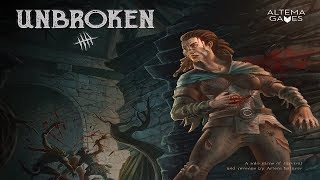
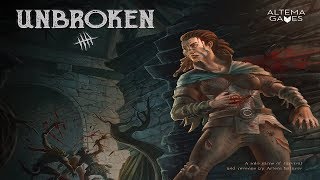
Not all adventures end well. Some groups meet their untimely demise at the hands of monsters all too soon, and Unbroken is a story of one such ill-advised expedition.
You, the player, take on the role of the sole survivor of that failed adventure. Finding yourself in hostile territory, weak and wounded, you will need to gather your wits and strength, craft weapons from scraps found around you, and attempt to tackle progressively more challenging monsters on your way out of this forsaken place.
Unbroken is a solo card game that is quick to set up and play but one that will produce a tense challenging experience.
You will collect resources representing your character's abilities and will need to ensure that you invest in a right mix of resources to both keep yourself alive during your travels and also prepare for the gruesome monsters that wait in the dark. There are several options at your disposal - brute force, trickery, clever use of skills.
Customize your character and use your limited resources wisely - only the craftiest and the most resilient survivors will make it out alive.

Unbroken Runthrough

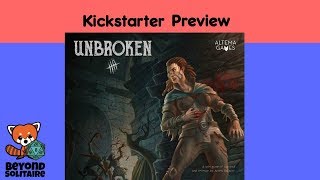
Kickstarter Preview: Unbroken
- Interesting survival game
- Good for an hour of play
- Not a terrible game
- Fun solo game
- Good resource management decisions
- Thematic flavor text
- Four different character classes with backstories
- Hinges on a lot of luck
- More luck than strategy
- Limited number of weapons
- Can suffer from lack of replayability after a few plays
- Not invigorating or the most exciting game
- Component quality could be improved (inset boards)
- This game would be bad if it was your only game
- Survival and revenge
Mechanics (from transcript analysis)
- character classes — There are four distinct character classes (Hunter, Huck Dorf, Sage, Brawler) with unique backstories, though they mechanically perform the same functions.
- encounter deck — A deck of cards is shuffled, and players draw from it to encounter various situations, skills, or monsters.
- Push Your Luck — Players can choose to take risks, for example, by resting with limited time, to potentially gain benefits or avoid negative outcomes.
- Resource Management — Managing resources such as food, effort, and time is critical for survival.
- scouting — A strategy involves scouting to see upcoming monsters and planning accordingly to prepare for specific challenges.
- Skill selection — Players draw two skill cards and choose one, providing some agency in mitigating randomness.
- Weapon upgrading — Basic weapons can be upgraded into more advanced weapons, which have different properties and uses in combat.
Video topics + discussion points
Quotes (from this video)
- This is gonna be an interesting discussion because this game has a lot of backlash based because of the publisher that made this game and their responses on Kickstarter
- I really feel for the designer cuz I don't think he had a hand in any of the the issues that surrounded the game
- Essentially like harassed a lot of people throughout their Kickstarter process and like took everything real personal
- I was actually surprised I got it without having to deal with any of that
- So you have to spend you have to give us an extra $30 to cover shipping because they just mismanaged how much all that was gonna cost
- It's essentially like harassed a lot of people throughout their Kickstarter process and like took everything real personal
- If you don't like luck heavy games this is not gonna be for you
- I think this game is gonna suffer from not having a lot of replayability
- 6.5 like I think is where I'm sitting like yeah it's a little bit above average
- It's not like that invigorating like it's not like the most exciting things ever like you're just kind of managing a lot of stuff
References (from this video)
- Unique solo play focus
- Interesting and weird story elements
- Good artwork
- Satisfying resource management and crafting loops
- Challenging combat that requires tactical thinking
- Skills gained after defeating monsters add variety
- Weird story elements can be off-putting
- High resource management can be demanding
- Difficulty can be high, leading to potential for harsh punishment (starvation, losing time)
- Survival and revenge
Mechanics (from transcript analysis)
- action selection — The player can "do as many actions as I would like" and has a variety of actions like 'scout', 'orientate', 'rest', and 'craft'.
- Card drafting/drawing — Encounter cards are revealed and selected from, and skills are drawn after defeating monsters.
- Combat — Involves attacking monsters, with mechanics like damage, shields, armor, wounds, and special abilities.
- Condition Management — Players can gain conditions like 'afraid' which impact gameplay (e.g., inability to rest).
- crafting — Players can craft items like a club and an axe using gathered resources.
- Dice Rolling — Used for actions like 'dangerous idea' to gain time or 'scouting' to determine the monster.
- Resource Management — Players need to manage resources like 'effort', 'time', 'food', 'cunning', 'metal', 'wood', and 'treasure'.
- Set Collection — Collecting resources like wood, metal, and treasure is necessary for crafting and progression.
Video topics + discussion points
Quotes (from this video)
- This game actually has like a huge well I would say like huge but like a story around it which I was very shocked about
- The story is really weird for this game it's like you would think oh it's a game about survival and revenge but yet there's this whole weird Adam and Eve god thing behind the scenes that is like what
- The Kickstarter came with a piece of sheet music that's a first
- There is a lot of resource management in this game like if you need certain things to be able to upgrade that would potentially help you survive you you have to keep that in mind otherwise you can't just willy-nilly just run in and to start drawing cards from the deck
- You starve and die which is something you most likely don't want to do anyway
- The artwork in this game is actually pretty pretty good like they have some repeats but ultimately like it's not bad
References (from this video)
- Intriguing concept of opening the box to discover rules and multiple games.
- Can be mentally taxing early in the morning.
- Requires the player to be smart enough to figure out the rules.
Mechanics (from transcript analysis)
- Legacy (loosely) — The act of unboxing and playing through scenarios reveals the game's rules and components.
- scenario-based play — Rules are discovered through playing through scenarios.
Video topics + discussion points
Quotes (from this video)
- Mortal Kombat 11 Versus Deck we played that game when it first came out as a ccg many many many years ago
- we took a flyer called Builder High we're going to report back on this it was very interesting
- so I was like oh that's a good thing that we stayed and got that
- we got to do an exciting demo of a new ccg style game coming from asthma Day called altered
- instead of beating each other down no you're not but there are a lot of very similar elements between this and Star Wars unlimited
- the art is some of the best art I've ever seen in a c game in a very long time
- it's just a very uh fancy fasy colory it's very bright and it's gorgeous don't get me wrong but it's not my cup of tea
- we're kind of wondering about those QR codes we talked about you can scan those into their application so that you can track who owns what card
- if that sounds wild it is we can't fully wrap our minds around it but is a odd business model that you want to keep an eye on
- J con the big things were the three card games
- it was given to me by Rainer and it's a candy from from uh cck was it C I think I think so and he just said when you try it there's going to be he just said wait for it
- it's salty that's different oh it's licorice it's licorice but salty
- I don't like black licorice but this isn't this doesn't taste like there's that salty on the top
- I do not like licorice at all at all
- hey y'all thanks for listening and thank you so much for helping us get to 300 episodes
References (from this video)

- Compact dungeon crawler with clear solo focus
- Cheat sheets and quick-start guidance are useful
- Table space can be large for a small-box game
- Some players may want minis or a map-based experience
- dark dungeon crawl with solo focus
- Dark dungeon adventure with monsters and a grim survival arc
- procedural through encounters and boss progression
- Descent: Legends of the Dark
- Gloomhaven (solo variants)
Mechanics (from transcript analysis)
- Action Timer — A timer and HP track govern survival and failure conditions.
- Boss Battler — Progress through escalating monsters with increasing difficulty.
- boss/monster progression — Progress through escalating monsters with increasing difficulty.
- Encounter-based exploration — Explore with encounter cards to gain resources and abilities.
- timer/health management — A timer and HP track govern survival and failure conditions.
Video topics + discussion points
Quotes (from this video)
- you are playing the Final Girl in a scary movie so think of the movie Alien you know Ellen Ripley
- every game is going to be different with different events every game
- this one is extremely challenging
- Swing with final girl like the game is way too swingy
- I found by sacrificing cards you can mitigate a lot of the Swing
- thoroughly enjoyed this one
- the environment with the key cards was just it was a puzzle it was almost euro-y
- I thoroughly enjoyed Wingard Cottage
References (from this video)

- Adventurer surviving and crafting to survive boss battles
- Grim dark experiential
Mechanics (from transcript analysis)
- crafting — Scrape together the lost little bits of material you can find to craft weapons armor and survive.
- Dice Assignment — Tracking stats and doing your best to make a decision between no good options.
Video topics + discussion points
Quotes (from this video)
- if you're looking for one two or a dozen great solo games to play at your local coffee shop your grandmother's house or at a porch in a park while knats fly around your face these are going to be some of the ones that I would recommend
- life has been chaotic and busy for the best of reasons and yet being on a road trip for a photography contract uh on my own is one of the only opportunities I've had recently to actually sit down and play some solo games
- if you really like RPGs you really like Grim dark experiential things where you're tracking stats and doing your best to make a decision between no good options you should be paying attention and potentially getting that to your game group
- If you want to play more games like I do and you have less and less time cuz you're about to have a brand new baby like I am well you got to do what you can meaning you set up next to a rock in a beautiful environment when you have an extra 30 minutes
- Remember to do the important thing find time to play a few games even if it's hot muggy and humid outside and there's black flies flying all around
References (from this video)

Mechanics (from transcript analysis)
Video topics + discussion points
Quotes (from this video)
- The food for the soul which is is truly therape therapeutic.
- The community that I came in on, I could be myself 100%.
- I'm an open book. I I'm happy to talk about like, you know, any of my personal struggles.
- This is happiness. And I told this story at the convention.
References (from this video)
- Enjoyed playing the game
- DC
- Marvel Token
Mechanics (from transcript analysis)
Video topics + discussion points
Quotes (from this video)
- The sheer quantity of game here is a downside to me.
- It took over two hours to punch out everything, get organized according to AR's guide.
- The campaign arcs are like 15 hours.
- It's a very clever way to bridge that gap between giving players tons of content while making it accessible at the same time.
- Board games give you that mental satisfaction in a way that video games just don't in my opinion.
- It's probably my favorite from them with the possible exception of Scoundrels.
- The general feedback around Lands of Outshade was so excellent that I think it wasn't just me.
- Even um Shelfside, who generally are very critical of Awaken Realms, uh they they thought it was their best game yet, and I agree with them because it is their best game yet.
- If you like slaughtering hordes of zombies with tactical decisions, I do think Zombicide's a great game. I'm a big fan of it.
- I like to own the things I buy.
- Grim Coven is a mustplay.
- The harder something is to table, the less likely I am to play it, even if I like it a lot.
References (from this video)

Mechanics (from transcript analysis)
Video topics + discussion points
Quotes (from this video)
- So, we have a game here called Sequoia. This is from 2022.
- It's It's fine. I'm giving it a six. Uh Beasty Bars is is is a fun style game where you're playing these different type of animals, and I think each additional expansion made it more complex and less fun.
- Trias is an old dinosaur game that originally came with cubes, and eventually they had little dinosaurs in it instead. And it's kind of grow out to different things. This is a very I have this ranked as a seven. Probably now, the next time I go through my rankings, I'll probably rank it as a six because it's fine, but it's showing its age.
- All righty, of all the games we talked about today, my favorite here is clearly David Goliath, although Hooky is a very close second.
- Either way, it's always good to talk to you all.
References (from this video)
- Strong strategic depth
- High replay value with score optimization
- Solid theme and mechanics
- Can be mentally taxing
- Less immediate fun than quicker games
- finance, balancing resources, strategic planning
- Resource-management heavy dungeon-crawl feel with score-chasing elements
- you manage a hero's finances and resources
- Iron Helm
- Rogue Dungeon
- Mini Rogue
Mechanics (from transcript analysis)
- difficult decisions — tough choices in resource allocation
- Resource Management — balance different resources to maximize score
- Score Chasing — achieve high scores through resource balancing
Video topics + discussion points
Quotes (from this video)
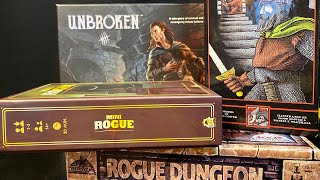
- the battle of the small box card games that simulate a big dungeon crawl feel
- I love replaying mini rogue
- rogue dungeon tops in that category
- Jason Glover's amazing art in Iron Helm
- this game does a great job of simulating a large box dungeon crawl
- I would choose Rogue Dungeon to play the most
References (from this video)

- The publisher has been an absolutely terrible human being.
- The publisher appeared on The People's Court and lost.
Mechanics (from transcript analysis)
Video topics + discussion points
Quotes (from this video)
- oh that was a really cool recap but what did you think of the game did you like it
- those conversations are really boring like really boring
- I did like the idea of giving my blessing to games I've really really liked
- I absolutely 100% stand behind and endorse
- I don't want to put my name and our brand alongside people I don't like or don't respect or who don't like and don't respect me
- you cannot divorce a game from its publisher and any attempt to do so just feels like a way to excuse pretty crappy behavior
References (from this video)
- Reuses components to minimize box content while maximizing variety
- Gives players a taste of game design and design thinking
- Quicker play sessions than expected; can be completed in a single sitting
- Cooperative puzzle-solving aspect can be engaging for designers and puzzle lovers
- Open-ended solutions reduce objectivity; there is no single correct answer
- Audience is unclear; may not appeal to regular gamers who just want to play
- Frustration with having to figure out how to play before playing; heavy upfront design tasks
- No clear single-payer experience; strong design overhead may deter casual players
- discovering and reconstructing history through game design
- Archaeological dig in Egypt; reconstructing ancient games from recovered components
- educational puzzle/experimental design journey
Mechanics (from transcript analysis)
- clue-based deduction — Players interpret clues and a description paragraph to deduce the setup and win conditions of a standalone mission
- component-based design — Each mission provides a subset of components; players select and assemble them to build the game for that mission
- Deduction — Players interpret clues and a description paragraph to deduce the setup and win conditions of a standalone mission
- recycling components across missions — Common components (tokens, meeples, cards) are reused across multiple missions to provide variety with limited parts
- Scenario / Mission / Campaign Game — Each mission is a standalone game, but shares a common underlying system to design from the components
- scoring deductions for hint use — Using clues lowers final score; points awarded for accurate reconstruction of intended design
- standalone missions with shared system — Each mission is a standalone game, but shares a common underlying system to design from the components
Video topics + discussion points
Quotes (from this video)
- it's open-ended and i don't like that there's any kind of objectivity
- i would rather just play a game; i did not enjoy this at all; hard pass
- this is supposed to be like almost a logic puzzle... there is only one solution that can come as a result of all these inputs
- it's a cool puzzle idea right but it's not a pure logic and i think that's what you need for something like this
- the fact that the game was figuring out how to play the game was not a fan
- gives you that game design fever
References (from this video)
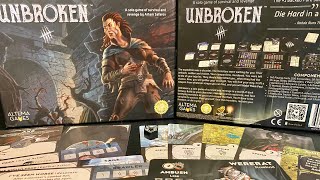
- Rich world-building and backstory that deepen immersion
- High-quality components and evocative artwork
- Well-structured rulebook with clear flowcharts and quick-start guides
- Accessible Easy Mode to reduce early frustration
- Engaging weapon upgrade system with clear upgrade paths
- Extensive encounter variety (140+) with flavorful flavor text
- Very high difficulty; tight economy leaves little room for error
- Gameplay can feel dry or overly cube-pushy for some players
- Flavor text font is very small and may require reading glasses
- External Kickstarter delivery issues affecting some backers
- Pacing and optimization pressure can be punishing for less precise players
- revenge, survival, perseverance against oppressive odds in a perilous underworld
- Dark fantasy dungeon setting where a hardened band of adventurers is trapped in a cursed environment after a disastrous expedition, seeking revenge and freedom.
- flavor-text rich worldbuilding with an emphasis on backstory and atmosphere
- Mini Rogue
- Iron Helm
- Rogue Dungeon
- Gloomhaven
- Mage Knight
Mechanics (from transcript analysis)
- Armor vs health in combat — Monsters have armor that must be broken before health can be damaged; combat is driven by resource spending and card-driven outcomes.
- Combat: Damage Based — Monsters have armor that must be broken before health can be damaged; combat is driven by resource spending and card-driven outcomes.
- Difficulty options — Easy mode lets you start with extra resources and skill draws to offset the game's high difficulty.
- Effort and resource management — Your survivability hinges on managing effort (hp/resolve), spent as weak/medium/strong to perform actions; zero effort can be fatal.
- Encounters (two-card draw) — During each travel/encounter phase you draw two encounter cards, pick one, and often exchange resources to resolve it.
- Flavor text and art integration — Encounter cards feature evocative flavor text paired with art to reinforce immersion and theme.
- Level progression and boss — Four levels with four fights per game, culminating in a final boss battle and a scoring/achievement system.
- Resource Management — Your survivability hinges on managing effort (hp/resolve), spent as weak/medium/strong to perform actions; zero effort can be fatal.
- Resource types — Cunning, metal, wood, and food are used to craft weapons, upgrade, trade, and sustain your expedition.
- Scoring and achievements — End-game scoring based on treasures, resources, and various achievements to chase higher scores.
- Skills from encounters — Successful encounters can grant skills; at times you draw two and choose one, granting bonuses or protection against conditions.
- Tech Trees — Two upgrade paths from basic weapons (club/knife) toward more capable options (spear, sword, axe, mall) with resource costs.
- Time Track — A global time resource that advances as you explore; hitting zero triggers ambushes or game-over scenarios unless mitigated.
- time tracker — A global time resource that advances as you explore; hitting zero triggers ambushes or game-over scenarios unless mitigated.
- Travel and combat flowcharts — Two flowcharts guide the travel phase and the combat phase, aiding player decision-making and rule clarity.
- Weapon upgrade trees — Two upgrade paths from basic weapons (club/knife) toward more capable options (spear, sword, axe, mall) with resource costs.
Video topics + discussion points
Quotes (from this video)
- Unbroken is a solo game of survival and revenge.
- This game is very difficult.
- I would actually really enjoy a more thematic, a more luck based you know adventure style dungeon crawl game set in this world.
- The art in this game is absolutely fantastic, I absolutely love it.
- Kickstarter game this might have some of the best rules and documentation I have seen.
- There are 36 different monsters in the game.
- On easy mode at the beginning of the game you can draw two skills and pick one.
References (from this video)

- tense, varied boss encounters
- publisher history; availability
- Resource management and boss battles
- Dungeon crawl; solo
- tense, cinematic
Mechanics (from transcript analysis)
- boss encounter progression — Encounter cards guide the boss fights and progression.
Video topics + discussion points
Quotes (from this video)
- this is just my opinion my list if your favorite game isn't on here it's more likely that I haven't played it
- it's a solid tense game
References (from this video)
- Kickstarter from one of worst studios in board gaming history
- Golden Bell Studios had dishonest dealings
- Threats and intimidation
- Lying about timeline and delays
- Toxic company run by terrible people
- Unknown
- Unknown
Mechanics (from transcript analysis)
Video topics + discussion points
Quotes (from this video)
- I used to call this a shelf of shame that was a pretty common thing to call it back in the day and I don't never really liked that term because I don't feel shame that I haven't got to these games
- this is mostly work like this is just a backload of things I probably should get to
- people will still be looking for it
- it doesn't matter if the game is like 20 years old people will still be looking for it
- I've painted this one and I spent a lot of time doing it
- there's no point putting them on the channel I think both of them have been out of print for like a decade
- one of the worst kickstarters by one of the worst studios in board gaming history
- Golden Bell Studios did everything wrong you could possibly think of
- purely toxic company run by incredibly terrible people
- it would be kind of a joke that I'd be able to do a three minute video of feudum
- this game has a tutorial video online that's like 40 minutes long
- The Rose explanation video feels like a parody but it's actually how the game is played
- nothing personally to me puts me off playing a game that then sitting down unboxing it and having a craft assignment
- stop making me spend hours assembling your damn games
- this is an uncontrollable mess right now
- I'm a full-time dad and I'm really doing this in the evenings
- I have a finite space and also it just puts pressure and stress on me having a whole bunch of crap there that I know I'm not going to get to
- I'm going to do a big cull
- I will be published by this company but that doesn't mean I'm going to be slavishly devoted to every single game they put out
- I am a sucker for cute animal games like I really am
References (from this video)
- Innovative concept of reconstructing rules from artifacts
- Engaging tie-in to gamer history and experience
- Rule reconstruction can be challenging for players who prefer explicit instructions
- rule discovery, puzzle reconstruction, gamer's artifacts
- Archaeological dig site where players uncover remnants of old board games and piece together rules.
- investigative/puzzle-driven
Mechanics (from transcript analysis)
- cooperative puzzle solving — Players collaborate to reconstruct missing rules by interpreting symbols and gamer experience.
- Rule discovery — Rules are inferred from artifacts and context rather than presented upfront.
Video topics + discussion points
Quotes (from this video)
- It's a Twist y'all it's a Twist.
- I am the librarian custodian of our game.
- Need some help, I can help you.
- We gotta match Creature Comforts for me too.
- Ding, ding—we're matching our creature comforts.
- The heart of the episode... we're going to talk about relationships and board games.
References (from this video)
- Deep resource management that integrates timing and planning across multiple currencies
- Flexible use of sneak and trickery to navigate fights and optimize outcomes
- Clear upgrade path for weapons with meaningful armor-bypass capabilities
- Rich thematic flavor and a strong sense of dungeon-crawling tension
- High learning curve and unforgiving difficulty can be daunting for new players
- Upgrading weapons and securing enough resources to survive longer runs requires meticulous planning
- Ambush mechanics can punish risk-taking and force careful pacing
- Survival, resource management, stealth vs direct confrontation, risk-taking
- Underground dungeon crawl where the player is alone after their party perished, navigating a hostile dungeon to escape.
- Narrative-driven, roguelike flavor with player voice acting through narration and storytelling during play
Mechanics (from transcript analysis)
- Boss Battler — Each level culminates in a boss fight with unique mechanics and rewards, affecting progression.
- Boss fights with level progression — Each level culminates in a boss fight with unique mechanics and rewards, affecting progression.
- Card Crafting — Defeating monsters grants skill cards; players select new skills to customize playstyle for future levels.
- Combat system with dice and costs — Monsters roll dice; players spend resources (cunning, effort) to influence outcomes and deals damage.
- Combat: Dice — Monsters roll dice; players spend resources (cunning, effort) to influence outcomes and deals damage.
- Encounter deck and exploration cards — Exploration draws encounter cards that present risks and rewards; players choose actions to resolve them.
- Feeding to avoid starvation — Food must be consumed to maintain energy; starvation or energy loss can end the run.
- Resource Management — Effort, time, cunning, food, treasure, and other resources must be managed to survive and progress.
- Resting and converting resources — Rest actions convert resources into effort; certain cards grant additional rest or conversion effects.
- Skill draw and customization — Defeating monsters grants skill cards; players select new skills to customize playstyle for future levels.
- Travel/preparation/exploration phases — Turns are structured into travel, preparation, and exploration steps to plan and execute actions.
- Trickery and ambush mechanics — Option to bypass monsters via trickery at a cost; ambushes increase difficulty when unprepared.
- Weapon upgrades and armor bypass — Weapons can be upgraded (e.g., knife, spear) to increase damage and bypass armor rough spots.
Video topics + discussion points
Quotes (from this video)
- This game is highly unforgiving and every last decision you make affects whether or not you're ultimately going to emerge victorious or at least whether you're gonna survive as long as you possibly can
- Poison mastery this skill bypasses armor
- I actually really enjoy playing this game where I win or lose it's all about balancing your skills
- the best reward is yet to come
- I actually intend to back the project with my own money when it comes to Kickstarter next month