





















Undergrove Deep Dive
What the Community Thinks About Undergrove
Coverage of Undergrove leans warm but not unanimous. Ilia and Tyler came away enjoying the engine-building feel and the pacing that the carbon track imposes on a session, and Let's Table It found a game that rewards planning across roots and carbon even while admitting the systems take a few plays to click. Beyond Solitaire's interview with designer Elizabeth Hargrave added the backstory: Undergrove grew out of conversations with a mycologist and real research into how carbon moves between trees, which lines up with how the other channels describe the theme landing at the table.
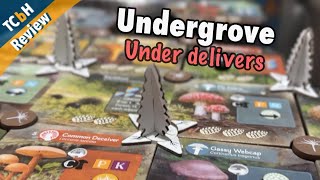
The dissenting voice is The Cardboard Herald, which went in wanting to like the game given Hargrave's track record but came away calling the experience bland. The channel still credited the ecological research behind the theme and the solo mode, but argued the resource cubes and mushroom actions blur together once the novelty wears off. That split, appreciation for the theme and systems paired with a debate over how distinct the moment-to-moment decisions feel, runs through the coverage.
Core Mechanics That Define Undergrove
Five Actions Built Around Trading With Fungi
Every turn comes down to one of five actions, each explained in detail across the teach-throughs. Reproduce spends carbon and phosphorus to add a new seedling and root at a forest intersection, with an optional side cost that lets a player add a mushroom tile first. Partner spends carbon and potassium to add two new roots to existing seedlings instead of a new seedling. Activate exhausts one of four activation tokens and typically spends carbon to trigger a mushroom's printed ability, while absorb exhausts a token and a resource cube to pull carbon out of the forest and onto a seedling. Photosynthesize is the free-ish reset: it hands over carbon, lets nitrogen buy more of it, refreshes all activation tokens, and lets a player redraw their hand of mushroom tiles.
Carbon, Roots, and the Trigger for Endgame Scoring
Carbon does double duty as both currency and clock. Absorbing it pushes a player up the carbon track for bonuses, and reaching the top of that track is what ends the game. It also gates scoring directly: a seedling with one carbon token scores one of its roots, two carbon scores two roots, and three carbon converts the seedling into a tree that scores every root attached to it. Public goal cards add a second scoring layer on top, rewarding things like total trees built by the end of the game. Ilia and Tyler summed up the loop as spending stretches of a turn placing and expanding roots before making a run at the carbon needed to convert them into points.
The Undergrove Experience
An Engine-Building Feel With a Built-In Pace
Ilia and Tyler described the game as having a lot of engine-building feel to it, and credited the carbon track with keeping that pace controlled rather than letting either player run away with it. Their account of a session includes deliberately banking roots and setup for several turns before committing to a push up the carbon track, and they flagged the risk of a root sitting without carbon on it as a real cost of misjudging that timing.
A Curve That Rewards Repeat Plays
Let's Table It went in expecting less complexity than it found, calling Undergrove more complex than expected on a first look, but came out the other side saying that complexity did not translate into dislike, only into needing a few plays to see how the systems mesh. The same account singled out the variable scoring built into some of the mushroom tiles, and the option to reset activation tokens early to retake a strong action, as details that reward that extra familiarity.
What Makes Undergrove Stand Out
Ecological Theming Backed by Real Research
Even The Cardboard Herald's more critical review pointed to the game's commitment to ecology as a genuine strength, calling the representation research-backed rather than decorative. Beyond Solitaire's interview with designer Elizabeth Hargrave fills in why: the team consulted a mycologist while working out the game's mechanics, and built the carbon-sharing system around real, still-debated research suggesting trees show a kind of kin selection in how they trade carbon through fungal networks.
A Thoughtful Solo Mode and Sturdy Presentation
The Cardboard Herald also called out the solo mode specifically, describing it as a thoughtful implementation that would make the game an easy recommendation for someone planning to play primarily by themselves, driven by an adjustable AI deck that competes for sapling spots and consumes board resources. The same review praised the packaging and its commitment to wood and paper materials as commendable, even while finding the gameplay underneath less exciting.
Potential Drawbacks
Resources That Blur Together
The Cardboard Herald's central complaint is that almost every action just trades one colored cube for another, and that the cubes themselves carry no identity beyond their color and a roughly even exchange rate. In that account, the mushroom tiles suffer the same issue: four types and colors of action icons that mostly reduce to a couple of underlying effects, so a game dense with text and abilities still plays out flat rather than dynamic or surprising.
Prototype Components and Early Wear
Both Ilia and Tyler's playthrough and the teach-through channel covering the game showed prototype copies ahead of Undergrove's Kickstarter campaign, with AEG sponsoring those videos, so final components and even the box were expected to change before release. Let's Table It, playing a further-along prototype, still flagged concern about the longevity of the root tokens and noted the storage box had started to come apart after a single play, though the same account expected a little glue to fix it.
If You Enjoy Undergrove
The Cardboard Herald introduced Undergrove by tracing it back to designer Elizabeth Hargrave's breakout hit Wingspan, positioning it as the latest entry in Hargrave's run of naturalist-themed designs. Beyond Solitaire's interview with Hargrave placed Undergrove in that same company, grouping it alongside the designer's other science-inspired games, including Mariposas, as products of the same instinct for turning real ecological ideas into mechanics.
What Reviewers Are Saying
"I like this game. It's got a lot of engine buildy feels to it, which I really appreciate. The game is well paced."
— Ilia and Tyler
"Almost all actions are in exchange of these tiny cubes, swapping colors for other colors, and the colors don't really have any identity or thematic foothold of their own. Each is associated with a different action, but because of the pretty neutral exchange rate, and that aside from carbon these cubes are all produced in essentially the same way, there's nothing really to grasp on to or to care about. They don't feel like they're unique resources that you're juggling or investing in, they're just more cubes that you happen to accumulate and happen to spend."
— The Cardboard Herald
"The game feels polished, it has been worked on for a while, so no problems there. The components are good, mostly cardboard. I'm a little concerned about the longevity of the root tokens, and I like the boxes including for the tight storage in the game, but they have started to come apart just a little bit after one play, but it just needs a little bit glue and they'll be good to go."
— Brody, Let's Table It