








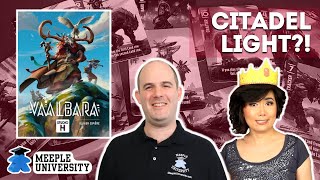



Vaalbara Deep Dive
What the Community Thinks About Vaalbara
Reviewers consistently place Vaalbara in the light, accessible end of the card game spectrum. Rolling Dice & Taking Names and Our Family Plays Games both describe it as a filler that is easy to teach and quick to set up, while still rewarding careful planning. The recurring praise centers on how little table time it takes to get into a game and how clean the core decisions feel. Watch It Played and Chairman of the Board single out the artwork, calling it gorgeous and beautiful, as a reason the game stands out on the shelf and on the table.
Core Mechanics That Define Vaalbara
Simultaneous Card Selection and Initiative
Every player holds an identical deck of numbered character cards. Each round, players choose a card in secret and reveal them together, then resolve the effects from lowest to highest number. Reviewers note that this simultaneous selection is what keeps the game moving. Nobody waits for a turn, and the reveal creates a tension that reviewers compare to a bluffing moment without the bluffing. Because low numbers tend to be weaker or more situational, and high numbers come with a cost in turn order, players must read the table and decide when a strong card is worth the sacrifice.
Land Drafting and Progressive Scoring
Land cards sit in shared rows, and the player who resolves first gets first choice from the current row. Most land types are set collection cards, so a player scores immediately on taking one. Some lands score a fixed amount, while others grow in value as a player collects more of the same type. A few reward pairing with neighboring clans. Because points are gained as the game unfolds rather than only at the end, reviewers say the scoring keeps everyone engaged. The tie breaker uses a sequence printed on the backs of the land cards, which Rolling Dice & Taking Names called a clever tiebreaker mechanic that resolves ties without fuss.
The Vaalbara Experience
How the Table Feels
Reviewers describe the rhythm as quick and social. Players are constantly watching which cards are coming up in the next round, which gives a light sense of planning ahead. The interaction is mostly indirect. Players can steal, swap, or remove cards in the shared rows, and Rolling Dice & Taking Names flags the potential for hate drafting once the rows are picked over. The gameplay rewards attention without asking for a long commitment.
Hand Management and Key Decisions
Each player keeps a small hand of character cards, and a key card lets a player return a played character to hand, which reviewers see as the main way to reuse a strong card. This gives the hand a steady turnover and creates a feeling that each card has a moment to matter. Reviewers who enjoy hand management say the game lets them plan a few steps ahead without drowning in options.
What Makes Vaalbara Stand Out
Accessibility With Real Decisions
Reviewers repeatedly point out that the rules are easy to teach. Most of the rule text lives on the individual clan and action cards, so new players can start quickly. Despite the low barrier, reviewers say the choices feel meaningful. The interplay between when to play a strong card, which land to take, and when to hold back creates the kind of decisions that keep experienced players interested across repeated plays.
Set Collection Without the Drafting Slowdown
The clearest comparison reviewers make is to Citadels. Several argue that Vaalbara keeps the feel of that style of game while removing the slow parts. Each player works from a personal deck rather than drafting from a shared pool, and simultaneous selection keeps turns moving. For reviewers who want a gateway into the Citadels style, the game is often recommended as the first step.
Potential Drawbacks
Swingy Cards and Runaway Leaders
Chairman of the Board flags swingy cards as a real risk, noting that a few card effects can dramatically shift the outcome of a round and that the balance between deck size and hand size can make the game feel more luck-dependent than players expect. Our Family Plays Games adds that as a lighter title, the depth may feel limited for heavier gamers looking for more to chew on.
Abstract Theme
The Board Game Garden notes that the theme can feel abstract rather than fully realized, even as the cards themselves look appealing, and that some of the balance nuances depend on which cards happen to be available. Players who want a strong thematic hook alongside the card drafting may find that Vaalbara leans more on its mechanics than its setting.
If You Enjoy Vaalbara
Reviewers who like Vaalbara tend to point toward a small set of comparison games. Each one shares a piece of the experience while offering a different feel.
- Libertalia: A card drafting and resolution game with a similar pirate-themed tension between timing and reward, which reviewers often name as a close cousin in spirit.
- Citadels: The game reviewers most often reference. Vaalbara is frequently described as a lighter, more streamlined take on its core set collection and character selection ideas.
- King of 12: A compact card game that reviewers mention for its quick play and careful timing decisions, appealing to those who enjoy the same short-session energy.
What Reviewers Are Saying
I think this game is probably the simplest one of all these styles of games that I've played but it might just be my favorite now. The kind of level of interaction in this game doesn't feel frustrating, it feels like if you pull off a card and get the maximum benefit from it, it feels great.
— Chairman of the Board
I think it is a great um like hand management game, easy to get to the table, easy to teach to people. I love the way that the cards looked as well and it was really fun.
— The Board Game Garden
It does have the feeling of a light Citadels, that's true to some extent with simultaneous card selection. Instead of drafting, you're simultaneously choosing cards that will give you special powers that resolve in an order, and that order is also the order in which you're drafting cards from the table.
— Meeple University