/pic5706121.png)














































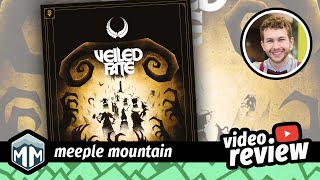



Veiled Fate Deep Dive
What the Community Thinks About Veiled Fate
Veiled Fate has generated genuine enthusiasm across the board gaming community, with reviewers consistently praising its unique approach to social deduction. What stands out most is how the game appeals to players who might otherwise avoid hidden role games. One reviewer noted that they know "a friend who hates werewolf, absolutely hates being in the spotlight, hates lying," yet "dominates it at Veiled Fate because it's all strategic inference." The game creates a new experience entirely, one where deduction happens through gameplay rather than social performance. Players describe feeling excited not just about the base game but about the direction the design takes the genre. The beautiful production quality from IV Games has also earned consistent praise, with the circular board, color-coded demigods, and elegant component design creating an appealing first impression that matches the depth of the mechanics underneath.
Core Mechanics That Define Veiled Fate
Hidden Roles and Strategic Deduction
The heart of Veiled Fate is its take on hidden roles. Each player is secretly assigned one of nine demigods, and their goal is to help that demigod accumulate the most renown by the end of three ages. The twist: you control all nine demigods on the board, not just your own. This forces you to move demigods other than yours while doing so strategically enough that other players cannot determine which one belongs to you. Reviewers highlight that this creates "strategic deduction" rather than "social deduction," meaning players figure out identities through observed behavior and gameplay choices, not through lies told face-to-face. One reviewer emphasized: "There's no performance, no lying to people's faces. You're just making moves and other players are trying to figure out which demigod you care about based on what you're doing."
Voting and Quest Resolution
Veiled Fate's quest system drives the core experience. Players move demigods onto quest cards, and when a quest is filled, everyone votes using fate cards marked with feathers or scorpions. The majority determines which effects resolve, creating moments of tension and surprise. Reviewers note that the voting mechanism ties voting directly to card play, meaning you must carefully consider which cards to spend. The system creates interesting moments where you're torn between helping your secret demigod and maintaining your cover, or where the outcome of a vote surprises everyone because the hidden votes didn't align with expectations. One reviewer described the experience: "After you vote once right there in those quests, you must vote...You place a vote card in the vote pile and we're basically going to count all the cards that have been submitted into the vote pile and see if there are more feathers or there are more scorpions."
The Veiled Fate Experience
Strategic Tension and Constant Engagement
Playing Veiled Fate creates sustained tension throughout all three ages. You're balancing multiple goals: helping your demigod advance, preventing others from discovering which demigod is yours, and reading the table to determine who supports which character. Reviewers consistently mention that the game moves quickly despite its strategic depth, with plays typically completing in 60-120 minutes. The tension never truly dissipates because the final ages can shift standings dramatically. One review noted that the game "scales to eight players, which is rare for a game this strategic. Most games at eight players are party games or social deduction. This is neither."
Accessible Yet Deep Deduction
What makes Veiled Fate special is that it feels inviting rather than overwhelming. The rules are learnable in a single session, yet the deduction becomes richer the more you play. Reviewers appreciate that new players can grasp the basic flow quickly, understand that they're managing a hand of cards to vote and move demigods around a board, yet still have plenty to discover about reading other players' strategies. The game rewards observation without requiring anyone to be the best liar or performer at the table, which expands who enjoys it. A reviewer described the accessibility: "We've played it everywhere from two players up to seven, and it scales shockingly well."
What Makes Veiled Fate Stand Out
A New Genre for Large Groups
Veiled Fate fills a genuine gap in the market: a game for large groups (up to eight players) that doesn't rely on party game mechanics or traditional social deduction. One reviewer called it "creating a new genre, strategic deduction or something. You're deducing, but you're doing it through gameplay, not through social pressure." This is significant because most eight-player games either devolve into party games or lean heavily on performance and lying. Veiled Fate's strength is that it lets strategic players shine while remaining engaging for everyone else. The six-to-eight player variant also introduces a clever twist: at those player counts, two players control the same demigod without knowing who each other are, forcing secret teamwork.
Beautiful Production and Variable Gameplay
IV Games has earned a reputation for exceptional component quality, and Veiled Fate reflects that commitment. The massive circular board depicting nine regions, the color-coded demigods with distinct bases, and the elegant card designs all contribute to an inviting table presence. Beyond aesthetics, reviewers highlight the game's variability. Age cards change from game to game, city cards unlock different effects, and the nine demigods create different board states each play. This variability ensures that multiple plays feel fresh, addressing a concern many have with hidden role games: repetition. A reviewer noted that "there's a large stack of city cards so every time you play it's always going to feel kind of different."
Potential Drawbacks
Theme May Intimidate Casual Players
The mythology theme and the game's emphasis on area control and resource management can feel less immediately approachable than a party game. Some players, particularly those new to modern board games, might look at the demigod concept and complex board and hesitate. However, reviewers note this is more of a perception issue than a real mechanical barrier. Once a player experiences a game, the theme becomes part of the charm rather than a barrier. One reviewer acknowledged: "The theme might not be for everybody. This is one that it is a little bit like, if you're going to get into a more competitive party atmosphere, strategic party atmosphere, that probably won't be a hold up."
Demands Observation and Memory
Successfully identifying other players' demigods requires remembering which demigods received which cards in which quests, and tracking which players seemed to support which outcomes. This demands more attention than a typical party game. Players who prefer less mental engagement might find themselves overwhelmed by the amount of information to track, especially early in learning the game. However, this depth is also what appeals to strategic players, so whether this is a drawback depends entirely on your group's preferences.
If You Enjoy Veiled Fate
Players who love Veiled Fate should explore other IV Games titles like Moonrakers, a deck-building negotiation game with similar production quality and mechanical depth. For fans of hidden role mechanics without the performance aspect, One Night Ultimate Werewolf offers quicker play but less strategic engagement. Those seeking more area control mixed with deduction might enjoy traditional strategy games like Twilight Struggle. For players who want the party game feel but with more mechanics, Blood on the Clock Tower offers social deduction with different innovation: eliminated players remain in the game as ghosts, solving the player elimination problem.
What Reviewers Are Saying
"It's creating a new genre, strategic deduction or something. You're deducing, but you're doing it through gameplay, not through social pressure."
— Board Game Critique
"Strategic social deduction misdirection and mischief, high player count, secret teams, seriously this is a perfect convention game. I am so excited to have played it. I loved it. I can't wait to play it more."
— Paula Deming
"You're moving other people's demigods trying to help your own, and the whole time everybody's watching what you do. It creates this fascinating puzzle where every single action is a clue."
— Meeple Mountain