/pic6728813.jpg)












Village Rails Deep Dive
What the Community Thinks About Village Rails
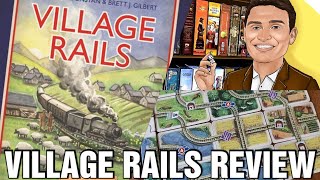
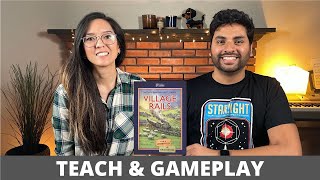
Village Rails occupies a curious spot in the board game landscape. It is a small box, easily transportable, and mechanically lean, yet channels like The Brothers Murph and Chairman of the Board consistently note that it delivers more strategic depth than its compact footprint suggests. The game does not break new ground in terms of mechanics, yet the way it combines familiar systems creates something that feels fresh and engaging. Community consensus suggests this is a game that deserves more attention than it receives.
Core Mechanics That Define Village Rails
Drafting and the Economy
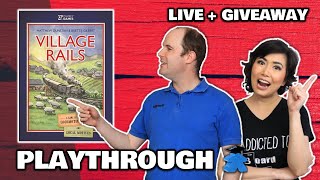
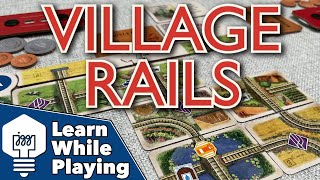
At its heart, Village Rails employs open drafting with a clever economic layer. You access a display of track cards, and while the oldest card is free, each card you skip over costs you one coin. As you take cards, coins accumulate on the cards you pass, creating a dynamic where leaving cards behind can either help or hurt future players. Designed by Matthew Dunstan and Brett Gilbert and published by Osprey Games, this economy forces constant negotiation between efficiency and affordability, generating tension throughout the short playtime of around 45 minutes.
Route Building on a Fixed Grid
Players build out a personal grid representing their railway network. Each track card placed must connect to an existing card or the border of the grid. The spatial puzzle of fitting cards into this constrained space creates satisfying moments of planning and adaptation. When a track reaches the edge of the grid, that line completes and scores, forcing players to manage both short-term cash flow and long-term point optimization.
The Village Rails Experience
Puzzly Satisfaction
The game delivers on what reviewers call a puzzly nature. Each turn presents a genuine puzzle: which track fits best, where does it go, and what does that decision enable or prevent? The brain burn is moderate, making the game accessible without feeling trivial. Players describe the experience as trying to spin multiple plates at once, managing money, track placement, and objective completion all within a tight number of turns.
Resource Management Tension
Money is the gating mechanism throughout. You need currency to purchase trip cards (objective cards that can multiply your points), and the only reliable way to generate cash is by completing lines and using terminus cards that pay based on what you have built. This forces tough decisions: do you rush a line to completion for cash, or hold it open longer hoping for better scoring conditions? The game becomes tight financially by the midpoint, creating sustained tension despite its gentle theme. Reviewers note that the squeeze between needing cards now and needing money later is what gives a small box such a satisfying bite, since almost every turn forces a small sacrifice somewhere on your board.
What Makes Village Rails Stand Out
Concise Design That Respects Your Time
The game delivers a complete arc in under an hour, yet never feels rushed. The turn structure is immediately visible and understandable, so players know exactly when the game ends, which changes how they approach each decision. This clarity, combined with modest table-space requirements, makes Village Rails the sort of game you can teach and play before moving on to something heavier, or play twice in an evening without exhaustion.
Elegant Combination of Mechanics
While none of the individual systems are revolutionary, their interaction creates depth. The drafting economy ties directly to the track-building puzzle, which feeds into trip-card scoring. The terminus cards that players use when completing lines reward thematic combinations. Reviewers note that the game strikes a balance between accessibility and thinky gameplay, making it suitable for both casual and experienced players.
Potential Drawbacks
Iconography Clarity
Several reviewers noted that some terrain types on the track cards can be visually similar, particularly for colorblind players. The icons, especially when partially obscured by artwork, occasionally require clarification from other players during play. This is a minor issue that does not impede enjoyment but can add momentary friction.
Limited Replayability Ceiling
While the game has a large deck of trip and track cards, reviewers suggest that after several plays the core decision space can feel familiar. The game does not have the endless variability of heavier designs. Some players reported reaching a point where they felt they had explored the design space sufficiently, though this typically occurs well after the point of diminishing enjoyment.
If You Enjoy Village Rails
You might explore Village Green, another Osprey Games small-box tableau builder that shares some DNA but uses a different mechanical approach. For those drawn to the railway theme, Ticket to Ride provides a lighter entry point into route-building, while Steam offers deeper railway economics. The skip-and-pay drafting economy also appears in games like Jaipur, though with less spatial puzzle integration.
What Reviewers Are Saying
"It is a nice, charming little game. It's very concise, nice and small. It's just a charming little puzzly game, and it's exactly what I wanted. A great way to start off the evening, easy to learn. These are the type of games that I love, that will stay on my shelf."
— Rolling Dice & Taking Names
"It's a nice charming little game. I do feel like it doesn't do anything tremendously new, but it strikes a nice balance between being very accessible yet pretty thinky at the same time. The player interaction stems back to the drafting, and it's nice that you have this currency, because when you skip over things you leave opportunities for your opponents to grab the money and potentially use that to hurt you in the future."
— Chairman of the Board
"I think this game is incredible. It's that great little travel game, the perfect epitome of small box, big gameplay. Pretty quick, pretty easy to get into. I'm so charmed by this game constantly. I love the little puzzle you do, because every single round you have to take a rail card, so you're trying to make it work."
— The Brothers Murph