












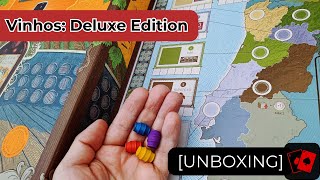

Vinhos (Portuguese word for "wines") is a trading and economic game about wine making.
Despite its small size, Portugal is one of the world’s leading wine producers. Why not get to know the country around a table? Over six years of harvests, cultivate your vines, choose the best varieties, hire the best oenologists, take part in trade fairs, and show your opponents you are the best winemaker in the game.
The players, winemakers in Portugal, will develop their vineyards and produce wine to achieve maximum profit.
The object of the game is to produce quality wines that can be exchanged for money or victory points.
The best wines are then sent to a wine fair in order to achieve fame and win awards.
Awake your senses and have fun making and selling your own wine.
From back of Box Cover:
In Vinhos (a Portuguese word meaning “Wines”) you will play the role of wine producers in Portugal.
Over a period of 6 years, you will expand your business by establishing Estates in the different regions of Portugal, buying vineyards and building wineries. Skilled enologists will help you increase the quality of your wine, while top Wine Experts will enhance its features at the "Feira Nacional do Vinho Português", the Wine Tasting Fair.
Selling your wines to Portuguese local hangouts will establish a market presence for your company, help you secure the funds to expand your company, and to pay your enologists’ salaries.
But, as everyone knows, prestige cannot come from money alone. To ensure a good reputation on international markets you must meet the requirements of various Countries, by consistently exporting high-quality wines.
Periodically, a Wine Tasting Fair will be held. It is up to you to decide the best time to announce which wine you intend to present. The choice of the best wine by value and features is essential to the prestige of your company and will definitely make all the difference!
It is suggested that players do not play their first game with the maximum number of players.
Vinhos was previously known as Vinícola
- Strong thematic integration of urban waste management with a tense, competitive auction/majority engine.
- Explicit no-tie rule creates clear, decisive control dynamics on patron tracks and cubes.
- Four distinct phases give a rhythmic, strategic cadence that rewards planning and timing.
- Dynamic card market with flip/discount mechanics adds depth and replayability across rounds.
- High learning curve due to dense rules, iconography, and multiple interacting systems.
- Prototype-era components and balance may shift; players should expect rule clarifications during play.
- Some players may find the engine heavy and the setup lengthy, especially with higher player counts.
- No explicit rating given in the video; potential buyers may need external references to assess value.
- Rival nightilo (nightly) companies turning waste into profit while navigating city dynamics, patron influence, and city governance.
- London, with day and night cycles, urban landscape focused on waste management and corporate competition.
- Card-driven, city-builder/area-control flavor with murky public image and private profit. Emphasis on timing, resource flow, and territorial control across neighborhoods.
Mechanics (from transcript analysis)
- Laborer cards and market — Laborer cards provide ongoing or flip-based abilities. Players can spend coins to acquire new laborer cards from a face-up market, refreshing the market as cards are purchased or discarded.
- Night soil cube movement and city management — Night soil cubes move through neighborhoods via card actions. Neighborhood limits exist (three cubes in regular neighborhoods, two in royal neighborhoods). Moving cubes and cleaning neighborhoods drive income and scoring, with neighborhoods becoming clean when the last cube leaves. Tokens and coins may be claimed when neighborhoods are cleaned.
- Patron tracks and majority — Patron tiles form tracks around the board. Players place tokens to claim patron actions and pursue majority. The player with the most tokens on a track gains the track's benefit; there are no ties for most, except for the sheriff patron tile, which is treated specially.
- Phase-based structure (day/evening/night/morning) — Each round consists of four phases. Day phase centers on placing workers and performing actions; evening adds mele-related effects and bonuses; night moves cubes and returns resources; morning resolves income and prepares for the next round, including converting cubes to coins and determining round bonuses.
- Variable Phase Order — Each round consists of four phases. Day phase centers on placing workers and performing actions; evening adds mele-related effects and bonuses; night moves cubes and returns resources; morning resolves income and prepares for the next round, including converting cubes to coins and determining round bonuses.
- worker placement — Players place workers on action spaces to perform actions (advertise, improve assets, influence patrons, move resources). After each worker placement, a night soil cube is placed in the corresponding neighborhood, with production dependent on the size of the worker (small = 1 cube, large = 2 cubes).
Video topics + discussion points
Quotes (from this video)
- In Nights, you compete as rival nightil companies, working day and night to turn waste into profit in the streets of London.
- There are no ties. What this means is that when players are tied for most, no player will be considered to have the most and no player will gain the benefit or reward.
- All actions are mandatory. You cannot place a worker and not take the action.
- This icon lets you move your place tokens either anywhere on the patron track to a different space on any patron track or anywhere in a neighborhood to a different neighborhood.
References (from this video)
- tight action economy
- interesting competition mechanic
- great visuals
- heavy for casual players
- wine competition and scoring
- wine production with regions and weather
- compact, strategic
Mechanics (from transcript analysis)
- 3x3 action matrix — movement to adjacent actions with cost
- multi-region vineyard building — build vineyard regions for abilities
- Weather system — weather affects wine production
Video topics + discussion points
Quotes (from this video)
- one of my absolute favorite cooperative games of all time
- this is another time travel themed game
- it's a ton of fun
- the solo mode is so quick and simple
- it's just a great worker placement Deck Builder
- the theme really works
References (from this video)
- Strong thematic integration of wine production, regional strategy, and global competition.
- Multiple interlocking systems provide deep strategic decisions (production, value management, fairs, and exports).
- High replayability due to dynamic vintages, regional bonuses, and magnate interactions.
- Satisfying for players who enjoy heavy euro-style engine-building with thematic flavor.
- Significant rules complexity and a steep learning curve for new players.
- Long playtime and heavy components management may deter casual players.
- Some players may find the central action mechanic fiddly or dense during setup and play.
- Winery management, regional economies, and reputation building through domestic sales and international exports
- Portugal, across multiple wine regions, pursuing production and prestige with vineyards, wineries, sellers, and fairs
- Eurogame economic simulation with heavy thematic phrasing around wine quality vs. value, vintages, and market prestige
Mechanics (from transcript analysis)
- Action spaces and movement — The game uses a central action-board where players have to move their meeple (or 'MLE') to one of nine action spaces each round. Players perform two actions per round and must update their position relative to the round marker. Moving costs money depending on destination: non-adjacent moves cost, moving to the space with the round marker costs money, and landing on a space occupied by another player costs each rival one money. The central action space is special—moving there costs nothing to the bank or to other players. The start position is central, and players rearrange turn order via a separate track mechanism.
- end game bonuses — After each round, maintenance occurs (barrels are returned, etc.), then production. At the end of rounds three, five, and six, wine tasting fairs award points based on wine value and magnate interactions. End-game scoring considers money left, remaining wine tiles, majority control of barrels in export columns, and purple magnate tiles with barrels. The winner is the player with the most victory points after final scoring.
- end-of-round and end-of-game scoring — After each round, maintenance occurs (barrels are returned, etc.), then production. At the end of rounds three, five, and six, wine tasting fairs award points based on wine value and magnate interactions. End-game scoring considers money left, remaining wine tiles, majority control of barrels in export columns, and purple magnate tiles with barrels. The winner is the player with the most victory points after final scoring.
- Estate, vineyard, winery, and seller management — Players manage Estates that host Vineyards, Wineries, and Sellers. Vineyards must be region- and color-consistent when expanding or creating estates; new estates grant bonuses (e.g., a free seller). Each estate accumulates components that determine wine quality and how it can be improved. Vineyards and Winery tiles increase wine quality, while Sellers hold wine and transfer wine when purchased to boost immediate value. Regions provide Renown Cubes that can be spent to raise the value of wines and to unlock regional bonuses.
- Export vs. local sales and barrel management — Wines can be sold to local establishments for money or exported for victory points. Each sale or export requires placing a barrel on the corresponding slot (red wine on red slots, white on white). The slot’s minimum value defines the cash or points gained, and barrels from established regions can be enhanced by spending Renown Cubes. Barrels contribute to end-game scoring and are essential for exporting to gain points while contributing to the eventual majority calculations in the export area.
- Magnates, booths, and action tiles — Magnate action tiles provide special end-game or mid-game bonuses. Players can discard wine tiles to take action tiles, which can be used on their turns in addition to normal actions. Action tiles may be flipped after use and reset after the first two fairs. Purple tiles grant extra end-game points, but to take a purple tile you must place a spare barrel on it and must have space to do so. Refill of tiles happens at the end of each fair, and tiles may be reassigned or removed as rounds progress.
- Production and weather influences — Production occurs at the end of each round, where wines produced by Estates are computed based on Vineyards, Farmers, Wineries, Enologists, and a weather modifier drawn from the Vintage tile. The formula yields a wine's final value for sale or scoring: two points per Vineyard, one per Farmer, one per Winery, two per Enologist, plus a weather-based adjustment between -2 and +2 depending on the current year. If the end quality is zero, no wine is produced from that estate. Weather, shown on the Vintage tile, adds strategic variability each round.
- Renown cubes and value modification — Renown Cubes are a resource used to boost the value of wines beyond their base quality. When you buy regions, you place Renown Cubes in those regions. You can remove up to two Renown Cubes when selling, exporting, or presenting wine to raise value by one for each cube removed. Additionally, certain regions carry explicit bonuses that increase wine value. A wine’s value (not its quality) is what matters most for selling and for fairs.
- Wine fairs, press releases, and magnates — There are three wine fairs (rounds 3, 5, and 6) where players score additional victory points. Players may perform a press release to enter a wine in the upcoming fair, which involves determining the wine’s value, selecting a booth, using experts to boost fair points, satisfying magnate expectations, and discarding the wine tile after scoring. Press releases can be done at any time, not only in the round of a fair, and doing so early yields advantages (earlier access to booths and additional barrels for future releases). Experts and vintage tiles influence fair points via symbols, with some tiles offering extra bonuses when used.
Video topics + discussion points
Quotes (from this video)
- The central space of the quadrel never costs you money to move to this space.
- The bigger the number the better the wine.
- This wine is currently value five.
- Spend one Renown Cube to make it value nine.
- Gain Fair points equal to the value of the wine.
- The value of this wine starts off at the Quality plus any modifiers shown in a circle icon.
References (from this video)
- Tight action economy with a clear core loop: acquire vineyards, age wine, and sell/export for points while juggling renown cubes and weather effects.
- Strategic depth achieved through coupling of production, aging, and market scoring; expansions (Azores, magnates, specialists) add meaningful variety without breaking the core rhythm.
- Balanced bank mechanism that rewards prudent liquidity and timely investments, while still pushing players to commit to ambitious plans.
- Beautiful component design and thematic cohesion; aesthetics and art reinforce the wine-world flavor while streamlining interpretation of complex rules.
- Teachability on stream is strong: Edward provides a structured, step-by-step walkthrough that clarifies core concepts before diving into full-player interactions.
- Event-driven scoring via weather tiles and magnates creates dynamic scoring opportunities across rounds, encouraging adaptive strategies.
- Inclusion of expansions significantly increases complexity and setup, which may be challenging for new players or casual streams seeking a lighter experience.
- The production/aging phase, while conceptually elegant, can be intricate in practice due to multiple interacting modifiers (weather, enologists, farmers, ports, and regional bonuses).
- The sheer volume of moving parts (estates, tiles, renown cubes, barrels, and magnates) can lead to information overload on first plays.
- Wine production, aging, and trade; vineyard acquisition and estate management; regional renown and prestige via wine fairs
- Portugal, centered in the Douro Valley with outlying Azores islands; a six-year arc culminating in wine fairs where players showcase aging wines to earn points
- Euro-style economic simulation with clear thematic anchors (regions, ports, aging, and market-based scoring); emphasis on logistics, timing, and strategic risk management
- Lisboa
- The Gallerist
- Speak Easy
- The Great Library
- On Mars
- Weather Machine
- Inventions
- Conbon
Mechanics (from transcript analysis)
- action_selection — On each annual round, players take two actions, then progress the turn order via a shared, but instrumented, sequence. The base action set is augmented by expansions (magnates, enologists, farmers, and the Azores tiles) which provide additional actions or modifiers. Movement between spaces has costs (wood/bags back to the game) and adjacency rules, creating a tight optimization problem about where and when to act.
- end game bonuses — Wine fairs occur in the third, fifth, and sixth years. Players automatically present wines (or can prepare with a press release in the center area to affect turn order) and then use wine experts to influence scoring according to weather-driven magnates. Ties are resolved with established rules and final scoring combines bank balance, export majorities, and magnate-driven multipliers for a final winner.
- end_game_scoring_and_wine_fairs — Wine fairs occur in the third, fifth, and sixth years. Players automatically present wines (or can prepare with a press release in the center area to affect turn order) and then use wine experts to influence scoring according to weather-driven magnates. Ties are resolved with established rules and final scoring combines bank balance, export majorities, and magnate-driven multipliers for a final winner.
- expansions_and_extras — Azores expansion enables more regional tiles, more flexible production tracks, and expanded vineyard placement rules; magnates and experts introduce additional tactical options such as recalling barrels, purchasing new vineyard tiles, and leveraging one-time-use abilities at the wine fair. The mixed expert deck introduces randomized, color-coded effects with both instant and deferred benefits that influence when and how you can deploy them.
- production_and_aging — Wine is produced and aged across all estates in parallel during a production phase. Existing wines age to the next slot; aging beyond the final space is discarded. Each wine's value is calculated based on several factors (base value from vineyards, presence of farmers and enologists, weather modifiers, and whether ports or special techniques are used).
- renown_markers_and_region_control — Renown cubes are placed in regions tied to vineyards and estates. They are used to improve wine values, unlock end-game bonuses, or shift turn order. The rule set enforces color-matching constraints (two wines of different colors in the same region cannot occupy the same estate) and allows a capped number of tiles per region to control diversification and scoring balance.
- sales_export_and_bank_balance — Wine can be sold for cash (bank) or exported for victory points. Sales convert barrels into money, while export converts barrels into VP and potentially unlocks end-game bonuses. Renown cubes from the wine's region can modify values during sales/export, and magnates or other special actions can further alter outcomes. The bank system provides liquidity, dividends, and investment opportunities each maintenance phase.
- tile placement — Vineyards are bought for regional tiles and placed into estates on a personal board. Each estate can hold one vineyard tile per region, with renown cubes attached to track prestige and affect production/market modifiers. Tiles come in red/white variants, and the Azores expansion lets players place more diverse tiles in an estate with shared limits.
- tile_placement_and_vineyard_management — Vineyards are bought for regional tiles and placed into estates on a personal board. Each estate can hold one vineyard tile per region, with renown cubes attached to track prestige and affect production/market modifiers. Tiles come in red/white variants, and the Azores expansion lets players place more diverse tiles in an estate with shared limits.
Video topics + discussion points
Quotes (from this video)
- No fluff. No fluff.
- The bank is integral to the balance of the game.
- The longer you let it go, the better it gets.
- We have 12 actions and a few extra via magnates; use them wisely.
- The weather tile can swing the numbers dramatically from year to year.
- This is Vinhos in its prime, especially with Azores and magnates.
References (from this video)
- Deep thematic integration of wine production and market dynamics
- Rich, multi-layered decision space with many strategic options
- Engaging production and fair bidding mechanic
- Rules-heavy and potentially opaque for new players
- Long setup and component management
- Numerous fiddly interactions may slow down play
- Wine production, aging, and regional strategy
- Portugal (Lisbon, Minho, Algarve, etc.)
- Economic simulation
Mechanics (from transcript analysis)
- Action selection on a grid — Players move a marker on an action grid to take actions in different regions; actions are limited per round, with potential for extra actions via wine experts.
- Banking and investments — Money management through a bank, investments, and divestments with dividends and end-game bonuses.
- Investment — Money management through a bank, investments, and divestments with dividends and end-game bonuses.
- Market systems — Two markets (internal and export) with different scoring and bonuses; weather and renown cubes influence sale value.
- Renown cubes — Renown cubes provide bonuses and can boost wine values or unlock actions; cubes are drawn from regional regions.
- Weather effects — Each year has weather that affects production value, altering the base value of wine.
- Wine aging and cellars — Wines age in bottles or with cellars, improving value and quality; wine types cannot be mixed within an estate.
- Wine fair and press release — Wine fair mechanics determine immediate and end-of-game scoring; press releases influence turn order and allow certain bonuses.
Video topics + discussion points
Quotes (from this video)
- the weather is going to affect the quality of the wine you produce every year
- you could get up to 20 actions
- the production value is calculated as described
- export market... to sell wine
- renown cubes boost the value of your wine