
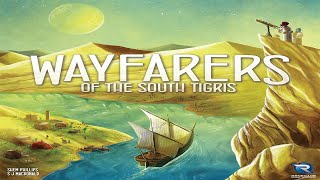






























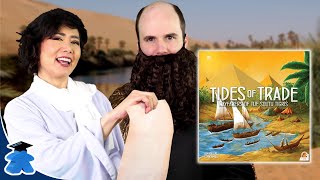
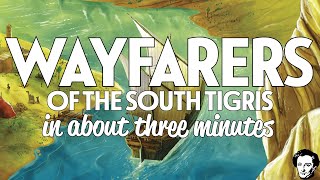
Wayfarers of the South Tigris is set during the height of the Abbasid Caliphate, circa 820 AD. As brave explorers, cartographers and astronomers, players set off from Baghdad to map the surrounding land, waterways, and heavens above. Players must carefully manage their caravan of workers and equipment, while reporting back regularly to journal their findings at the House of Wisdom. Will you succeed in impressing the Caliph, or lose your way and succumb to the wilderness?
The aim of Wayfarers of the South Tigris is to be the player with the most victory points (VP) at the game's end. Points are primarily gained by mapping the land, water, and sky. Players can also gain points from upgrading their caravans, by gaining inspiration from nobles, and by influencing the three guilds of science, trade and exploration. As they make discoveries, players will want to quickly journal their progress. The game ends once one player’s marker has reached the far right column of the journal track.
—description from the publisher
- deep, rewarding tableau-building with many options
- clear directional guidance via journals
- complexity may challenge new players
- tableau building with journaling progression
- South Tigris with a journaling track
- detailed, goals-driven
Mechanics (from transcript analysis)
- journaling objective progression — progress through mini-goals tracked across the journal.
- tableau building — build an evolving set of cards to score points in a tableau.
Video topics + discussion points
Quotes (from this video)
- it's such a good Gateway game
- the art on the cards looks fantastic
- it's one of those simple flip and write games that you just want to play again and again
- the lazy Susan is genius
- Planet Unknown just knocks our socks off
References (from this video)
- Engine-building feel with modular discovery elements
- High interactivity and meaningful player moments
- Complex, with a high learning curve for first-time players
Mechanics (from transcript analysis)
Video topics + discussion points
Quotes (from this video)
- This is a cooperative decorating game where you're basically trying to meet the conditions of the house in order to make it work.
- One of the best crunchy feel type of games in the shorts amount of time.
- It's a really tight 4x4 puzzle and very replayable.
References (from this video)
- unique dice-based worker placement with shared tactile feel
- solo mode available and varied AI opponents
- strong theme and feel of exploration
- can be heavy for casual players
- tableau-building with territorial exploration
- exploration across land, sea, and sky
- story-driven exploration with a dice/worker nuance
Mechanics (from transcript analysis)
- deck manipulation — dice pips and faces influence what actions are available.
- dice placement — dice act as workers that occupy placements to gain effects.
- dice_manipulation — dice pips and faces influence what actions are available.
- dice_worker_placement — dice act as workers that occupy placements to gain effects.
- tableau building — build a tableau by selecting actions through cards and tiles.
- tableau_building — build a tableau by selecting actions through cards and tiles.
Video topics + discussion points
Quotes (from this video)
- Earth is a fantastic bang for your buck.
- Tableau building with simultaneous play is great.
- I love this game so so much.
- I could talk about this for hours on end because I love this game so so much.
- I hate the way the game looks but I absolutely love the game play.
- Please ignore the look of it, try Concordia, I promise you you will enjoy it.
- Stardew Valley is a cooperative game, a great one to bring to the table if you have people in your life who aren't into board games.
- Cartographers is one of my favorite role and write games and will always have a special place in my heart.
- Near and Far is a campaign game; Francis and I have played through quite a few maps and we love this game.
- Tapestry is probably one of my favorite games right now; it's just so satisfying to me.
References (from this video)
- Dense, multi-path engine with rich interlocking systems
- Engaging solo mode with a responsive AI that ramps pace
- Strong thematic cohesion through journaling and exploration imagery
- Clear routes to end-game scoring via sets and guild influence
- Steep learning curve due to dense icons and interactions
- User interface and iconography can be dense until familiar
- End-game scoring tables and city/harbor/townfolk interactions are easy to miscount
- Exploration, cartography, and exploration-driven advancement across land, sea, and space
- Baghdad, 820 A.D., explorers/cartographers/astronomers map land, waterways, and skies
- journaling-driven storytelling with card- and tile-driven tableau construction
Mechanics (from transcript analysis)
- AI solo opponent — A programmable solo opponent uses an action deck and rest cycles to simulate competition
- card drafting — Spend provisions to draw from top decks, gain immediate benefits, or draft via special actions
- Card drafting and deck management — Spend provisions to draw from top decks, gain immediate benefits, or draft via special actions
- Dice crafting and icon sequencing — Roll dice, attach them to spots, collect tiles to modify icons and broaden activation options
- Influence and guild-majority scoring — Influence tokens on guilds contribute to end-game scoring and strategic positioning
- Journaling track and end-game trigger — Advance on a journaling track; reaching its end triggers end-game scoring dynamics
- programming — A programmable solo opponent uses an action deck and rest cycles to simulate competition
- tableau building — Land, sea, harbor, space, and inspiration cards form a layered tableau with synergies
- Tableau construction with multi-type cards — Land, sea, harbor, space, and inspiration cards form a layered tableau with synergies
- worker placement — Assign workers to 16 board spots; color-specific spots constrain who can use them
Video topics + discussion points
Quotes (from this video)
- "This is the first game in the South Tigers Trilogy by Shem Phillips and SJ McDonald"
- "we're brave explorers cartographers and astronomers setting off from Baghdad"
- "the solo opponent doesn't care about silver and Provisions"
- "the AI deck this is how they're going to be taking actions"
- "end of the game we're going to score points"
- "Lan cards always go to the left of your board"
- "I'm fairly tempted to take this card right here"
- "the top number is a one so we move the marker one space"
- "this is going to let me influence another card"
- "that's going to trigger the end of the game"
References (from this video)
- innovative dice/Caravan mechanic
- strong objective-driven play with color-cards
- replayability from objectives
- dice worker placement with caravan manipulation
- Caravan trade in a fantastical southern region
- adventure/trade objective-driven
Mechanics (from transcript analysis)
- caravan optimization — manipulate die values to maximize action options
- dice placement — roll dice and assign pips to actions via caravan lanes
- dice worker placement — roll dice and assign pips to actions via caravan lanes
- tile and tableau layering — place tiles into columns and build a tableau with objectives
Video topics + discussion points
Quotes (from this video)
- Cascadia is my number 10, it is a fantastic puzzly tiling game
- the veil of Eternity this game is so good
- Twist on Hadrian's Wall in Paladins feels similar but fresh
- Wayfarers of the South Tigress, carvan mechanic is one of my favorite things in a game
- Castles of Burgundy is my number one game of all time
References (from this video)
- beautiful, impressive tableau presentation
- varied solo AI boards add replay value
- manageable yet substantial for a heavier solo game
- long playtime for solo
- initial intimidation from AI boards
- iconography requires acclimation
- exploration, discovery, tableau construction
- earth tableau across land, sea, and space with journaling track
- lush, story-driven tableau with evolving caravan
- Batoku
Mechanics (from transcript analysis)
- caravan tiles and space cards — tiles determine dice usage and scoring on your caravan
- dice workers on tableau — place dice as workers on your tableau and influence dice values via tiles
- journaling track end-game trigger — progress along the journaling track ends the game
- set collection — score from tableau cards and space objectives
- set collection and objectives — score from tableau cards and space objectives
Video topics + discussion points
Quotes (from this video)
- the flowchart in this is the smallest little flow chart
- the solo AI is easy to manage
- I really really enjoy the solo variant
- randomness opens me up to enjoying the challenge
- it's intimidating but not as scary as it looks
References (from this video)
- rich mechanics in one game
- challenging solo mode
- beautiful components
- solo can be very challenging
- risk of cognitive load
- tableau building, engine-building, and exploration
- ancient trade routes across land, sea, and sky
- adventurous, historical-fiction vibe
Mechanics (from transcript analysis)
- dice workers and engine-building — dice-based actions and variable engine construction
- tableau building — assemble land/sea/sky cards into a tableau
- tableau-building — assemble land/sea/sky cards into a tableau
- worker placement — place workers to enable actions and build caravan
Video topics + discussion points
Quotes (from this video)
- the hype of final girl is real
- I freaking love Final Girl
- Cascadia is a fantastic solo game
- On Tour Paris and New York... a very unique rolling-right
- Twilight Inscription is absolutely fantastic
- Wayfarers of the South Tigris is absolutely fantastic
References (from this video)
- deep, customizable dice mechanism with strong thematic payoff
- trilogy cohesion and distinct feel within the same mechanic family
- rule complexity and setup can be intimidating
- requires a committed group to explore full depth
- dice customization and caravan tableau
- silk road caravan journey across southern regions
- dice-then-build tableau of worker-placement spots
Mechanics (from transcript analysis)
- dice customization — modify pip numbers for caravan dice to tailor actions
- dice workers — start with three dice, expand to five; you customize pip numbers
- tableau building — build a tableau of cards that become worker placement spots
- tableau-driven actions — build a tableau of cards that become worker placement spots
Video topics + discussion points
Quotes (from this video)
- This has been the hardest one thus far to rank because there are so many games that are like amazing with this kind of mechanism of using dice in cool ways.
- I love the mechanism video. There are so many good dice games.
- Wayfarers of the South Tigers is my number one favorite game that uses dice in cool ways.
References (from this video)
- Clever dice caravan mechanic allows tailoring dice to actions
- Rich thematic integration with exploration and journaling
- Mitigation and customization options add depth
- Complexity may be intimidating for new players
- exploration and discovery, caravan-building
- Exploration of lands, sea, and sky; journaling track
- world-building through a journaling mechanic
Mechanics (from transcript analysis)
- dice as workers with a caravan/tiles system — Dice faces are customized via the Caravan grid; tiles modify die usage for various actions.
- dice-driven worker placement — Place dice to activate different worker spots; tiles determine reach and outcomes.
- tile-based die-face customization — Tiles below numbers alter which actions a given die can perform.
Video topics + discussion points
Quotes (from this video)
- I really love the way that this works
- I really enjoy this solo as well
- the dice Caravan mechanism is really cool
- the dice mechanism for this one is you have three dice in three different little spots
- the dice in this game are absolutely beautiful
- you are creating a character … you are trying to complete all of your different attributes
- I really enjoy the dice puzzle mechanism that they have in role player
- the end scoring phase you're going to lose some points and also you're going to have less for the next round
References (from this video)
- Huge decision space with multiple viable engine-building paths
- Tension and momentum generated by the central board race
- Wide variety of engines and scoring avenues (space cards, inspiration cards, and matching icon sets)
- Upgrade tiles expand die-slot options and open new play styles
- End-game gates provide clear long-term goals and planning incentives
- Resource management and timing create satisfying strategic depth
- High complexity that can be overwhelming for new players
- Opening turn presents many options (roughly 20), making initial planning challenging
- Can be less accessible for players who prefer lighter, quicker games
- Requires sustained strategic focus across the entire game to maximize scoring
- Exploration, knowledge gathering, and cultural exchange within a historic Middle Eastern context; the game blends astronomy, cartography, and city-building into a strategic engine-building puzzle.
- Baghdad, 820 AD, at the dawn of the Islamic Golden Age; players assume roles as astronomers and cartographers exploring and mapping the known world, with the House of Wisdom as a focal narrative frame.
- Historical-inspired, semi-abstract narrative where the story emerges from engine-building choices and territorial expansion rather than explicit fiction.
- Underwater Cities
- Lost Ruins of Arnak
Mechanics (from transcript analysis)
- card_row_and_area_management — Land, sea, and space cards form distinct tracks on the board; acquiring cards unlocks new actions, increases options, and sets up future scoring opportunities. Placement on the right position matters for unlocking bonuses and gating advancement.
- dice_action_system — Actions are gated by dice; you must roll and then place a die into a corresponding action slot that matches the symbol on the die. This creates a tension between dice management and action efficiency, as you balance short-term gains with longer-term engine development.
- gates_and_end_game_routing — End-game gates constrain and shape route planning across the main board. Players must anticipate these gates throughout the game to optimize scores while advancing toward the finish.
- Influence Points — Black influence can be spent to advance twice during a rest, provided you meet the gate requirements. This adds a strategic layer for risk-reward decisions across turns.
- influence_mechanic — Black influence can be spent to advance twice during a rest, provided you meet the gate requirements. This adds a strategic layer for risk-reward decisions across turns.
- inspiration_and_space_cards_scoring — Space cards drive scoring opportunities and can be buffed by inspiration cards. Collecting sets of matching icons and leveraging these cards creates multiple scoring vectors and strategic depth.
- Resource management — Resources (coins, provisions, influence) are scarce and must be allocated carefully. The scarcity creates meaningful trade-offs and forces prioritization of actions and cards.
- resource_management — Resources (coins, provisions, influence) are scarce and must be allocated carefully. The scarcity creates meaningful trade-offs and forces prioritization of actions and cards.
- upgrades_and_upgrade_tiles — Upgrade tiles provide new die-slot actions and expand options. They are double-sided, allowing players to tailor their engine and expand strategic choices as the game progresses.
- worker placement — You place workers on various cards to activate printed benefits. Worker color (blue on sea, yellow on land, green flexible) determines where you can act, and some slots require specific constraints, driving strategic positioning and synergy with upgrades.
- worker_placement — You place workers on various cards to activate printed benefits. Worker color (blue on sea, yellow on land, green flexible) determines where you can act, and some slots require specific constraints, driving strategic positioning and synergy with upgrades.
Video topics + discussion points
Quotes (from this video)
- Wayfarers is an interesting beast of a game and one with a huge decision space
- The best thing about this game is the tension the race on the central board brings to it
- However, if you have issues with making decisions in games this one will not be for you
References (from this video)
- Six-card AI deck provides robust solo design
- Aggressive AI creates steady pressure and pacing
- Clear synchronization of targeting with cards and upgrades
- Engaging depth from guilds, townsfolk, and upgrades
- AI turns can be slow, especially when resting and upgrading
- Complex rule interactions require careful setup and ordering
- The mode is best for heavier-skill solo players; may be less accessible to casual players
- Engine-building through card upgrades and worker placement in a semi-abstract setting with AI competition
- Galactic exploration with regional maps featuring seas (blue) and land (yellow), guilds, and townspeople
- Semi-abstract, with flavor from card interactions and AI behavior
Mechanics (from transcript analysis)
- card drafting — AI and player both draft or acquire cards/upgrades and townspeople.
- Card drafting / card acquisition — AI and player both draft or acquire cards/upgrades and townspeople.
- Influence / guild tracking — Influence in different colored guilds affects actions and card choices.
- Influence Points — Influence in different colored guilds affects actions and card choices.
- Scoring via victory points and comet cards — Victory points are tracked; comets and comet cards can yield points.
- Targeting system — AI uses a targeting track and sums the last two cards to determine which card to take.
- Turn order and rest actions — AI takes actions and may rest; player scoring is affected by rest and rest bonuses.
- Upgrades and townsfolk integration — Acquired cards can upgrade or grant townsfolk with bonuses.
- worker placement — Green workers are placed to activate actions; AI lacking workers still triggers other effects.
Video topics + discussion points
Quotes (from this video)
- the best thing about the solo mode is the six card ai deck it's a brilliant bit of solo game design
- the ai is busy at times but aggressive so you'll have to play an up-tempo game to have any chance of beating it
- this is a solo mode for the solo fans out there who love playing games against an ai opponent who will routinely kick your butt
- the ai turns can take a little while especially when it rests and it moves two spaces and gets lots of upgrades
- why would you like this game?
References (from this video)
- thematic exploration
- versatile and flexible on a desert island scenario
- rookie performance mentioned; long-term payoff uncertain
- exploration and mapping on a newly charted world
- desert-island exploration with map discovery
- adventure-driven, exploratory
- Cartographers
- Cascadia
Mechanics (from transcript analysis)
- exploration — discover new areas and resources as the map unfolds
- tile-placement — place tiles to reveal and populate a map
Video topics + discussion points
Quotes (from this video)
- This Is A Feast for Odin
- I want to pick a game that has infinite possibilities
- 52 cards, 52 standard deck
- that is a fair call that's not a cheat
- You're spending your entire life on a desert island
- Friday touring machine
- Sometimes tenure is irrelevant
References (from this video)
- Unique cartography-themed setting that you don’t see often in board games
- Strong thematic integration with mechanics (exploration, astronomy, and journaling track)
- Rich dice-placement and worker-placement fusion that supports interesting decision-making
- High replayability due to companion cards and varied land/sea cards
- Beautiful components and artwork; evocative theme across visuals and narrative
- Solid engine-building feel, particularly in two-player play
- Endgame tension from the journaling track adds meaningful decisions and pacing
- Overwhelming number of options can cause decision fatigue
- Interaction between players is minimal/hidden, which may disappoint players seeking heavier confrontation
- Some players may find the companions visually unappealing or not engaging
- Warped or awkward card quality (as a noted gripe) can detract from components
- Expansion possibilities are discussed but not clearly defined in the base game
- Risk of feeling like you miss actions due to the vast action space and deck variability
- cartography, exploration, and astronomy as core motifs
- 8th Century Baghdad, with exploration across land, sea, and sky
- companion-card layering and journaling path toward a long-term objective
- Paladins of the West Kingdom
Mechanics (from transcript analysis)
- Companion cards — Companions slide under land/sea cards to augment actions and provide extra resources
- Dice placement and die manipulation — A dedicated dice tab allows upgrades and placement on action spaces to perform effects
- Expansion potential — Design space discussed for expansions, including cross-player action effects
- Indirect area control — Influence markers create competition via area control with minimal direct confrontation
- Journal/track-driven endgame — A journaling track provides short-term objectives and ultimately ends the game when the last path space is claimed, creating tension
- Resource management — Balance Earthly Goods, Inspiration, and Land/Sea cards to advance toward landmarks and scoring
- Scoring with inspiration and landmarks — Inspiration cards can boost scoring, including doubling points through specific combinations
- Worker placement with color-coded workers — Three workers per player can be placed to activate actions around the board and on personal cards
Video topics + discussion points
Quotes (from this video)
- Tabletop Turtle recommends this game
- the theme is crazy good
- it's a really good like worker placement and dice placement fusion
- no two games would ever be the same
- there's not a ton of interaction it's definitely pretty subtle
References (from this video)
- Deep, interlocking engine with multiple strategic paths
- Strong replayability due to modular board and varied card interactions
- Clear thematic flavor through card synergies and journaling endgame mechanics
- Distinct endgame scoring that rewards planning across tags, space cards, and guilds
- High initial complexity with dense iconography; a steep learning curve for beginners
- Lengthy setup and component management can slow early plays
- Balancing at lower player counts may feel different from higher player counts
- Exploration, trade, and city-building with dice-driven actions and card-driven economies
- A modular, caravan-based adventure across the South Tigris region in a stylized setting
- Abstract thematic framing supported by card synergies and board progression
Mechanics (from transcript analysis)
- Card-type ecosystem — Five types of cards (land, water, townsfolk, space, inspiration) grant actions, bonuses, and endgame scoring possibilities
- Dice-driven actions — Players roll action dice and place them to activate assets within a caravan, with die value affecting available bonuses
- End-of-game journaling track — Players move on parchment-like spaces; reaching the end triggers scoring and game conclusion
- Influence and guilds — Spend influence in Blue, Yellow, and Black guilds to trigger effects and gain strategic advantages
- Inspiration and space card interactions — Inspiration cards attach to space cards and can double the victory points from those cards under certain conditions
- Modular board and setup — A three-section, double-sided board setup that can be customized each game for replayability
Video topics + discussion points
Quotes (from this video)
- the game is published by Garfield games
- five victory points for every set of four different primary tags
- this mechanic sort of forces you to use most of your dies first before resting