/pic7453753.jpg)








Weirdwood Manor Deep Dive
What the Community Thinks About Weirdwood Manor
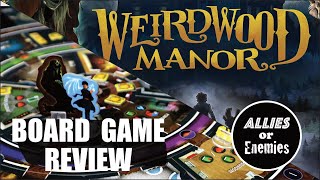
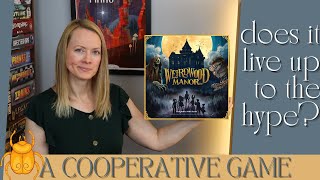
Weirdwood Manor draws strong reactions from the board game community. Tabletop Tolson praised its ideas while admitting it did not fully come together, Allies or Enemies enjoyed its art and rotating board, and Board Stupid was hyped for its temporal mechanic. Reviewers consistently celebrate its thematic hook, beautiful production, and ambitious design, yet several find the play patterns restrictive and grindy in practice. For players drawn to cooperative boss battlers with asymmetric heroes and a modular board, Weirdwood Manor offers a distinctive experience, though success depends heavily on player count and group expectations.
Core Mechanics That Define Weirdwood Manor
Temporal Card Play and Time Management
At its heart, Weirdwood Manor is a race against an ever-advancing time track. Each turn, players select a card from their unique character deck and place it into one of four slots above their board, each tied to a different time of day. The slot you choose determines how far you push the shared time tracker. This creates a constant push and pull between accomplishing things and not accelerating the clock so fast that the monster grows stronger. The temporal mechanic is not just flavor; it shapes every decision, forcing the group into tense negotiations about whose turn it should be and what can realistically happen before time runs out.
Modular Board and the Rotating Manor
The manor itself is the game's most striking feature: a board of rings that rotate as time advances, changing which rooms connect to which pathways. This forces constant adaptation, since after each player and monster action the rings turn, potentially trapping a character, opening new routes, or closing off planned movements. The rotating rings generally work smoothly, though reviewers note they can feel slightly clunky and the inner ring may warp with use. Each room is unique, offering distinct actions and opportunities, which keeps the board fresh while demanding vigilance about its ever-shifting layout.
The Weirdwood Manor Experience
Asymmetric Heroes and Escalating Challenge
Several characters are available, each with their own board, special powers, and a unique subset within their deck. Some feel more distinctive than others, but every character brings a different strength, whether focused on allies, magic, or managing the swarming threats. Players also gain experience by defeating enemies and taking actions, leveling up along multiple tracks to customize their power progression. The challenge ramps substantially at higher player counts: at two players there is more time to level up and plan big attacks, but at four or five the board and monster state shift dramatically between turns, making coordinated strikes far harder, since players have fewer turns overall and less time to prepare.
Dice-Driven Combat and Mitigation
When combat comes, players roll battle dice shaped by the cards they have played and the equipment they have forged. The dice introduce meaningful variability, which some embrace and others find frustrating, since bad luck can consume an entire turn fighting a handful of enemies and losing. The game provides mitigation tools, letting players forge dice to favor attack or defense, gain companions that unlock extra card slots, heal to manage their hand, or clear blighted rooms. These options add tactical depth but demand careful planning, and reviewers noted that neglecting threat management or falling behind the leveling curve leads to harsh punishment, making some late wins feel more like lucky rolls than strategic triumph.
What Makes Weirdwood Manor Stand Out
Visual Design and Thematic Coherence
Weirdwood Manor is undeniably beautiful. The art carries the storybook quality of the young-adult books it is based on, creating a cohesive aesthetic that feels like a show brought to the table. The game drips with lore even for players new to the source material, conveying a larger world beneath the rules. The standies, the rotating rings, and the card designs all conspire to make players feel like they are genuinely defending Lady Weirdwood's manor from supernatural threats. Production quality is high, and the components encourage engagement even when the mechanics frustrate.
Cooperative Depth Without Heavy Rules Overhead
Weirdwood Manor occupies an interesting middle ground, lighter than Robinson Crusoe or Arkham Horror: The Card Game but more complex than Pandemic or Horrified. The leveling system is simple yet meaningful, letting players choose advancement tracks and creating emergent specialization. The boss encounters feel genuinely different from one another, since each one pursues a different goal and demands its own counter-strategy. Players can control multiple characters in solo play, and the game works well at one to three players, becoming far more demanding at higher counts due to turn scarcity and board volatility.
Potential Drawbacks
Downtime and Action Scarcity at Higher Player Counts
The biggest structural complaint centers on what happens between your turns. In a five-player game, by the time play cycles back the board has changed, the monster has advanced, and carefully laid plans may no longer be viable. Worse, you may simply lack the cards you need, leaving you unable to move out of a room or fight because the right card is not in hand. Reviewers described this feeling of helplessness, combined with the wait for your turn, as undermining the cooperative experience. The game is not impossible at five players, but players frequently feel unable to contribute meaningfully, which dampens the satisfaction of an eventual victory.
Length and Repetitive Play Patterns
Weirdwood Manor advertises around two hours but often stretches to three or more, especially on early plays while the table learns the rules. More concerning to some reviewers is that later plays feel similar despite variable room layouts and monster encounters, since the core loop stays consistent: play cards to advance time, move around the manor, fight when forced, and hope the dice favor you. With no rule variation between difficulty levels, winning can feel less like clever strategy and more like fortunate endgame rolls. Combined with setup, teardown, and rules to internalize, the time investment does not always feel justified, and one reviewer who liked the concept still concluded it might not be worth the fuss for their group.
If You Enjoy Weirdwood Manor
If Weirdwood Manor resonates with you, consider Mansions of Madness for a more thematic, app-driven investigative experience, or Arkham Horror: The Card Game for deeper cooperative deck-building with a darker flavor. Robinson Crusoe: Adventures on the Cursed Island offers a more complex survival puzzle with meaningful asymmetry, while Betrayal at House on the Hill captures the haunted-manor aesthetic through a different structure. Co-op fans seeking lighter, faster games in the same spooky space will find Horrified and Pandemic more streamlined, while still rewarding teamwork against escalating threats.
What Reviewers Are Saying
"You are playing together with the help of warden companions, and you're also working with Lady Weirdwood to fight back these fade demons. There's this really lovely feature of the board that rotates: certain places will move on the map in circles, so rooms are going to change and everything's going to be a little weird."
— Tabletop Tolson
"While everything on paper sounds great, and I keep talking about the game like, wow, this is so exciting and I love this feature, and I was so excited about all these elements, for me it didn't come together."
— Tabletop Tolson
"The manor is a mysterious and magical place where rooms and pathways between them shift as time progresses. So this is where it gets really interesting. What took my fancy was that the game features a temporal mechanic, so each time a player or the fame takes an action, time moves forward in the game."
— Board Stupid