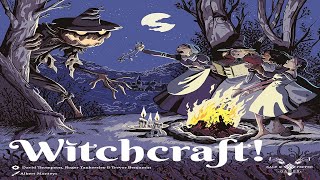














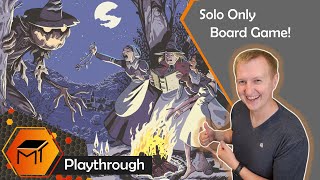

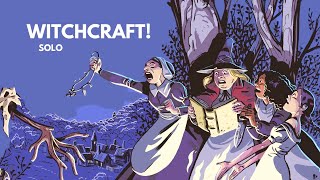






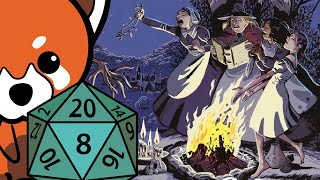



A midnight bell tolls on the streets of Wildegrens as the villagers shutter their windows against the darkness. Something moves through the night–in the forest, through the fields, across the old battlefield. The isolated village is in danger. Crops are failing, animals are dying, and villagers are disappearing. Townsfolk are scared. Some of the women are fighting back, but the villagers suspect that these women may be dealing with the devil himself. From behind the old school a shadow crosses to the town well. A feeble light reveals two witches who nod to one another, shutter the lantern, and make their way towards the dark woods.
Witchcraft! is a fast-playing, card-driven solitaire game where you lead a coven of witches in a fantasy world where magic is real–and so are the monsters. Building on the hidden / revealed mechanism of Resist! you will decide when to use magic to defeat the challenges you face–revealing yourself to your fellow villagers and being imprisoned for witchcraft. As you complete missions and defeat enemies you will try to prove to the villagers that magic is not evil, and convince a jury that you are protecting the village. Three jurors will decide your fate and their conviction is strong. Can you persuade them? Or will evil overcome you and the village?
At the beginning of the game you assemble a coven of witches from families of women represented by a deck of cards. Selecting multiple witches from a family makes that family more powerful. Each family is focused on different tasks in the game–revealing challenges, increasing attack power, uncovering the conviction of the jurors, or capturing familiars to help you in your fight. The fight is real and each of the eight jurors face a different villain. Is it the Headless Horseman, Baba Yaga, the Scarecrow, or some other fiend? On setup you choose three jurors, their missions, and their unique challenges–providing 56 possible combinations with great variety in the types of challenges and monsters you will face. If you fail two missions or lose five villagers, you lose the game. Even if you defeat the missions you still face the trial, and you are only sure of your fate when you reveal the conviction of the jurors and see if you have done enough to persuade them.
—description from the publisher
- Engaging witchcraft theme with unique family ties (Kent line) producing thematic flair
- Rich deck-building and hand-management with meaningful choices
- Multiple difficulty modes (Easy/Normal/Hard) add replayability
- Clear narrative flow with phase-based turn structure and mission selection
- High randomness and luck in draws and conviction cards
- Complex setup and heavy pile management (multiple decks and discard piles)
- Some interactions may be confusing and require frequent rulebook reference
- Can be punishing and long-winded for new players
- Array
- Fictional witchcraft-themed setting with juror-based conflicts
- Deck-driven, narrative-driven with hidden/revealed choices
Mechanics (from transcript analysis)
- Deck building — Players build and manipulate two decks (coven and recruit) and draw from the coven deck; cards are discarded and reshuffled
- hand management — Players manage a hand of witches and associated curses, deciding which to play and which to discard for future draws
- Hidden/Face-Up Card States — Witch cards have hidden sides that may flip to revealed sides, activating different powers
- Jail/Discard Piles and Recovery Phase — After completing a mission, players move cards to discard/jail and recover to five cards; rounds continue
- Mission/Challenge System with Act Decks — Missions and challenges are drawn from act decks; completing missions requires power and overcoming challenges
- Persuasion/Conviction Track — Players track persuasion per juror and conviction numbers to determine victories
- Reclaim as Action — After completing a mission, players move cards to discard/jail and recover to five cards; rounds continue
- Resource management — Power is accumulated from witches and used to overcome missions; power can increase via abilities if you have no curses
- resource/power management — Power is accumulated from witches and used to overcome missions; power can increase via abilities if you have no curses
Video topics + discussion points
Quotes (from this video)
- the point of this game is to go through some missions and challenges and stop whenever we think we're ready to and compare the two numbers added up above these jur to the track number here
- I find this game to be pretty pretty tough lots of luck in terms of what you're drawing and and of course the challenge cards are also a little bit surprising a lot of luck with the conviction cards too but very enjoyable this is a fun theme
- this is a fun theme I don't have many games with this type of Witchcraft theme but it's definitely fun
- we've resolved the mission we overcame the challenges we overcame the mission
- power is seven and then now I have to overcome the challenges
References (from this video)
Mechanics (from transcript analysis)
Video topics + discussion points
Quotes (from this video)
- Cardboard Spooktacular community list is up and running right now.
- We have 10 days left to vote.
- Final Grill continues to sit at the top of the list.
- Horrified has made a huge run up with positive 13 votes.
- As a reminder, this is an up vote, down vote system.
- Witchcraft as well tied there.
- Arkham Horror card game.
- Dreadful Meadows.
- It being this high on the list had me looking at it yesterday.
- Thulu Death May Die.
- Vagrant Song.
- Arkham Horror.
- Boop.
- I like the cutesy game in there.
- And Mysterium rounds out the top 10.
- As you can see, there are tons of games that you can go vote for right this second.
- If you don't happen to see your game on this list, no worries.
- Scroll to the top, create a list. It's already hashtagged properly and you can nominate games for this list.
- You can go make your voice heard right now at crdbrd.ap.
- I want to hear from you.
- Make sure if you make a list, you can comment on each and every game and your comments will be shown on the list.
- So even if you see games on the list, go make your own favorite spooktacular game list.
- make comments there because I'd love to hear why you think the game should be on the
References (from this video)
- thematic witchcraft premise with engaging puzzle
- clear tension of when to reveal cards
- art and theme are appealing
- complex setup decisions may slow early plays
- witchcraft, hidden vs revealed cards
- witch coven and village
- puzzle-focused with confrontation cards
- Resist
Mechanics (from transcript analysis)
- area-based defeat of locations — defeat locations to unlock icons that advance tracks.
- hidden/revealed card play — use cards either hidden or revealed; revealed cards are stronger but costly.
- Simultaneous reveal — use cards either hidden or revealed; revealed cards are stronger but costly.
Video topics + discussion points
Quotes (from this video)
- this is a wonderful little puzzle game
- it's easy to get to the table
- I absolutely love this game
- Legacy of You has captured my heart
References (from this video)
- fantastic witchy theme
- clever timing and side-selection mechanics
- two-player or small counts can limit dynamics
- witchcraft, magical duels, and deception
- witch coven with a townsfolk-tracking mechanic
- gothic, competitive with hidden/exposed mechanics
- Resist
Mechanics (from transcript analysis)
- hidden/exposed card sides — choose which side of a card to activate, with consequences
- vote/track to influence townsfolk — progress tracks to persuade townsfolk of your alignment
Video topics + discussion points
Quotes (from this video)
- Chakra is wonderful
- I absolutely love it and I'm so freaking happy I didn't get rid of it
- Dutch Blitz is the best time
- Rove is absolutely amazing
- Witchcraft is a fantastic card based game
- Azul I am so excited to talk about my number 72
- Role Player is wonderful wonderful game
References (from this video)
- Solo-only design with a cozy witch theme
- Interesting hidden vs revealed card play
- witchy cozy vibe
- witch coven in a village
Mechanics (from transcript analysis)
- card drafting — draft witches as cards with hidden/revealed sides; manage jail/discard vs. hidden abilities to achieve town goals
Video topics + discussion points
Quotes (from this video)
- I think this is like literally the perfect cozy game
- Walk and Roll... it gives me all of the Cozy Vibes
- Harvest is absolutely wonderful I definitely recommend it for a cozy fall/autumn game
- Spellbook... fairly simple in gameplay
- Three Sisters is a huge recommendation for me if you're looking for a roll-and-write game that is a little crunchier
- Witchcraft... I definitely recommend checking out Witchcraft
References (from this video)
- Compact and quick to play, ideal for travel
- Strong solo play experience with campaign depth
- Engaging coven drafting and character recruitment
- Campaign structure adds substantial replayability
- Thematic and flavorful witch options with meaningful synergies
- Draft pool can feel limited in later plays, potentially reducing variety
- Curse and jail mechanics introduce volatility and potentially punishing turns
- Some players may wish for a larger witch pool or expanded modules
- Dark folklore, witch coven politics, moral and strategic choices under pressure
- A witch-hunting village with a coven-building mechanic, tied to a campaign of modular acts and missions.
- Campaign-driven, story-led with modular acts and scenarios that morph based on witch recruitment and revealed powers
Mechanics (from transcript analysis)
- Active missions and challenges — Players select active missions; each mission has a number of beneath-the-surface challenge cards that must be resolved to succeed, with consequences if failed.
- Campaign and act structure — The Tales of Wilder Greens campaign provides modular acts (tail missions) with specific setups and challenges, enabling progressive difficulty and varied outcomes.
- Coven deck drafting — Before play, players construct a coven from a pool of witches; 12 coven cards are chosen for the coven deck and 12 for the recruit deck, with hidden vs revealed sides affecting power and jail risk.
- hand management — At recovery, players discard played witches and curses and draw a fresh hand; some cards manipulate the recruit/coven decks or draw from Coven deck.
- Hand management and draw phases — At recovery, players discard played witches and curses and draw a fresh hand; some cards manipulate the recruit/coven decks or draw from Coven deck.
- Influence Points — Witches contribute power (depending on hidden/revealed side and synergies with other witches); power is spent to overcome missions and challenges.
- Jail, curses, and recovery — Revealed witches can go to jail; failing missions or triggering certain effects can add curses to the coven deck; curses alter hand and draw rules and can cause loss if mishandled.
- Power and influence system — Witches contribute power (depending on hidden/revealed side and synergies with other witches); power is spent to overcome missions and challenges.
- Villager deck and lost souls — A villager deck is used to determine losses. Losing villagers adds pressure: accumulating five lost souls can cause a loss condition.
Video topics + discussion points
Quotes (from this video)
- It's so compact. You go on a business trip, bring the witchcraft game with you.
- Huge recommend for a solo player.
- I really recommend starting with the Tales of Wild Reds.
References (from this video)
- thematic depth and strong witchy vibe
- replayability through different character/townfolk interactions
- may require careful planning to maximize revealed actions
- witchcraft and town defense with persuasion
- witch-themed negotiation and social interaction with townsfolk
- story-driven with social manipulation elements
Mechanics (from transcript analysis)
- hand management — hand of five cards with revealed and hidden actions; balance between using revealed vs hidden actions
- hand management / card actions — hand of five cards with revealed and hidden actions; balance between using revealed vs hidden actions
Video topics + discussion points
Quotes (from this video)
- I really really enjoyed it
- I absolutely love this one I love the art of this one too and this one will definitely be one that I choose to bring traveling and stuff in the future. I really really like it
- I freaking loved it. I am so, so happy that I have it in the collection
- I absolutely love it and I'm excited to hop into those
- I love engine-building games
- I absolutely love the solo I've heard a ton of good things about the solo from a few of the people in the board game Garden solo community
- I think it's very cool that you can name the baby too; it just makes me very happy
References (from this video)
- Strong thematic cohesion tied to witch trials, village defense, and coven politics.
- Solid solo-solve design with meaningful choices that affect both short-term power and long-term deck health.
- Hidden vs revealed mechanic adds meaningful tension and strategic depth, offering multiple levers to optimize each turn.
- Mission variety and escalating threats encourage adaptive planning and multiple playthroughs.
- Teaching the rules during the playthrough can be approachable for new players who want a guided experience.
- Curse cards can clog the coven deck and create frustrating dead draws, especially early in the game.
- The rule surface is dense and some interactions (e.g., when exactly to reveal or exile a witch) can be nontrivial to track during a live playthrough.
- Luck-driven elements (random draws for mission, curse distribution) can swing outcomes and lead to abrupt endings.
- The game can be punishing: losing villagers or triggering multiple challenges can trigger a cascade of failures if not managed carefully.
- Witchcraft, covens, trials, curses, and the tension between perceived danger and hidden power.
- An isolated village under threat from mythical evils, where a coven of witches must prove their benevolence during Witch Trials and protect the village from encroaching darkness.
- Story-driven, narrator guides through setup, mission selection, and escalating threats; emphasizes cause-and-effect consequences of power choices and the villagers' perceptions.
- Resist
Mechanics (from transcript analysis)
- Conviction and persuasion — Endgame scoring hinges on persuading jurors by matching or exceeding their conviction with persuasion. The jurors’ counters are drawn from a fixed distribution, and certain cards can modify conviction or draw results, creating a tense race to innocence.
- Curses and penalty risk — Curses primarily clog the coven deck and increase future risk. They can be drawn into hand, potentially forcing suboptimal plays or endangering the ability to fulfill missions. Managing curses is a core strategic concern.
- Deck building — The player assembles and manages multiple decks (coven deck, recruit deck, and mission deck) and optimizes power by selecting which witches to reveal or keep hidden. The deck composition directly influences available actions, power generation, and future options through jail/discard paths.
- deck-building / engine-building — The player assembles and manages multiple decks (coven deck, recruit deck, and mission deck) and optimizes power by selecting which witches to reveal or keep hidden. The deck composition directly influences available actions, power generation, and future options through jail/discard paths.
- end game bonuses — Endgame scoring hinges on persuading jurors by matching or exceeding their conviction with persuasion. The jurors’ counters are drawn from a fixed distribution, and certain cards can modify conviction or draw results, creating a tense race to innocence.
- Hidden vs revealed cards — Witches can be played on their Hidden Side or Revealed Side. Hidden witches provide power with a special ability, but revealed witches offer stronger effects at the cost of moving to jail when used. The choice alters current power, future availability, and risk management.
- Jail vs discard lifecycle — Played witches reveal a trade-off: revealed witches go to jail (limiting future use but potentially enabling strong effects), while hidden witches go to the discard pile and are shuffled back into play later. This creates long-term planning considerations and cycle timing.
- Luck and decision points — Power output and mission outcomes depend on card draws, hand composition, and the timing of when to reveal or retain certain witches. The player occasionally faces coin-flip-like uncertainty in pivotal moments.
- Mission-based objectives — The game presents multiple missions (e.g., extinguish fires, cure villagers, or destroy nests). Each mission requires a certain amount of power to complete and may interact with the current challenges or curses in play.
Video topics + discussion points
Quotes (from this video)
- Curses don't do anything they just sort of clog up our coven deck.
- you must play all of your witches you cannot save any for next round
- it's basically flipping a coin
- we convinced two jurors … draw your valiant efforts against the threats to the Village
- the trick is we can play witches either before or immediately after picking our mission
- this is face of Baba Yaga in the woods this is our first act three mission
- you can lose if you draw your hand of five cards and they're all curses
References (from this video)
Mechanics (from transcript analysis)
Video topics + discussion points
Quotes (from this video)
- Stardew Valley the board game can be played solo.
- This is literally the cozy farming game you can find in a board game.
- I 1000% recommend this one.
References (from this video)
- interesting theme reimagining
- clever deck building mechanic
- difficult decision-making
- solo only game
- no multiplayer support
- witchcraft
- history
- deck building
- Salem
- Resist
Mechanics (from transcript analysis)
Video topics + discussion points
Quotes (from this video)
- one of the best if not the best boss battler out there
- this is the must get expansion if you're only going to get one
- you've never seen dragons quite like these they are stunning
- Simone Luciani strikes again
- freaking brilliant
- one of my top three favorite Thematic settings in board games
- live the best life you can
- be the best human being you can
- probably my game of the year
- there is no way it doesn't make it into my top 10 of the year