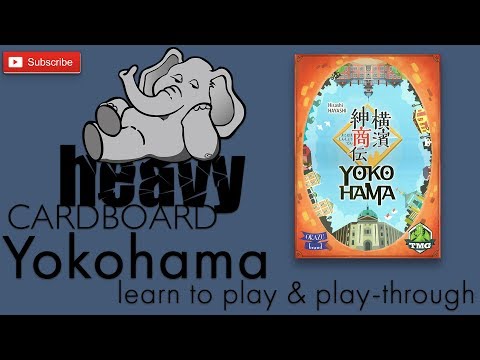
Once Yokohama was just a fishing village, but now at the beginning of the Meiji era it's becoming a harbor open to foreign countries and one of the leading trade cities of Japan. As a result, many Japanese products such as copper and raw silk are collected in Yokohama for export to other countries. At the same time, the city is starting to incorporate foreign technology and culture, with even the streets becoming more modernized. In the shadow of this development was the presence of many Yokohama merchants.
In YOKOHAMA, each player is a merchant in the Meiji period, trying to gain fame from a successful business, and to do so they need to build a store, broaden their sales channels, learn a variety of techniques, and (of course) respond to trade orders from abroad.
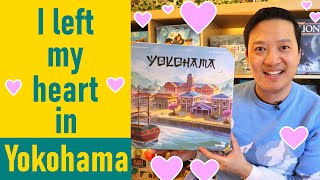
Yokohama Full Playthrough - JonGetsGames
- Array
- Array
- Resource management and route-building with cube-based action economy
- Array
- Port and logistics hub in Yokohama, early-to-mid 20th-century-inspired resource management
- Array
- Array
- Array
- positive
Mechanics (from transcript analysis)
Video topics + discussion points
Quotes (from this video)
- Everything is programmed in
- On Board Game Arena everything's programmed in you know exactly where you can go, how many resources you would get, where your dice are at, which tracks will move up
- this video is not sponsored by Board Game Arena in any way shape or form
References (from this video)
- well-supported base game with a strong core feel
- highly competitive and planning-focused
- expansion support is not prolific yet
- base game can be complex for newcomers
- industrialization, trade, and competition for contracts
- 1920s-1930s port city development with a global influence emphasis
- player-driven engine building on modular boards with contracts and tech
- Concordia
- War of the Ring: Against the Shadow
Mechanics (from transcript analysis)
- Modular board — board layout changes with each play, altering routes to points
- Modular board setup — board layout changes with each play, altering routes to points
- resource gathering and contracts — players gather resources to fulfill contracts, gaining points and influence
- technology and country icons — special cards and country-specific bonuses influence scoring
Video topics + discussion points
Quotes (from this video)
- "I'm incl some games that I haven't gotten the chance to play its expansion or expansions yet"
- "I would love some added variability in the building tiles perhaps some additional modules"
- "this game deserves expansion"
- "I would love to see some additional content for that game"
- "I think there's plenty of room to expand this game"
References (from this video)
- The worker-placement scaffold with scaling power creates satisfying optimization choices; you feel the leverage of investing more into a single location while considering opportunity costs across the board.
- The Yokohama setting is richly thematic, giving a strong sense of place and historical context that aligns well with the mechanics and resource types.
- There is a tangible collectible appeal, with the option to own multiple versions of the art, which adds personal value beyond gameplay.
- The progression through resources (tea, copper, tech) provides a clear and rewarding sense of advancement as you build your city’s capabilities.
- The combination of route-follow and location actions creates a fluid pace that can feel addictive, encouraging repeated plays to optimize routes and placements.
- The thematic synergy between district types and worker actions makes each session feel unique, with different districts offering distinct strategic avenues.
- The information density around how action power scales with buildings can be subtle, which may slow early game comprehension for new players.
- Because power is so strongly tied to local buildings, the pacing can become rigid if a player misjudges which districts to invest in early on.
- Economic development, trade networks, and city-building within a competitive market. The core tension is balancing resource extraction (tea, copper, textiles) with infrastructural and technological advancement to boost efficiency and prestige.
- Set in Yokohama, Japan, during a historical moment when Japan has reestablished trade relations with the West. The coastal port town transitions from a sleepy fishing village into a premier, bustling hub of commerce and exchange. The game's backdrop blends maritime trade, local production, and urban growth, depicting a period of rapid economic shift and international connections.
- Historical economic simulation with emergent strategy. The narrative leans into a procedural storyline where players’ choices shape the city’s growth and the relative power of different districts, rather than a linear storyline.
Mechanics (from transcript analysis)
- area diversity and resource generation — Locations correspond to different economic sectors (silk mills, copper mines, tea farms, fishing ports). Actions at these sites produce distinct resources (tea leaves, copper, and technologically oriented cards) and sometimes unlock advantageous future actions. The combination of area variety and resource diversification encourages multi-location planning and interlocking strategies.
- president-follow mechanic — A central figure (the president) travels along a defined route, collecting or guiding the assistants you’ve placed. The president’s route acts as a meta-constraint that ties individual location actions into a broader movement-and-resource system. This creates a dynamic where you’re not only choosing where to place workers but also how to shepherd them along an advantageous path to maximize outcomes.
- worker placement — On a turn you may place up to three assistants from your hand into different locations, or two assistants into a single location. The key twist is that the action’s power is scaled by both the number of assistants you place and the number of shops or trading houses present at that location. More assistants and more nearby buildings yield more potent actions, driving careful planning about where to invest your workforce on a given turn.
- worker placement with scaling power — On a turn you may place up to three assistants from your hand into different locations, or two assistants into a single location. The key twist is that the action’s power is scaled by both the number of assistants you place and the number of shops or trading houses present at that location. More assistants and more nearby buildings yield more potent actions, driving careful planning about where to invest your workforce on a given turn.
Video topics + discussion points
Quotes (from this video)
- This is one of my top 10 favorite Euro
- I love it so much I actually own two versions of this game.
- This is one of those games that feels really addictive and I love
References (from this video)
- deep, satisfying engine with huge table footprint
- great for experienced players
- high replayability
- requires large table and long session
- not beginner-friendly
- busy worker-placement with a heavy table presence
- port city in Japan-inspired setting
- long-form engine-building with many locations
- Keyflower
- Lost Ruins of Arnock
Mechanics (from transcript analysis)
- area placement / tile placement — place workers on many locations with varied effects
- card drafting / tableau building — draft cards to extend your engine and scoring
Video topics + discussion points
Quotes (from this video)
- Breaking news… our fan plays games will be at Cardboard Caucus in Des Moines October 22nd to the 24th.
- There is light at the end of that tunnel.
- We love Cascadia and we want to thank Efka and Ellen for the shout-out.
References (from this video)
- Deep engine-building with multiple strategic paths (tech, commerce, and logistics).
- Public achievements and flag-set collection add meaningful endgame objectives.
- Foreign agents provide flexible tools to mitigate positional blocks and enable dramatic finishes.
- Spatial layout and canal/port dynamics create interesting route planning challenges.
- Three-player setup demonstrates balanced paths and viable alternate strategies.
- High component and resource management pressure (lots of assistants, money, and crates).
- Opponent interaction can cause blocking and downtime, increasing player fatigue.
- Rule complexity and setup can be intimidating for new players; pacing can slow in longer runs.
- Trade expansion, urban development, and technological transfer
- Late 19th-century Yokohama, Japan
- Economic engine-building with spatial planning and route-based action activation
Mechanics (from transcript analysis)
- action tracks and power activations — Actions are organized into zones with activation powers (including five-tier raises). Endgame triggers and bonuses stem from reaching thresholds and meeting platform-specific conditions.
- foreign agents and bonus actions — Foreign agents allow activating certain areas without paying penalties from opposing presidents, enabling strategic sequencing and late-game surges.
- public achievements — Board-wide achievements offer additional VP bonuses when thresholds are met, adding dynamic targets beyond standard orders.
- resource management, warehouses, and trading houses — Resources are managed via warehouses; building trading houses yields VP and creates shared and opponent-interaction effects on the board.
- set collection and endgame bonuses — Collect flags (foreign agents/territory markers) to complete sets that grant endgame VP bonuses; completing sets also unlocks further turn economy.
- Spatial worker placement — Players place assistants on various action spaces around the board; activation value is determined by the number of pieces in color within a zone, creating spatial tension and planning ahead.
Video topics + discussion points
Quotes (from this video)
- this is a spatial work replacement style game
- it's easy to run out of money in this game
- public achievements right here... seven fish on hand
- the five power activation
- you can end the game by eight shops or four trading houses
- we were the first to get up to four Technologies, nine points
References (from this video)
- Deluxe components and tactile materials
- Modular board with varying action layouts increases replayability
- Elegant engine-building core once you get the flow
- Board looks busy and can be intimidating on first exposure
- Setup and teach can be lengthy for new players
- Urban development, trade, resource management
- Port city of Yokohama, Japan; economic development and trade era
- Euro-style engine-building with modular action layout
- Race for the Galaxy
Mechanics (from transcript analysis)
- assistant_placement — Place assistant tokens to unlock stronger actions or to influence future turns; action potency scales with assistants on a space.
- spatial_worker_placement — Move a generic worker around a modular map to activate actions, requiring pathing via assistants.
Video topics + discussion points
Quotes (from this video)
- There were eight new pledges to the campaign over the last month and that's just awesome to see
- This third year has been huge for the channel; the studio really changes things
- Annotations can no longer be added to YouTube videos probably forever
- Klingon on close captioning is a neat idea for board gaming channels
- I ended up liking this game quite a bit; it’s a cool core game with strong mechanics
References (from this video)
- Deep, crunchy strategy for experienced players
- Rich theme and immersion
- Heavy for new players
- Long playtime can be daunting
- Trade, city-building, and economic expansion
- Japan, port city of Yokohama during early 20th century
- Economic strategy with strong player interaction
- Catan
Mechanics (from transcript analysis)
- Negotiation and resource management — Balance resources and opportunities with opponents
- tile drafting/placement — Draft and place tiles to develop districts and routes
- worker/action selection — Choose actions that shape city growth and income
Video topics + discussion points
Quotes (from this video)
- we're gonna give you five in no particular order
- these are real places i know but could i still want to visit japan
- education value of board games... we love that
References (from this video)
- deep, thoughtful planning
- great table presence
- excellent re-playability
- can be punishingly tight for new players
- economic optimization and route-building
- port city commerce and expansion
- economic puzzle
- Terra Mystica
- Hansa Teutonica
Mechanics (from transcript analysis)
- engine-building — develop actions via cards and tokens to optimize income and scoring
- worker placement / hand management — select actions and manage a hand of cards to perform efficient turns
Video topics + discussion points
Quotes (from this video)
- it's a fight and we're fighting
- analysis paralysis is here to stay
- it's a brain burner
- it's not that heavy there's a lot to do
References (from this video)
- Excellent heavy game
- Strategic depth
- Route building satisfaction
- Requires significant table space
- Brain-burning complexity
- trading
- port_city
- economic
Mechanics (from transcript analysis)
Video topics + discussion points
Quotes (from this video)
References (from this video)
Mechanics (from transcript analysis)
Video topics + discussion points
Quotes (from this video)
- I think five shorts in the can is a momentum, it's going to be a priority.
- The YouTube algorithm is fickle because we don't want to tailor our content to it, but we have to consider it.
- PAX Unplugged could be a great place to do interviews, but we have to be mindful of publishers' time and not be overly intrusive.
- Yokohama is a really interesting game with an interesting history, and I wanted to capture that in the review.
- Desperate Oasis is a small game and the Shorts performed reasonably well for it.
References (from this video)
- deep, replayable, rich with decisions
- strong thematic link to Meiji era
- translation limitations affected English release
- heavy for newcomers
- deep economic euro-game with historical flavor
- Meiji restoration-era Japan
- masterclass in heavy Euro design with thematic hook
- Twilight Imperium
- June
Mechanics (from transcript analysis)
- economic engine / engine-building — players optimize placement and actions to grow influence and wealth
- unique movement system — movement provides access to different actions and paths
Video topics + discussion points
Quotes (from this video)
- these bones are there all the foundation is there to make something truly epic
- i would love to be the designer to do that
- the core mechanic is this bag management system
- it's a fantastic solo game
- the queen's gambit is a rare thing for the time a good star wars game
References (from this video)
- Deep strategic planning with meaningful interaction and planning ahead.
- Excellent production value and table presence.
- Setup can be beastly; table space and organization matter.
- Becomes quite dense for new players; may require some persistence.
- Worker placement with action planning and merchant routing.
- Historic port town development in 19th-century Japan.
- Tight, planning-forward Euro with a strong emphasis on path optimization.
Mechanics (from transcript analysis)
- merchant_path_restrictions — Your merchant moves only along spaces occupied by your workers, shaping routing choices.
- variable_setup_and_interaction — Starting setup changes each game, affecting strategy and player interaction.
- worker_placement_with_pacing — Place workers to unlock actions, planning across the board with limited slots.
Video topics + discussion points
Quotes (from this video)
- it's such a classic and i would highly recommend it even if you're not into anime
- this game is what a push your luck game should be in my opinion
- i love this game i love the tension that it brings with such a simple concept
- semi-cooperative games and this one is a great example of the semi cooperative genre
- the mind is a super simple cooperative card game for two to four players where all you're trying to do is place your cards in ascending order
- between two castles is semi-cooperative because that means that it's really easy to teach new players
References (from this video)
- deep planning and sequencing
- heavy puzzle with strong action economy
- thematic integration with trade and commerce
- some players may find it heavy
- mercantile growth and strategic action sequencing
- Yokohama during a period of trade and commerce expansion
- historical-economic flavor with sequencing depth
- Terraforming Mars
- Mechs vs Minions
Mechanics (from transcript analysis)
- action sequencing — assistants and a president pawn create a sequence of actions
- contracts — fulfill contracts to score and progress
- resource gathering and contracts — fulfill contracts to score and progress
- set collection — collect tech and nation symbols to score and unlock rules
- set collection / technology cards — collect tech and nation symbols to score and unlock rules
Video topics + discussion points
Quotes (from this video)
- Flavor text is absolutely on point because these cards that you're collecting are just kind of colors.
- I melted my brain. It was just like way too heavy for me.
- Star Wars in a box. This is Star Wars in a box.
- I absolutely love the original Clank.
- This is a cooperative programming game where you need to do one of them… it’s so much fun.
- I love the networks.
- I really like tiling games in general. I like citybuilding games and Quadropolis adds that really extra interesting unique uh tile selection mechanism.
- Feast for Odin is a game where you are Norwegians. It is just so darn good.
References (from this video)
- Beautiful planning puzzle with rewarding decisions
- Strong social interaction and heavy brain-work without being clowning around
- Complex scoring with multiple scoring tracks to track
- Can be intimidating to new players but very rewarding once learned
- set collection, path-building, and city planning
- port city development in Edo-era Yokohama
- highly strategic planning with long-term action sequencing
- Terra Mystica
- Gaia Project
Mechanics (from transcript analysis)
- Area control / scoring majorities — manage districts and fulfill scoring criteria for points
- Set collection / path building — build achievement paths and fulfill orders to score
- Worker placement / action economy — select actions to advance on the board and score multiple ways
Video topics + discussion points
Quotes (from this video)
- I dare say this is the best game that they have ever put out
- it's actually interesting variation of strategy
- I love the asymmetric play, it's really cool
- I walk away from that game thinking about what I did and how I could have done better
- I am a huge mind Clash fan
References (from this video)
- Accessible entry into a weighty euro with depth
- Smooth, intuitive flow for a large design
- Feels like a true designer's passion project
- Can appear intimidating at first glance
- May require several plays to master optimal paths
- Strategic planning with a strong sense of place
- Gourmet worker-placement in a bustling urban port city
- immersive, designer-driven passion
Mechanics (from transcript analysis)
- Action Planning — Turn-by-turn sequencing to optimize outcomes.
- worker placement — Plan actions across several turns and move around the board to complete tasks.
Video topics + discussion points
Quotes (from this video)
- i'll be doing a giveaway on my instagram page of the number one game at the end of this list
- i'll also be running a fundraiser to support the stop asian hate cause
- donation would mean the world to me if you'd donate and it might also earn you a few extra entries into the giveaway
- thanks so much for sticking around to the end
- yokohama is truly a gamer's game