/pic342165.jpg)
In remote times, King Gradlon had the magnificent city of Ys erected for his daughter Dahut. Gargantuan sea-walls protected the city from the violent waves. Dahut decided to make Ys the most powerful place in Brittany; thus, she dispatched dragons to seize merchant ships loaded with jewels which sailed on the open sea…
Each turn, ships filled with gems land in the city's ports. The players, embodying merchant-princes of Ys, set their team to work, two at a time, in the 4 neighborhoods of the city; deciding which area of each neighborhood to focus on. Controlling the port to claim special black jewels, the commercial area to gain a financial advantage or the palace to influence characters of influence. However it is the player who dominates the neighborhood as a whole who has the first choice of the precious stones carried in the hold of the ship docked there. Don't overlook the gem market as other players may send their brokers to influence the value of the different types of jewels, making your collection less valuable.
Each player has a team of 11 brokers of varying skill levels. These brokers are placed on the players turn, one face up and one face down. Bluff your opponents on where your intentions lie, misdirection is the key to victory.
At the end of the game, the winner is the player who has accumulated the most gold (represented by victory points).

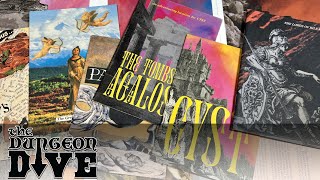
- familiar, accessible rules for players who enjoyed Lords of bile deep
- varied charts for quick, modular adventures
- still largely chart-driven; niche appeal for fans of indie zines
- mechanics-forward storytelling with roll-up charts
- Dungeon-crawling fantasy science-fantasy terrain echoing Lords of bile deep
- narrative-forward with chart-driven prompts
- Lords of bile deep
Mechanics (from transcript analysis)
- Asymmetric Mechanics — Cyst uses mechanics very similar to Lords of bile deep; the speaker notes the similarity in play style
- Dungeon Crawl — Dungeons/Creatures/Placess/Curiosities charts to rapidly generate adventures
- Encounter Generation — Dungeons/Creatures/Placess/Curiosities charts to rapidly generate adventures
- roll-up prompts — charts for adventurers, their Garb, features, and trappings to generate quick scenarios
- shared-rule family — Cyst uses mechanics very similar to Lords of bile deep; the speaker notes the similarity in play style
Video topics + discussion points
Quotes (from this video)
- Lords of bile deep is a game in that it has mechanisms and it has some rules
- one player's the narrator they describe to the other players the happenings of the bile lands and the awful things within it
- these zines these collage style scenes they do hearken back to kind of the golden age of zines
- I would love to order some of these and just frame them for my game room because I think they are I think they're they're really nice pieces of Art and I like collage art a lot
- it's funny the more you start to look at these zines the more you realize that a lot of the creators who do this kind of collage and this photo bashing they use similar images
References (from this video)
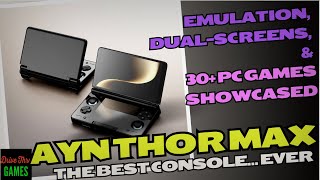
- Looks great
- Fun sailing mini-game
- Smooth combat and sailing
- Controls can be tricky on handheld
- Ys 8
- Ys 9
Mechanics (from transcript analysis)
- Sailing mini-game — it has like a sailing component uh which is a lot of fun. So, it's kind of kind of like a mini sailing game.
- ship combat — So, let's get over to some combat and show you that.
Video topics + discussion points
Quotes (from this video)
- Here we've also got the good old games Doom 1 Doom 2.
- Yeah, so you know, it's Doom.
- It works.
- And while we're talking about it, same idea here with Heretic and Hexen.
- this is just Doom fantasy.
- And then here we have System Shock 2.
- But, it's it's a remaster of System Shock 2, so it's a little bit updated.
- But it runs good just like basically right out of the box there.
- And this is last one this Pico-8.
- So, what Pico-8 is, it's almost like it's own little console.
- But then, you get like hundreds and hundreds of games for free.
- these little like Gameboy S games.
- This top screen runs at 120 Hz.
- So, if I'm just playing like, you know, retro games or something, I don't worry about it.
- And if I'm especially if I'm playing the dual screen games here, then if you set this to 120, this bottom screen is like a little bit weird cuz the screen technically can't go to 120, but it kind of fakes it out.
References (from this video)

- build the game board and place your huts and claim land based on their placement
Mechanics (from transcript analysis)
- Area Control — Claiming land based on hut placement.
Video topics + discussion points
Quotes (from this video)
- so we have a list of every single game that was released in 2005 and we're going to go through all of them in a three-hour episode absolutely not
- we have a potential pool of 25 board games but only 10 can be inducted into our newly minted Hall of Fame that's the rules that's the rules only 10 we made them up that's the rules
- you could argue with us in the comments and tell us why we're wrong you could do that always an option
- I'm going to be real honest with everyone that this list of games from 2005 there are a bunch on here I don't know
- that is like the oldest of old school hidden Trader Trad
- it spawned so many other games right we have a ton of games in this Arkham Horror World which is obviously the world of HP Lovecraft
- I think wits and wagers is a is a classic
- it is on my list it's one of the very early like kind of worker placement kind of mean Euro dry Euro kind of game that I played
- this is like a grill game for people
- wow we didn't even rehearse that
- it sounds like if your jam is hidden rolls or social deduction style games and you haven't played Shadow hunters and you see it out in the wild maybe pick KCK it maybe give it a whirl you might like it
- if this isn't a classic game I don't know what it is
- it is ubiquitous when it comes to board games not just the theme but sooner or later if you're talking about board games eventually Arkham Horror is going to hit the table
- many aboard gamer covet this
- people still talk about I mean any game that you're still it's 20 years old and you're like I should play that sometimes
- I may have my Nostalgia goggles on and uh you know be looking at it through those rosecolor glasses
- it's a game 100% you can play with your kids
References (from this video)
- Interesting action point allowance mechanism
- Tactical maneuvering required
- Interesting player interaction where others can swoop in
- Other players can swoop in and take tiles if not planned correctly
- Excavation
Mechanics (from transcript analysis)
- Action Point Allowance — Players are allocated a certain number of action points at the start of the round, which they can spend on actions.
- contract fulfillment — Players complete contracts by collecting and arranging tiles.
- Set Collection — Players collect tiles to fulfill contracts.
- tile laying — Players take tiles from a central board and place them onto their personal board.
Video topics + discussion points
Quotes (from this video)
- welcome to March 2025 where we are going to talk about our favorite games of February
- fishing has already become their families goto competitive trick-taking game
- many of us prefers brains of Braun
- this is my number five is a Prototype game uh called get over with the muscle bound man
- my number five ice but this is the second edition and it's also a prototype
- my number three is for much which appeared before so now we can talk about it
- this is card shedding it's a card shedding game and it's a climbing shedding game
- this is power grid outpost which is the next edition of outpost of power grid I should say
- this is T of Raar so this is one of a three small game series from the Twisted Realms by Inside Up Games
- this is that detective ktis trying to solve day-to-day job little cases eventually trying to find who's the suspect
References (from this video)
- Rummy-inspired
- Abstract card game
Mechanics (from transcript analysis)
- Hand Management — Optimize hand for scoring
- Rummy-style set collection — Form sets and runs with card colors
Video topics + discussion points
Quotes (from this video)
- Disney has always been a jerk about copyright.
- Don't get sued.
- Swagless is definitely a word.
- TI4 is digital or it's coming digital.
- If Magic the Gathering latches on to this, it might do.
- This is going to be epic scale digital speed.
References (from this video)
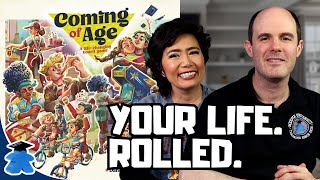
- Engaging timing puzzle with evolving options per life stage
- Rich token and track-system with meaningful end-track bonuses
- Beautiful artwork and thematic cues around adolescence
- Positive interaction through friendships and shared objectives
- Thematic disconnect for some players; emotion/theme can feel abstract
- Low direct player interaction; often puzzle-focused on own board
- Limited dice pool can constrain decisions and slow pace
- Complex timing and scoring can be confusing
- Life progression, friendships, relationships, and self-discovery
- Adolescence, coming-of-age, life stages
- Personal-development puzzle with evolving mechanics across life stages
- Wingspan
- Dirt and Dust
- Civil
Mechanics (from transcript analysis)
- Compound Scoring — Objective tiles and personal goals provide scoring variance; some scores depend on timing.
- dice action allocation — Each life stage adds dice and action options; you roll dice to determine viable actions.
- frustration resource — Frustration can block rewards or be converted into positive outcomes.
- interaction balance — Interaction exists primarily via relationships; overall gameplay leans toward multiplayer solitaire with occasional competition.
- location-based actions — Face-placement on spaces enables minor actions per round; spaces open up as the phase progresses.
- Neighbor Interaction — Form friendships with NPCs or other players to trigger bonuses and points.
- objectives and scoring tiles — Objective tiles and personal goals provide scoring variance; some scores depend on timing.
- relationship interactions — Form friendships with NPCs or other players to trigger bonuses and points.
- tokens and resources — Fitness tokens and memory tapes are spent to gain actions and adjust tracks.
- Track Advancement — Five tracks on a player board advance or regress from actions; top ends grant passive bonuses.
Video topics + discussion points
Quotes (from this video)
- This game probably didn't meet my expectations overall.
- If you like solo puzzle with your dice, although it's interactive, although it's multiplayer but a lot of these are done solo.
- Does it have positive player interaction? It does. Yes. A little bit.
- One of the main actions you can take is to put your face there permanently so that you can take minor actions there every round.
- You would roll both the dice and choose one of those, do actions there.
- There will be two additional actions added.