/pic2242246.jpg)
Between 230 and 221 B.C., the ambitious and extremely young king of Qin, Ying Zheng, unified China, adding all the other so-called Warring States (ZhanGuo) to his empire. Through this, Ying Zheng became the first emperor in Chinese history, taking the title of Qin Shi Huang Di.
Plenty of things had to change in order to make the Chinese empire whole, and Qin Shi Huang Di didn't waste any time. He divided the empire into prefectures, personally appointing central and local functionaries; afterward, he decreed that the same writing symbols had to be used throughout the entire nation. Furthermore, he unified the laws and the units of measure, particularly the currency, creating amazing conditions for the economic development and growth of the empire.
Internal decisions were not the only things that shaped this new unified nation. From the North, the menace of the Hsiungnu barbarians kept shaking the empire, and Qin Shi Huang Di knew that the only way to stop that menace was to build one of the most ambitious buildings in human history: The Great Wall of China. Thousands of peasants left their fields to take part in the construction, not only of the Great Wall, but also of roads, channels, palaces, and majestic buildings.
In ZhanGuo, you are the emperor's emissaries, and you have been assigned the challenging task of contributing to the process of unifying the empire, helping to build the wall, and all infrastructures needed. During the five rounds of the game, you must make the best of the few cards you get each round. You can play each card either on your own player board to increase your personal power in the empire, or on the game board to recruit manpower, construct buildings wanted by the emperor, call reinforcements from Qin, and move the armies from kingdom to kingdom.
Each player has to choose the best time and best way to play his cards in order to earn the emperor’s favors. Careful, though, because trying to get too much power, or exploiting the workers for personal gain could increase dissatisfaction among the populace, and consequently increase the risk of uprisings in the newly added kingdoms. Whoever is able to make the greatest contribution to the emperor's cause, while at the same time keeping the citizens placid, will be the winner.



Mechanics (from transcript analysis)
- Card Driven Action — Card driven action game.
Video topics + discussion points
Quotes (from this video)
- This is one of the big Euro releases from the Essen it's really good we both really enjoy it especially me I think
- It's really fun. It feels like it's very satisfying engine building.
- Competitive relaxing holiday in Japan.
- The design is actually the movie maker or film maker based on the movie and they make the board game out of it
- viral virual what is it called hang on virual revolution virual revolution
- this is Studio H this is the biggest box game I think I've seen from Studio H
- this seems really interesting it's it's I think this was the one from the movie so the design is actually the movie maker or film maker based on the movie and they make the board game out of it
- a good looking map always makes me uh picks my interest
- it wasn't on my list as an anticipated list but I picked it up
- this is a waterfall park
- look at this uh there was a common board and you are a color frame and you place it and then you gain the TOs of the building and you can negotiate to each other to gain the building that you want to score points
- the points is comes from the money that you have you have to buy stuff and then you goate
- those are the games please do let us know which one that you like to see the most or the ones that you actually got either from ENT or pre-order or anything like that and let us know what you think of them hit the like button if you've been enjoying it hopefully you have an awesome awesome day everyone thank you so much and see you next time bye
References (from this video)
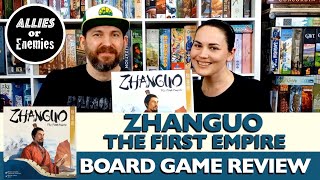
- Elegant card management that ties engine-building to action choices
- High replayability due to multiple scoring paths and variable goals
- Strong two-player experience with clear interaction and pacing
- Clever solo mode added in the new edition
- Strong production values: clear icons, bright player colors, and a clever board design
- Not ideal for players seeking minimal interaction; there is area majority and racing for bonuses
- At higher player counts (4 players) there can be idle time between turns
- Aesthetic may feel beige to some players who prefer more vibrant visuals
- Learning curve can be non-trivial; initial setup and rule language can require a teach-through
- Engine-building and card-driven court actions within a political and territorial expansion setting
- Ancient China during the unification period
- Array
- Lisboa
- Istanbul
- Tillum
- Marco Polo
- Carnegie
Mechanics (from transcript analysis)
- area/majority control and race — Compete for majorities at governors, walls, palaces, and mausoleum scoring areas.
- card management — Six-card hands; decide whether to add cards to your engine or to execute actions.
- Compound Scoring — Different scoring goals per session boost replayability.
- Engine Building — Card placement and court actions build an engine and unlock different actions.
- Engine-building and action selection — Card placement and court actions build an engine and unlock different actions.
- Hand Management — Six-card hands; decide whether to add cards to your engine or to execute actions.
- solo mode — Card-driven solo variant with levels that scale difficulty.
- Token economy — Tokens fuel round bonuses and Mausoleum scoring, requiring strategic timing.
- varied scoring paths — Different scoring goals per session boost replayability.
Video topics + discussion points
Quotes (from this video)
- The rules are so smooth and absolutely this is a game we could not play for a year and I could teach this game to somebody a year from now
- There are a lot of different paths to victory
- This is such a nice midweight Euro and a stepping stone to more complex games
References (from this video)

- Quick card game
- Plays well with 2-5 players
- Fun for late night convention play
- Good when exhausted
- Interactive card effects
- Memory elements add humor
- Cards need to be sleeved for easier shuffling
Mechanics (from transcript analysis)
- Betting and Bluffing
- bluffing
- Card Play
- Hand Management
- Memory
- Three Rounds
- two to five players
Video topics + discussion points
Quotes (from this video)
- this game is like there's like magic it's like real magic
- don't tell me what to do
- I should really get to pick first
- this is a riot I'm even exhausted from it
- this is like putting whatever under the cup then they do it on the big screen and you're always like this one
References (from this video)
- strong engine-building core with a clear multi-use card concept
- dual-use card design creates meaningful trade-offs
- heavy for newcomers; learning curve can be steep
Mechanics (from transcript analysis)
- Engine Building — players invest in engines across rounds, triggering benefits when playing higher or lower value cards than the pile.
- engine-building via card investment — players invest in engines across rounds, triggering benefits when playing higher or lower value cards than the pile.
- split-card design — cards are divided into two halves; top half provides engine-building benefits, bottom half drives actions.
Video topics + discussion points
Quotes (from this video)
- there's this real tradeoff of how much do I want to invest in building my engine which cards do I want to hold back to actually reap the benefits from that engine
- the tempo of the game is dictated by the players
- you can use the cards as money, to unlock more actions, or to push your engine—it's all about balancing short-term gains with long-term setup
References (from this video)
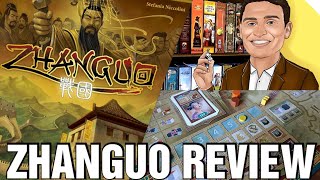
- Deep, interlocking engine-building with multiple viable paths
- High replayability due to variable boards, dual-sided objectives, and hand composition
- Strong player interaction through region control and end-round rewards
- Elegant crossovers between card actions, engine power, and endgame scoring
- Beautiful production and components that feel thematic and sturdy
- Can induce AP (analysis paralysis) and high decision density
- Steep learning curve despite relatively simple core rules
- Not always easy to acquire in print or in stock, which can affect accessibility
- Two-player sessions can feel slightly slower or tighter in pacing
- regional influence and architectural development with a focus on control of territories and endgame bonuses
- An imperial city-building scenario with regions, walls, pagodas, governors, and endgame scoring based on area control
- engine-building puzzle where card play and placement generate ongoing effects and scoring opportunities
Mechanics (from transcript analysis)
- Area Majority — Players compete to control regions; the majority yields points and endgame bonuses.
- Area majority / regional control — Players compete to control regions; the majority yields points and endgame bonuses.
- Card-tuck engine-building — Players tuck cards behind their personal boards to gain ongoing bonuses and trigger effects on future turns.
- Endgame scoring multipliers — Scores are amplified by multipliers based on the number of different categories achieved.
- Resource Management — Finite currency tokens drive end-round rewards and influence action choices; managing these tokens is central to strategy.
- Resource tokens / currency management — Finite currency tokens drive end-round rewards and influence action choices; managing these tokens is central to strategy.
- Two-action card use with overlap mechanics — Cards can be used as actions by playing over/under existing cards, with benefits scaling by whether you play higher or lower than the overlapping card.
Video topics + discussion points
Quotes (from this video)
- the brain burnery this game can be
- I cannot overstate how brain burnery this game can be
- the breadth of options you have here
- engine building part of the game I think is magnificent
- this game is clever and massive in its decision space