
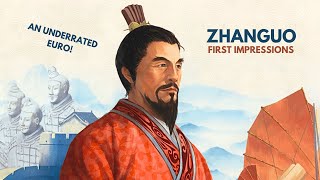
In 221 B.C., all the so-called Warring States are brought together. This is the birth of the vast Chinese empire, ruled by Qin Shi Huangdi. A skilled and determined strategist, but also a shrewd governor, he undertakes actions aimed at standardizing all the elements at the basis of Chinese society and culture; he imposes a single script and a single currency, then he establishes a new system of laws equal for all. He also builds palaces, installs local governors, and above all, starts the works for the construction of the greatest building in the history of mankind: the Great Wall.
A single life cannot suffice for such a vast empire. He sends ships to distant lands in search of the legendary elixir of life, and he builds a huge mausoleum containing the scale reconstruction of his empire. In defense of it for eternity, he deploys an impressive terracotta army...
In Zhanguo: The First Empire, you go along with the Emperor's plans to offer your family a place in the terracotta army. To help you in this challenging task, six cards will be at your disposal every round. They will give you permanent support during the rest of the game or will obtain the Emperor's approval for your actions.
At the end of the game, the player who made the greatest contribution to the Emperor's cause by scoring the most points wins!
—description from the publisher
Images


- Cool use of card synergy not seen in many other games
- Actions on the main game board are probably not as effective as the ones built more uniquely on the player board.
- historical construction and empire building
- 221 BC during the building of the Great Wall of China
- Imperium
Mechanics (from transcript analysis)
- action selection — Players choose whether to play a card on their player board for personal actions or on the main game board for location effects.
- area influence — Using cards on the main game board to contribute to building parts of the Great Wall, palaces, or hiring workers.
- Card Driven — Cards in hand determine actions for the round.
- Tableau Building — Tucking cards under slots on the player board to trigger cultivated action effects.
Video topics + discussion points
Quotes (from this video)
- I have eight games that I'm super excited about that are coming up very soon so much so that I wanted to share it with you my friends my family and the viewers
- The whole aim of the game is to kind of cultivate these mushrooms that grow on your leaves acquire sets of animal cards but also create this cool intricate Victory Point generating mechanism using the shapes of the leaves themselves
- This game is all about moving from the old city into this grandiose new city and starting a new life and decorating and making the streets of the city feel unique
- Makes for such an interesting interconnected interlocking dot to do puzzle that I cannot wait to play
References (from this video)

- Reprint of a classic game
- Design changes and additions incorporated
- Awesome artwork
- May take more than one lifetime to accomplish all tasks.
- contributing to the emperor's cause during the formation of the Chinese Empire
- 221 BC China, during the unification of the Warring States
Mechanics (from transcript analysis)
- area influence — Standardizing all the elements at the base of Chinese society and culture by imposing us new single script and The single currency along with a new system of laws all while installing local Governors and starting construction of the Great War.
- Objective Completion — The player who made the greatest contribution to the emperor's cause will win.
Video topics + discussion points
Quotes (from this video)
- The heroes and maps are also compatible with regular unmatched so that's cool as well
- This looks a lot like another here's more game expansion instead of a here's a whole new area you now have to manage.
- The artwork I think looks awesome
- I thought writing this script was time consuming well thank you I guess it's a matter of perspective
References (from this video)
- updated art and cards
- card-driven action system
- strategic card tucking
- originally released in 2014
- Ancient China
- Battle of Borodino: Napoleonic Wars
- White Castle
Mechanics (from transcript analysis)
- Card Play — action by playing card so action driven by card play
- Hand Management — you can also Talk cards and you can multiply multiply the bonus depending how many cards already have
Video topics + discussion points
Quotes (from this video)
- Rats of Wurtzburg by Cranio Creations so it is a worker placement game it is by Simon luani which we love the games
- Footprints by chili fox games so we love come together from last year yep yeah that one was a real hit for us big hit for me it was in my top five by the same designer and publisher Footprints so this is going to be good
- general orders World War II by Osprey games the fourth one because it was at demo it's demo and then followable at chenon but they sold out and I heard good things about it it's a great to player game but it's got World War II theme not the theme that I would usually kind of like attracted to but because there so many things so many people like oh I recommend this game it's very tight worker placement uh taco war worker placement so there you go general orders
References (from this video)
- top-notch solo mode
- engaging and dynamic puzzle
- multi-use card system elevates beyond other dry Euros
- building palaces, installing governors, and constructing the Great Wall
- united a new Chinese empire in 221 BC
Mechanics (from transcript analysis)
- multi-use card system — play a card to take an action or tuck it under the player board for a bonus to future actions
- Multi-Use Cards — play a card to take an action or tuck it under the player board for a bonus to future actions
Video topics + discussion points
Quotes (from this video)
- And there you go. 10, 15, actually 17 solo games that I like way more than you.
- What are some games that you feel you enjoy more than other people? Please let me know in the comments.
- I absolutely adore it.
References (from this video)
- Strong integration of theme with learning mechanics; thematic elements help remember rules
- Engaging card-driven action system with meaningful bonuses
- Balanced tension in a medium-plus weight Euro game; not too punishing
- Solid production value and reprint upgrades compared to the original
- Solo mode is simple to implement and enjoyable, with multiple difficulty options
- Clear sense of puzzle and multiple pathways to victory
- Perceived as a dry Euro by some players; not for everyone
- Limited global variability between plays; some randomness in cards and setup
- Solo rules can be easy to forget or misapplied, particularly around unification tokens
- Not a broad audience game; may not convert players who dislike heavy crunch
- Theme supports learning the rules through tangible actions (palace, walls, governor, court actions) rather than pure flavor
- Historical empire-building setting centered on palace construction, walls, mausoleum, and governance in an alternate ancient empire context
- Mechanisms-first with thematic hooks that reinforce rule understanding; thematic elements support memory of rules
- Castles of Burgundy
- La Granja
Mechanics (from transcript analysis)
- Card-driven action selection — Players use a small deck of cards to trigger and influence the six core actions, with bonuses and constraints shaped by the cards drawn and played.
- Rule-pivot card interactions — Card draws and reveals around each round create dynamic planning, with some flexibility but built-in structure.
- Spatial selection and competition for spaces — Players compete for spaces in the mausoleum, walls, and palace-related actions; timing and planning matter.
- Tableau Building — Cards contribute to a personal tableau that enhances core actions and unlocks special powers or tokens.
- Token economy and end-of-round actions — Unification tokens and other resources can be spent to gain extra actions or to activate late-round bonuses.
- Worker/officer management — Workers and officers are needed to perform actions like building a palace, collecting governors, or claiming spaces.
Video topics + discussion points
Quotes (from this video)
- This is what I would consider to be a dry Euro game.
- The theme here does the job it transports us to an interesting setting.
- The theme works very well to the point that you can really think of this game and these actions thematically and it will help you to remember the rules.
- The card play is really a game about bonus actions.
- This is top tier stuff and really deserves more recognition.
- Comfort food for me, this is the kind of game I just love to get out and get lost in all the different decisions.
References (from this video)
- Engaging card-driven action system
- Cleaner, more thematic components and iconography
- New module (alchemist/elixir) adds depth and decisions
- Variable governor bonuses increase strategic planning
- Changes alter pacing vs. original; could be polarizing
- Some players may prefer the classic scoring approach and tighter endgame
- city-building and empire administration with card-driven actions
- Ancient China-inspired empire-building
- historical-meets-puzzle
- Lisboa
- What's Your Game?
Mechanics (from transcript analysis)
- alchemist_track_and_jokers — Alchemist track introduces new bonuses; joker-like cards provide flexible scoring opportunities and require planning.
- card-driven_actions — Play cards to perform actions at your board or the central board, driving player interaction and timing.
- governor_bonuses_variable — Governor bonuses are now variable, influencing decision-making and space control.
- mosum_statues — New mosum/statue system replaces certain fixed scoring tokens with collectible statues that unlock points.
- officials_as_workers — Officials act as workers with location-based bonuses and new interaction mechanics compared to the original.
- palace_scoring — Palace scoring structure changed to tie points to card types and early timing, increasing interaction.
- wall_scoring — End-game walls scoring adjusts for player count, changing risk/reward tradeoffs.
Video topics + discussion points
Quotes (from this video)
- I really do like Sango
- this new version fantastic get it if you can
- it's a fantastic game
- get this game I recommend it
- if you have the original basically it's up to you if you look at these changes