/pic6988937.jpg)
What if the animals were the ones who ran the zoo?
…Presumably, this wild government would be built upon the support of fellow creatures and fueled by the fame, attention, and prestige of wide-eyed visitors. Naturally, the most aspirational beasts would lobby for a position in the star exhibit, and the lead star would be elected Zoo Mascot.
In order to join the star exhibit, each species must campaign its way up the hierarchy of enclosures with the majority support of animal voters. And the lead star will be the species that has earned the most laurels from both raving fans and jealous rivals along the way.
How does one gain support and earn laurels? Through crafty politicking, clever negotiations, and ruthless schemes. There can only be one Zoo Mascot, after all.
Where are you going? That is the ultimate question of Zoo Vadis.
Zoo Vadis is an evolution of Reiner Knizia’s classic negotiation game, Quo Vadis? It retains the elegant, political gameplay that fans have come to love while introducing many innovations and improvements by:
Enhancing the 3-player game and tailoring the board to all player counts through neutral, bribable figures—roaming peacocks
Widening the player count with a second game board for 6-7 players
Expanding the possibilities for strategic negotiation with asymmetric animal abilities
Increasing tactical opportunities with new special laurel tokens
Broadening the appeal of the theme and presentation with vibrant zoo art by Kwanchai Moriya and Brigette Indelicato
Enlivening the production with chunky animal figures and functional player screens
Like the original design, the game ends immediately when the Star Exhibit is full. Only the animals who have reached the Star Exhibit qualify for victory, and the winner is the player with the most laurels.
–description from publisher


- great game
- negotiation
Mechanics (from transcript analysis)
Video topics + discussion points
Quotes (from this video)
- Settlers of Catan has probably brought more people into this hobby than anything else and for that I'm truly truly thankful I really am.
- Playing a solo game helps clear my mind... I find it quite a good form of meditation, a good way to get into that very important state of flow in my brain.
- The more intense it gets, often the more I can relax whilst I'm doing it.
- Hunting down gems like this, I know a gems and have to convince other people to play.
- It's the thrill of the hunt. It's the hunter and just like the hunter-gatherer in me going out and finding the rare exotic board, bringing it back, plucking its feathers, it's great.
- If you've got any board game adjacent hobbies, what do you do on your time away from the board? Let me know down below.
- There's enough people on this planet for more than one person to be interested in everything.
References (from this video)

- Reprint of a 1991 game
- Improved art and mechanics
- Bribable peacocks and animal figures
- Expanded player count to seven
- Guaranteed backstabbing
- Negotiation and backstabbing
- Zoo
Mechanics (from transcript analysis)
- cooperative with betrayal — the whole time while you need to work together you know you just know for sure that eventually everyone is getting stabbed in the back
- Negotiation — negotiating your way through rooms
- Set Collection — new bonus tokens
- Variable player powers — new asymmetrical abilities
Video topics + discussion points
Quotes (from this video)
- trailblazers where one to eight adventurers will create the longest hiking biking and kayaking paths by the ageless medium of tile length with a catchy is that you can't get lost as you always have to find your way back to camp and you only score points for paths that begin and end at matching colored campsites
- you're gonna get stabbed in the back it's just i mean it's a guarantee
- point city a sequel to the wonderful hit game point salad which i linked to my friend beth now i think about it not important in point city your drafting cards similar to the original point salad but you're building a city and as such there's a little more going on with resource management and engine building aspects but gosh if i'm not excited for it when it's out next year
- board game day which is written by amy valdez from the board game blitz podcast and illustrated by rachel kramer from the semicolo internet comic and they've teamed up to create board game day a 16 page fully illustrated children's book the game follows a group of friends two pandas a cat a bird and an octopus as they prepare for and have a board game day illustrations include many actual children's games so the kid might recognize them and i think this is a lovely project to finish on
References (from this video)

Mechanics (from transcript analysis)
Video topics + discussion points
Quotes (from this video)
- I think I can already say I would really like to try at some point just from the table presence alone.
- Honestly Cooperative games are far from my favorite type of game but I love Carcassonne so that is enough to have me quite intrigued if I have an opportunity to try this one.
References (from this video)
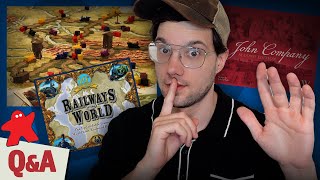
- Fantastic game where everyone's trying to help each other get to the top
- Involves backstabbing
Mechanics (from transcript analysis)
- Betrayal — The game involves backstabbing at the end.
- cooperative play — Everyone's trying to help each other get to the top of the board.
Video topics + discussion points
Quotes (from this video)
- I very rarely very rarely want to play the big old Euro at the full six player count.
- Power Grid is the game that's so popular, so successful, but still feels like an underdog when compared to other games.
- The auction here is very tense at six players.
- Cursed Court is a fantastic betting game that really shines at higher player counts.
- Lifeboats. H you want to play a game with six friends but you don't necessarily want six friends at the end of it.
- Zu Vardis, that's a fantastic game where everyone's trying to help each other get to the top of the board, the zoo in Zuardis. But you also want to be the person who gets to the very top the first.
- The jazzy pattern, which doesn't always make for great cognition of a board and what the heck is going on.
- It's an incredibly dark board. I think they reprinted it with a lighter board, just they already did this. It's like no one can This is very dark. No one can see what's happening.
- I did learn that if you mix red wine and white wine together, that's how you make rosé. That's fact according to Viticulture.
- the main thing that I've learned from games is that little insight into different worlds all around the world and beyond because of board games.
- I've learned that from board games. And while I can't say I've learned a bunch of hard facts, I think board games have kind of opened up the world to me a little bit from my table.
References (from this video)

- Controlling a zoo
- Quo Vadis
Mechanics (from transcript analysis)
- Moving things up — moving things up.
Video topics + discussion points
Quotes (from this video)
- Hens is a game I didn't like at all.
- Gobblet is a simple game in which you are to stacking pieces and trying to get four in a row, but bigger pieces cover up other pieces.
- Dice as resources to buy cards, kind of like a Dominion-style game. And it was fine. It just didn't have any kind of air of excitement to it.
- And it's a big, grandiose Euro-style game that I thought worked pretty well.
- The biggest problem with Echoes of Time is I think it's almost too short.
- It's a cool mechanism. This is the game that should have it.
- It's a very different feeling of Lost Cities. It's not as good as Lost Cities, but it's still pretty cool game.
- It's very Ameritrashy.
- It's a lot going on in this game.
- I think my favorite of those is Pixel Tactics 2.
- Thanks as always for joining me in my pile of mid games.
References (from this video)
- The elegance of using laurels as both currency and victory points.
- Asks more of the group than other games in the category.
- Animal factions climbing through zoo enclosures toward the star exhibit
- Zoo
- Quo Vadis
Mechanics (from transcript analysis)
- Asymmetric powers — Each animal faction has unique abilities that can be used to help others.
- Negotiation — Players need majority support from others to advance, offering laurels for votes.
- Resource Management — Laurels are spent as currency and also serve as victory points.
Video topics + discussion points
Quotes (from this video)
- The best move you make in a trading game isn't on the board. It's the face you make when someone slides an offer across the table.
- A trading game lives or dies on the moment the table goes quiet.
- It's not about rolling dice or placing tiles, it's about reading people.
- Because that moment is the game. Everything else is just the box it comes in.
References (from this video)
- Loudest game on the list.
- Great for groups who love to argue, wheedle, and wheel and deal.
- Plays a true seven.
- Gets better and louder with more players.
- Ends as soon as the top exhibit fills, never drags.
- Skip if you have quiet players.
- Anyone who sulks when betrayed should avoid it.
- A shy group will cause the game to die.
- Negotiating and using faction powers to move animals up the ranks.
- A zoo.
Mechanics (from transcript analysis)
- Hidden Role/Power — Each faction has a special power that cannot be used on one's own animals.
- Negotiation — Players must negotiate and make deals to advance their animals.
- Trading — Players trade future support and call in favors.
- Voting — Animals need votes from others in enclosures to move.
Video topics + discussion points
Quotes (from this video)
- We're telling you which ones to buy and which ones to leave on the shelf. No filler, no mercy.
- And we don't agree on all of them, which is the fun part.
- If it made the cut, what you do messes with what everyone else is doing.
- No quiet point salads where you barely look up from your own board.
- Long enough to sink into and feel like a real game. Short enough that you lose, hate it, and demand a rematch on the spot.
- This is the one I'd grab off a burning shelf.
- Every character plays like a different game.
- Learning a new fighter is learning a new game from scratch.
- The cards do double duty, too.
- It's my top pick on this entire list, and I'm not sorry about it.
- One of you is the Nixon White House burying a scandal. The other is the press trying to expose it.
- Every single card hurts a little to spend.
- It takes those huge heavy political card games and crushes all that tension into 30 minutes.
- The asymmetry is the heart of it.
- The cards are loaded with photos and history. It feels like the era it's about.
- Skip it if history as a theme leaves you cold. Or if you wanted something breezy, because this one bites hard.
- So, you're walking a tight rope every round.
- It's the rare party game that rewards being smart.
- Buy it if your group likes word games with a real edge.
- Adam would walk straight past Sky Team to grab Unmatched. I'd do the exact opposite and never look back.
- Short games are not lesser games.
- 30 minutes is plenty. Plenty for tension, plenty for a real decision, plenty to feel like a hero or an idiot.
References (from this video)
Mechanics (from transcript analysis)
- Negotiation — Heard it's a negotiation game.
Video topics + discussion points
Quotes (from this video)
- If I was a smarter man, Oh, Mitchell, you're the smartest man. You did it, but I just in case you didn't, I had to have a little voice giving up.
- What would a modern day like a proper modern hobby board game of life look like?
- The fact that you're horrified by King of Stone is another one.
- The end at the end of the day, it's more about the social experience and the social experience was so fun, so enjoyable, and so connected that as much as it would have been great to play a board game, it was like we didn't miss it.
- The Stonemaier Games logo with little cat ears.
- I say that because you'll see products being announced or here and I say oh we decided, you know, world peace. No, that's not happening anything now. We're doing this now you're not doing that we know so there's so many things that people put out there that are not, you know, real products or real things and I'm like aw, it's sort of like did you ever have a dream that something amazing happened cuz a lot of times I can tell when I'm in a dream.
References (from this video)
- pure negotiation title with social interaction at its core
- asymmetric animal abilities add flavor
Mechanics (from transcript analysis)
- Negotiation — pure negotiation; players use votes and special abilities to influence moves
- special abilities — each animal has a special ability used in negotiation
- vote-based movement — to move between spaces you need the majority of votes
- Voting — to move between spaces you need the majority of votes
Video topics + discussion points
Quotes (from this video)
- Put away chess? Seriously? Stop playing Ticket to Ride, Lords of Waterdeep, and even Catan.
- Board games have evolved.
- once you try them, you'll never look back at those classics again.
References (from this video)
- fast to teach and quick to play, enabling multiple back-to-back games
- snappy turns with strong engagement, especially during negotiations
- highly thematic art and tactile components that draw players in
- emergent strategy with a lot of variation between sessions
- accessible for a wide range of players, including non-gamers and families
- not ideal for players who dislike negotiation or potential bad-faith play
- group dynamics can produce negative feelings (kingmaking, betrayal, grudges)
- requires the right group to realize its full potential; can feel mean in some sessions
- play balance can depend on player count; lower counts may reduce tension and interaction
- Politics and intrigue within a playful animal kingdom
- A zoo where animals demonstrate democracy and elections to determine the star attraction
- Emergent, player-driven negotiation that shapes the political drama
- Quo Vadis
Mechanics (from transcript analysis)
- end-zone scoring and token collection — Advancing into the end zone yields point tokens; at game end, players tally these tokens to determine the winner.
- Negotiation — Players negotiate for votes, favors, and deals to progress, often trading or bribing, making negotiation central to success.
- negotiation and bargaining — Players negotiate for votes, favors, and deals to progress, often trading or bribing, making negotiation central to success.
- peacock tokens and NPC interference — Peacocks act as non-player elements that can block paths or be bribed to influence votes, adding a layer of strategic disruption.
- placement and area access — On your turn you place a piece on an empty space in the bottom row to begin your path toward the end zone.
- special powers and token economy — Animal power tokens grant unique abilities that can be traded or used during negotiations, adding depth and variability.
- vote-based movement — To move a piece, you must secure the majority votes of everyone in the target space; the required votes depend on occupancy (e.g., 2 for a 3-person space, 3 for a 5-person space, with adjustments for fullness).
- zookeeper movement — The Zookeeper can move forward freely without needing votes, acting as a free move that can alter positioning, but without awarding a point token on that path.
Video topics + discussion points
Quotes (from this video)
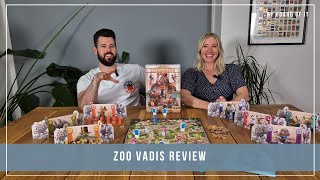
- it's a great negotiation game which is facilitated so well through the game play
- it's quick to teach and quick to play so you really can get a couple of games in and introduce new players very easily
- the art is on point and this has gone down super well with everyone we've played this with
- it's just good clean fun
- we really recommend it but with a caveat that you need to know that your group or yourself this is something they want in terms of negotiation
References (from this video)
- engaging, fast-paced negotiations that feel meaningful and tense
- high production quality and colorful, chunky components
- reimagines a classic concept with a fresh zoo-themed skin and star-exhibit goal
- easy to pick up for new players but with enough depth for experienced players
- the negotiation can become chaotic or one-sided depending on players' alliances
- endgame can feel abrupt if one player gains control early
- design references to the original Crow Fighters pedigree may leave purists wanting closer fidelity
- political campaigning, popularity contests, and crowd influence among animal voters
- Seven animal species compete to become the zoo's star exhibit within a sprawling, publicity-driven zoo environment.
- competitive, negotiation-driven with player-driven manipulation of votes and positions
- Lacrimosa
Mechanics (from transcript analysis)
- area/hashtag: star exhibit control — The goal is to place at least one animal in the star exhibit and accumulate Laurels; the star exhibit fills up over the course of the game.
- End Game Bonuses — When all spaces in the star exhibit are filled, the game ends and Laurels are tallied to determine the winner.
- endgame triggering by exhibit fullness — When all spaces in the star exhibit are filled, the game ends and Laurels are tallied to determine the winner.
- negotiation and vote-based influence — Players trade votes and Laurels to influence which animals gain spots in the star exhibit and to move strategically toward victory.
- special power use — Certain Laurels grant immediate or reactive powers (e.g., moving the Zookeeper) that can swing negotiations and positioning.
- token-based action economy — Laurel tokens and other power tokens are spent to gain actions (including moving the Zookeeper) and to secure votes.
Video topics + discussion points
Quotes (from this video)
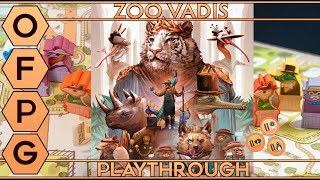
- the components are gorgeous and the game plays fast
- I love these negotiation Powers
- it's not co-op, it's on you
- this is a great night concept; the idea is solid
- the production is high quality; I would buy this game
References (from this video)
- Interesting mechanics
- Large group game
- Requires large player group for full experience
- Zoo management
- Zoo
- Abstract
Mechanics (from transcript analysis)
- Area entry — Enter available spaces in zoo sections
Video topics + discussion points
Quotes (from this video)
- I love Huton. Oh my gosh.
- Oh my gosh, I am in love with that game.
- It knocks out of the water.
- One of the better games I've played in a long time.
- The components are so much better. It makes a better game.
- It's a fun little like watch the world fall apart and burn and see who can survive that process the longest.
- One of my favorite party games, if not my favorite party game.
- It's a lot going on. Very thinky. But very rewarding, too, at the same time.
- When trick taking gets to a point where I feel like I'm just trying to math out every probability and it starts to feel like homework, I start to like it less.
- I cannot wait to play it again.
- My ideal would be combining the best parts of Bruges and Hamburg into one game, but I can't do that.
- It's just easy, straightforward, satisfying.
- There's not quarterbacking, there's assisting, because it's so much happening at once and so much daisy chaining that the quarterbacking is almost impossible.