









A Game of Thrones Deep Dive
What the Community Thinks About A Game of Thrones
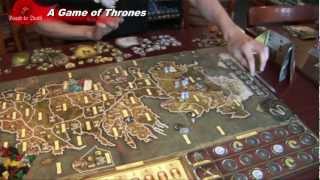
Reviewers treat A Game of Thrones, the Fantasy Flight Games board game of the War of the Five Kings, as a serious strategy game first and a licensed product second. Zeb, Board to Death TV describes it as a very tense, involved strategy game that borrows many of its ideas from Diplomacy while adding a lot of flavor from the series. The Secret Cabal Gaming Podcast places it in the same negotiation-driven space and praises how its politics feel true to the source material.
Opinions split once the conversation turns to the table itself. Reviewers who love the game say it rewards a stable group that knows the rules and plays it repeatedly, and several suggest it works best with five or six players rather than three or four. 3 Minute Board Games frames the concern around skill: a newcomer can throw off the balance for everyone at the table, while a committed group finds the game deeply rewarding. The Cardboard Herald describes it as a big, stompy war game that leans toward the diplomacy end of the spectrum, and the channel's hosts keep it in their collections largely for the social experiences it has supported.
Core Mechanics That Define A Game of Thrones
Auction and Bidding
Bidding is the engine that moves power around the board. Each player holds influence tokens, announces how many they have, and secretly bids on the tracks on the board, including the Iron Throne and King's Court. Board to Death TV explains that the holder of the Iron Throne decides ties and can use that position to punish rivals or reward allies. Wildling attacks reverse the logic: the highest bidder gains a benefit when the threat is repelled, while the lowest bidder suffers when it is not. Reviewers focus on the tension between paying for position and keeping enough influence back for the battlefield, since spending too much on the tracks can leave an army exposed.
Negotiation
Negotiation is where much of the game happens between the printed rules. Orders are placed face down, support from an adjacent area can add strength to a battle, and ships act as bridges that let armies cross the sea. Those mechanics only matter because players make and break deals to get them. The Secret Cabal Gaming Podcast points out that the game has no real currency, so the only currency players truly hold is the deals they make with one another. That is why the experience depends on persuasion, reputation, and reading the people across the table, and why reviewers keep drawing comparisons to Diplomacy.
The A Game of Thrones Experience
Paranoia and Shifting Alliances
Reviewers describe a table where suspicion never fully switches off. One of the hosts of The Secret Cabal Gaming Podcast recalls stepping away from the game at a convention and returning to find an enemy chatting with a friend, then spending the rest of the session anxious about what they were planning. That constant reassessment of who can be trusted is what sets the game apart from an abstract wargame, and it is why reviewers call the play deeply social.
An Epic War of the Five Kings Atmosphere
Zeb's walkthrough emphasizes how each house plays out its own story. Tyrell can expand rapidly through its supply, Greyjoy is isolated and so is pushed toward constant offense, and Martell is a dangerous player to ignore. Zeb observes that Lannister and Baratheon almost always end up fighting each other, which makes the game play out much like the war it is named after. That thematic fit keeps the setting alive at the table, even for players who came to the board game before reading the books or watching the show.
What Makes A Game of Thrones Stand Out
Combat Built on Hidden Cards and House Abilities
Zeb praises the distinctive combat cards each house carries, which grant strength bonuses and hidden special abilities, and says they sync up well with how the series works. Battles are resolved when both players secretly choose a card, add leader values and army strength, and let the holder of the Valyrian steel blade break ties. Retreating units are set aside and protected for the rest of the round, but they are destroyed if attacked again, so every fight carries real stakes. Shelfside calls the combat system very good in its own right, and it is one of the few points where reviewers speak without reservation.
Asymmetric Houses That Feel Distinct
Each of the six houses begins with its own armies, strongholds, and hidden abilities, and Zeb notes that the starting positions differ enough to shape early decisions. Because the houses are built around different strengths, the same map plays out differently depending on who is at the table. Reviewers credit that asymmetry with giving the game much of its replay value, and they frame it as a reason the game rewards learning each house's tendencies over multiple sessions.
Potential Drawbacks
Player Count and Table Dynamics
Zeb recommends the game for five or six players and finds it less satisfying with three or four. With three players, the front runner tends to get ganged up on by the two players behind, and four is still a little low. Zeb also dislikes the rule that ends the game the moment a player reaches seven strongholds, preferring the common house rule that requires holding them through the rest of the turn, because an instant win encourages reckless rushes and cheapens the finish.
Runaway Leaders and Long Recovery
Shelfside finds the game feels terrible once a player falls behind, and notes that a single misplay can effectively eliminate someone from contention over a long session. 3 Minute Board Games makes a similar point about the skill gap: when one player does not commit to the game or does not know the rules, the balance tilts sharply toward the people who do. Both channels suggest the game asks a lot of its table, with a stable group that treats it seriously and is willing to sit through a lengthy game.
If You Enjoy A Game of Thrones
Players who enjoy A Game of Thrones's blend of alliance-making and secret commitment will find similar satisfaction in Diplomacy, the negotiation game that Zeb and The Secret Cabal Gaming Podcast both name as the closest comparison. Players drawn to its large-scale area control and hard-edged competition may enjoy Twilight Imperium, which Shelfside credits with pulling its table away from A Game of Thrones. Both recommendations reflect the same core appeal reviewers describe: a table of rivals whose promises matter only until someone sees an advantage in breaking them.
What Reviewers Are Saying
"I love it. I do. I will say I don't like it with three or four players. Three, basically what happens is the front runner just gets ganged up on by the two people behind him and then they fight it out. It's not particularly interesting."
— Zeb, Board to Death TV
"I find its combat system to be very good. The asymmetry makes perfect sense. It's just extremely cutthroat and feels terrible once you fall behind. I've come close, but I actually have yet to win the game at all."
— Shelfside
"I love playing this game. I love it. It's a game that can make you paranoid when you're playing it, like totally insanely paranoid."
— The Secret Cabal Gaming Podcast