/pic1497102.jpg)
/pic1673124.jpg)
/pic1857661.jpg)
/pic2038798.jpg)
/pic2302759.jpg)
/pic2843367.jpg)
/pic3261056.jpg)
/pic3406958.jpg)
/pic3311945.jpg)

/pic4017476.png)
/pic4461764.png)
/pic4616602.png)
/pic5714454.png)




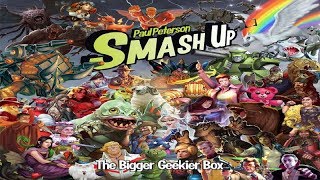







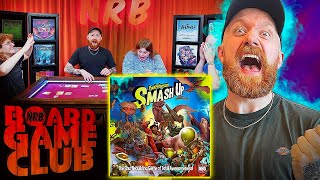

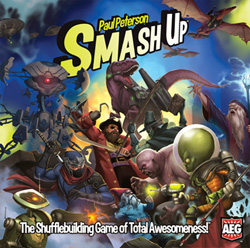
Smash Up Deep Dive
What the Community Thinks About Smash Up
Smash Up occupies a fascinating position in the board gaming landscape. It's a game that clearly resonates with players who love its wacky premise and faction-building mechanics, yet also one that sparks polarized opinions about its execution and balance. Reviewers consistently praise the elegance of its core concept while grappling with implementation challenges that emerge, particularly in the base game without expansions.
Core Mechanics That Define Smash Up
The Shufflebuilding Foundation
The heart of Smash Up is deceptively simple. Players select two distinct 20-card faction decks, shuffle them together into a single 40-card deck, and use that hybrid combination to compete. This shufflebuilding mechanic (distinct from traditional deck building because players combine pre-built decks rather than acquiring cards) creates immediate thematic and mechanical synergy. Reviewers highlighted how pirates feel different to play than ninjas, and how mixing pirates with aliens produces yet another unique experience. The game takes less than five minutes to teach, making it highly accessible for newcomers while the faction combinations create seemingly endless variety.
Area Control Through Base Scoring
The gameplay loop revolves around bases in the middle of the table. Players play minions and action cards to bases, and when the total power reaches or exceeds a base's threshold, it scores. The player with the most power gets the highest point value, second place gets the middle value, and third place gets the lowest. This simultaneous multiple-player scoring mechanism creates interesting strategic decisions about whether to contest a base aggressively or position for consistent second-and-third-place finishes across several bases.
The Smash Up Experience
Infectious Theme and Humor
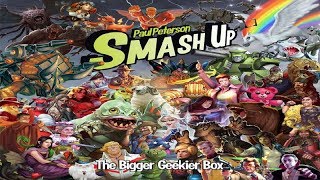
The theme is where Smash Up truly shines. Reviewers consistently emphasized how well each faction captures its archetype. Pirates have ropes and boats in their border artwork. Ninjas feature throwing stars. Wizards combo spells with recursive effects. The humor of combining incongruous factions creates memorable moments: ninja ghosts, zombie dinosaurs, leprechaun robots. This thematic coherence extends beyond flavor text into actual gameplay, where each faction's mechanics reinforce their identity. Dinosaurs win through brute power, wizards through spell chaining, robots through token flooding. Players reported enjoying the experience of theorizing strange combinations and watching them play out.
Chaotic Board States and Downtime Struggles
As the game progresses, particularly with multiple bases and many minions on the board, tracking power totals and abilities becomes cognitively taxing. Reviewers noted that the base game lacks icons or symbols to quickly indicate card effects, forcing players to read text repeatedly. When bases become overloaded with minions from robot token spam or wizard recursion, the board state can feel overwhelming. Combined with the meanness of player-versus-player card effects and the ability for one player to substantially undo another's work, games can feel prolonged. The chaotic nature means individual player actions between turns often feel irrelevant, as game state swings dramatically with each resolution.
What Makes Smash Up Stand Out
Infinite Expansion Potential
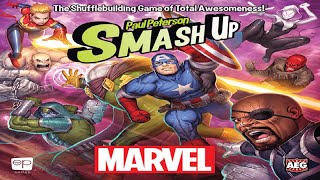
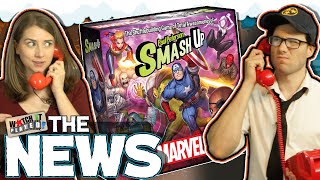
Unlike many games, Smash Up's design allows for seemingly endless expansion. The license model is particularly clever. Reviewers noted the game has brought in Marvel IP and recently announced Disney properties. The premise accommodates any faction imaginable: Disney Princesses, Captain America, cyborg apes, time travelers. This flexibility means the game can stay fresh and relevant for years. Players who burned out on the base game found renewed interest when additional expansions provided new combinations and mechanical variety. The game community theorycrafts endlessly about which license will come next and what faction combinations might exist.
Accessibility as a Gateway Experience
Smash Up's simplicity and speed have made it a vehicle for introducing people to modern board gaming. Reviewers pointed out that non-gamers grasp the concept immediately, and the game completes in under an hour. The visual theming makes it immediately appealing to people who might not consider themselves gamers. Several reviewers mentioned introducing family members and friends who fell in love with it as a first modern board game experience. This gateway function is significant and shouldn't be underestimated.
Potential Drawbacks
Severe Faction Balance Issues
The base game's balance is problematic. Robots, wizards, and zombies can consistently circumvent the one-minion-one-action-per-turn restriction through recursive effects and token flooding. These factions have ways to draw cards or recycle resources in ways other factions cannot. Ninjas struggle because many of their effects rely on destroying minions, and if opponents don't play many minions, ninja abilities feel wasted. Meanwhile, factions like leprechauns and aliens lack the explosive power plays available to top-tier factions. Games often feel decided by faction selection rather than clever play. Reviewers emphasized that the balance issue isn't just about power level but about consistency. Broken factions can consistently execute their strategies, while weaker factions feel reactive and slow.
Expansion Bloat and Diminishing Returns
While expansions improve the base game's balance and add variety, reviewers warned that newer expansions vary in quality. Some expansions felt rushed or poorly designed compared to the earliest ones. As the expansion list grows, tracking which new mechanics do what becomes difficult. The sheer number of special abilities and tokens across multiple expansions can transform the game from elegantly simple to mechanically overwhelming. Reviewers suggested that there is definitely a point of diminishing returns on expansion purchases, and players should be selective rather than completionist.
If You Enjoy Smash Up
Players who love Smash Up's core premise of mixing distinct power sets should explore Small World, which provides a similar experience of combining special abilities with area control but with a more balanced mechanical foundation. Those drawn to the combo potential and faction interactions might appreciate Dice Throne, which offers dueling mechanics with unique character powers without some of Smash Up's balance problems. For players who want pure theme-driven card game chaos, Marvel Snap delivers fast-paced combo gameplay with similar satisfying moments of chaining effects. Oceans offers a different take on the faction combination concept with deeper strategic depth. Carcassonne and Ticket to Ride provide area control without the faction complexity but with tighter design.
What Reviewers Are Saying
"The theme here is done incredibly well. All the cards have great art with just as great borders to really help sell the different aesthetic of each faction. You can pick up any card and immediately tell what faction it's supposed to be."
— Shelfside
"It's a game that takes a very simple premise: what if each game you played you used two distinct power sets and had to figure out how to make them work, and it runs with it. Each of the eight sets in the core box is distinct with strengths and weaknesses."
— 3 Minute Board Games
"I get a huge kick out of the ridiculous theme of this game. Coming from a background of Yu-Gi-Oh and Magic, I'm just a big fan of card games in general. I like the base game enough that I went out and got two expansions, and the game immediately feels so much better to play balanced, just bam, you don't even notice there's an issue."
— Shelfside