





































Emberheart Deep Dive
What the Community Thinks About Emberheart
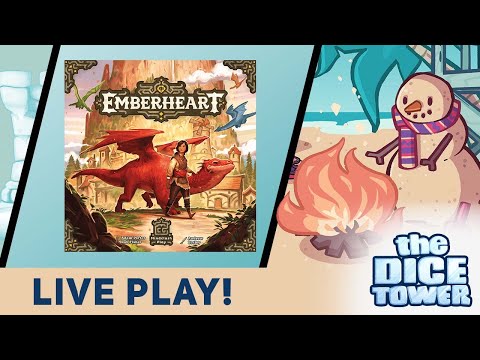
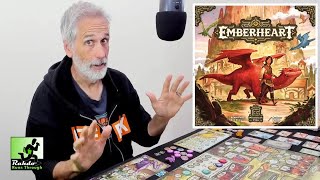
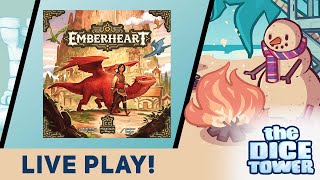
Emberheart has arrived with a wave of enthusiasm from the board gaming community, and the general consensus is clear: this is a worker placement game with a distinctly fresh angle. Published by Mindclash Games under their lighter "Mindclash Play" sub-line, it represents a deliberate departure from the dense, hours-long systems the publisher is traditionally associated with. Titles like Anachrony and Voidfall define Mindclash's reputation, and reviewers consistently note that Emberheart sits comfortably below that weight tier while still delivering enough mechanical texture to satisfy experienced players. The Dice Tower's Tom Vassel placed it at a 6 out of 10, calling it a game that feels "almost developed" and noting some structural unevenness, while his co-host Chris Ye was more enthusiastic, recommending it at a 7.5 and praising its refreshing combinations and satisfying feel. That spread captures how reviewers in general land on this one: broadly positive, with some debate about its intended audience and polish.
What earns near-universal praise is the presentation. Andrew Bosley's illustrations draw immediate recognition from the hobby community, and reviewers describe the board's soft, painterly aesthetic as approachable and gorgeous in equal measure. Designer Adam Porter, who co-created the game alongside Rob Fischer and describes a ten-year development journey, confirms the theme was a conscious creative choice: human champions living alongside dragons, with poachers threatening that harmony. Reviewers across channels including kovray, Allies or Enemies, the Board Game Garden, and Foster the Meeple all note that the art and theme land together in a way that makes the table feel alive before the first card is drawn. Several reviewers draw an unprompted comparison to How to Train Your Dragon as the emotional register this game hits.
For target audience, reviewers position Emberheart as a midweight gateway-plus experience. Allies or Enemies frames it as "an easy next step from Wingspan or even slightly above that complexity level," a natural on-ramp for groups ready to graduate from introductory worker placement games. The Dice Tower crew is more measured, agreeing that this is not a first worker placement game and is more accurately aimed at hobby enthusiasts who want something lighter in the Mindclash family, not newcomers looking for a casual evening.
Core Mechanics That Define Emberheart
Worker Placement as Competitive Bidding
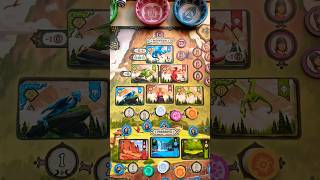
The foundation of Emberheart is a worker placement system that functions more like an auction than traditional placement. Players build parties from a pool of hierlings, spending between one and five of them to claim a numbered slot at one of six common locations. The slot number you occupy determines your priority during the reward phase: higher bids resolve first and claim cards before lower bids. Tom Vassel noted bluntly that "it's really an auction," and the distinction matters for how you approach the game. You are not simply placing a worker and locking out a space; you are gambling on how committed your rivals are to the same destination.
Hierlings come in two essential tiers. Grunts are versatile and can go anywhere, but are permanently discarded after use. Experts come in three colors: scouts (yellow), rangers (blue), and wardens (purple). Each color is restricted to its corresponding locations but returns to your supply after each round. Gear tokens let you convert grunts into experts at any time, creating a satisfying long-term investment arc. Reviewers at kovray describe this thematically: "The grunts are not as loyal to your cause. But once you start giving people the gear, giving them a little bit more pride in their work, they're going to be more loyal." Allies or Enemies highlights that in later rounds, as expert pools grow, the intensity of competition for locations escalates meaningfully, with the scarcity of grunts and the cost of outbidding rivals creating natural pressure throughout each round.
The dragon companion adds a third bidding dimension. Once per round, each player can attach their dragon meeple to one of their parties, activating up to three attribute-based bonuses tied to their player board. These bonuses depend on track levels and placement conditions: one track extends your party's effective size, one triggers when placed at a position-three slot, and one activates when you are first to a location in that round. The Board Game Garden describes how this creates a satisfying layer of planning within planning: knowing when to commit your companion to maximize all three bonuses, versus holding it back for a safer placement elsewhere, is a recurring micro-decision that keeps every turn interesting.
Aid Tokens and the Round-End Trigger
The game's round-end mechanism is one of its most discussed features. Four ambassador aid tokens sit on the board each round, each offering a powerful benefit: the leader grants first player for the next round and lets you recall and reposition one already-placed party; the defender lets you choose which of two raid cards activates at round end; the survivalist awards a gear token and breaks ties at the mountain; and the healer reduces your flame by two. The round ends the moment the fourth aid is taken, regardless of whether all players have exhausted their placement discs.
Reviewers find this trigger creates genuine tension throughout every round. Allies or Enemies notes that at four players, someone can accelerate the round unexpectedly, leaving rivals with workers they cannot place. The defender token draws particular attention as a direct, high-stakes form of player interaction. kovray describes racing for it: "If you grab that banner first, you get to decide which raid card gets triggered at the end of the round. You can pick the one that is most detrimental to you out of play, or look at everybody else's board and decide which one would ultimately cause the most chaos." Foster the Meeple frames all four aids collectively as consistently powerful, making every round a secondary priority race layered beneath the main bidding competition at each location.
The Emberheart Experience
A Push-and-Pull Economy Under Constant Raid Pressure
Emberheart is not a game where you build resources in peace. After every reward phase, a raid card resolves, stripping hierlings from every player's supply based on conditions tied to their current game state: the number of certain dragon colors owned, the number of heroes attached, the number of expert types held. Allies or Enemies calls these raids simply "it hurts, it hurts a lot," and notes that they compound over the game as players accumulate more assets and thus more raid exposure. The Board Game Garden explains the double-edged nature of the mountain location's wardens as a clear example: they are required for the best dragons, but they are permanently consumed by the mountain, and raid cards specifically punish warden-heavy players at peak moments.
This pressure forces constant triage. Going to the tavern for fresh hierlings costs a turn that might have gone to the mountain or the heroes guild. Upgrading grunts into experts costs gear tokens that might have been saved for the flame track adjustment at game end. Allies or Enemies frames this as central to the game's identity: "You are keeping an eye on how many tokens other players have put out. When they have spent a lot, you've got a pretty good sense of whether they might block you. But you also have to always be thinking about the raid." The Board Game Garden adds that hero cards require careful sequencing: you need matching dragons attached before heroes can score, and heroes need to be acquired before they can be paired, making long-range planning across all five rounds an essential skill.
Compound Scoring and Emergent Strategy
End-game scoring in Emberheart draws from five sources simultaneously: individual dragon point values, the highest position reached on each of three attribute tracks, hero card scoring conditions once matching dragons are attached, completed garrison cards, and the flame track bonus. No single source dominates reliably, and reviewers celebrate how this makes different approaches feel viable across plays. kovray describes it as a dynamic balance between predictable scoring (getting dragons and moving tracks up) and opportunistic scoring through hero and garrison cards, which shift based on what the market deals each game.
The flame track is the most discussed of these systems. Moving up (getting "hotter") is unavoidable: the fire station grants grunts at the cost of one flame, many dragon rescues add flame, and failing to pay raid costs adds flame. At the end of the game, the player with the highest flame scores nothing from this track; all other players score points equal to the steps between them and that high marker, with the gap scaling significantly as distance increases. Foster the Meeple calls this elegant: "Managing flame well throughout the game can make a huge difference in your final score. Don't let the fire run away." The garrison cards, which increase in difficulty each time the lowest version of a color is claimed, provide a reliable secondary target that often completes naturally through normal play. kovray notes these felt "very natural to move towards, even if you weren't super focused on them."
What Makes Emberheart Stand Out
Graphic Design Clarity in a Complex System
One of the most admired qualities of Emberheart is how its graphic design makes a layered ruleset navigable at the table. Designer Adam Porter specifically praised the work of graphic designer Albert Bockner in his community videos about the game, noting that color-coded iconography makes it immediately clear which hierling types belong at which locations, how the mountain levels resolve, and what each card's scoring conditions require. Porter described being "so impressed with it" and called the clarity a genuine achievement given the number of distinct systems the game contains. A viewer in that same video called out how "Emberheart takes a game that isn't simple or easy and makes the choices clear and inviting," identifying graphic design as an underappreciated contributor to that experience.
Reviewers at Allies or Enemies also highlight the physical production quality of the companion dragon meeples: "All of your dragon companions are silk-screened on the front, which is really nice." The player boards feature a dual-sided design, offering a simpler A-side for first-time play and an asymmetric B-side for experienced players, each with a unique special ability tied to their color. The Board Game Garden notes this graduated approach as a strength: groups can learn the system cleanly before layering in variable powers, which extends the game's shelf life naturally.
The Mountain as a High-Risk Reward Mechanism
No single location in Emberheart generates more discussion than the mountain. It is the only place to access high-value dragons (worth up to 7 points individually) and the only location that rewards climbing through multiple tiers in a single round. Players send warden hierlings to compete for position across three levels. After grunts are discarded and initial dragons are claimed from the bottom row, players remaining with wardens compete for the middle and top rows, which offer stronger dragons, attribute track advances, and increased flame costs.
Allies or Enemies captures the tension with wry affection: "I don't know how expert those experts are, because they die all the time. When you go there, you're definitely going to lose folks." The Dice Tower session showed players repeatedly confronting the mountain's math mid-round, recalibrating how many wardens to commit given what rivals had placed. Tom Vassel identified the mountain rules as the one section of the rulebook that causes the most friction at the table, with two and a half pages of rules and extended examples that he felt most players would not read carefully enough before play. Despite this, most reviewers agree the payoff, securing multiple high-value dragons while advancing an attribute track, is worth the complexity investment once groups are familiar with it.
Potential Drawbacks
Teaching Friction Around Unintuitive Rules
The most consistent criticism across reviews centers on the learning curve, not because the game is too complex overall, but because a few specific rules break from the logic of the rest. Tom Vassel describes the teaching experience as "easy, easy, weird, easy, weird again," pointing to the mountain's multi-tier resolution, the garrison card timing (you can claim a card before meeting its requirement, then score it later, which catches players off guard), and the aid token mechanics as recurring stumbling points. He characterizes these as "little bits of roughness" embedded in an otherwise smooth system. Allies or Enemies adds that the survivalist aid's tiebreaker function matters so rarely in practice that it can feel oddly specific for a slot on the board that players take seriously.
The dragon companion's placement bonus conditions also generate table confusion in early plays, particularly the blue track bonus that only activates when placed on a position-three slot at any location. Reviewers agree that these friction points smooth out with repeat plays, but anyone teaching the game should expect to referee a few rules clarifications per session until the group internalizes the exceptions. For groups who play a game once every few months, this means each session may start with re-teaching the same edge cases.
Player Count and Competitive Depth Variation
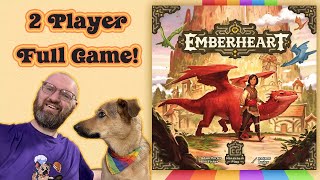
Reviewers are consistent in observing that Emberheart plays differently at different player counts, and not all counts are equal. Allies or Enemies notes that at two players, the game "feels a lot less mean" and that the blocking and bidding tension central to the experience happens only rarely, often just once per game per player. The automated dummy player in two-player mode provides location blockers, but reviewers find it telegraphs its intentions from the start of each round, reducing the push-and-pull uncertainty that makes the game exciting. Allies or Enemies concludes: "At four players, the competition just happens. Someone is almost definitely not going to get what they wanted each round. At two, it just feels a bit different."
For more experienced gamers, Tom Vassel raises a related concern. Because the game sits in a midweight space, lighter than Mindclash's flagship titles but not light enough to be a true gateway, it occupies territory where some gamers may find parts of the system familiar without being surprised by it, while others may find it a step above their comfort zone. The game is best appreciated by players who enjoy auction-style tension with meaningful engine-building decisions, and groups looking for a punishing strategic challenge may leave wanting more depth than five rounds provide.
If You Enjoy Emberheart
Reviewers naturally reach for Wingspan as the clearest stepping stone to Emberheart, positioning this game as a level above that engine builder in complexity while sharing the accessibility of beautiful production and an approachable theme. For players who enjoy the contested bidding of auction-style worker placement, Tom Vassel mentions Rurick as a comparable game occupying similar mechanical territory. Mindclash's own Ironwood is frequently cited as the closest sibling in the Mindclash Play line. Reviewers who love how Emberheart handles its flame management and compound scoring might find the deeper systems of Anachrony or Voidfall rewarding at substantially higher complexity. The Board Game Garden notes that Astra, also from the Mindclash Play line, makes a natural companion recommendation for groups who enjoy this weight tier from the same publisher. Designer Adam Porter also mentions Surakata as a design that came out of similar creative exploration around emerging game systems. For groups drawn to the area competition within Emberheart's bidding, Battle Sheep and Goblet offer lighter abstract takes on contested territory.
What Reviewers Are Saying
"How you adapt to other players in this game is one of the most dynamic and engaged ways I've seen a game do this. Whatever every other player does will impact you one way or another, because you do kind of keep an eye on all the six locations. You're trying to see where everyone else's interests are so you can maximize your own strategy."
— kovray
"It moves really fast. I think that's one of the things I really like about this: there's no time in this that is going to slow down that much. It's surprisingly light for a Mindclash game, and it works. You could bring someone from Gateway or Gateway Plus up to this game."
— Allies or Enemies
"I still really enjoy what's going on. I enjoy the overall package. There are little things that feel just a touch out of place with how smooth the rest of the game is. But those things aside, it's a wonderful production and I think a lot of people are going to enjoy it."
— The Dice Tower