










1960: The Making of the President Deep Dive
What the Community Thinks About 1960: The Making of the President
Reviewers tend to describe 1960: The Making of the President as a streamlined, more approachable cousin of Twilight Struggle. Designed by Christian Leonard and Jason Matthews and published by GMT Games, this two-player card-driven game recreates the 1960 contest between John F. Kennedy and Richard M. Nixon. The channel Watch It Played walks through the full rules and stresses how much of the game revolves around winning states, placing support cubes, and fighting for the debates and the election.
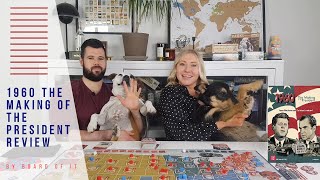
The strongest point of agreement is that the design is easier to pick up than its genre peers. Farrell of Board of It says the game takes the good parts of Twilight Struggle and makes them faster and more action-packed, singling out its theme as the strongest of the GMT two-player titles Farrell has played. Steve, whose channel ranks 1960 second on its list of top two-player games, calls it the best area control game Steve has played and one of the most thematic games Steve knows.
Opinions diverge on luck. Reviewers who love the tension also acknowledge that the random political capital bag and the random event deck can swing a game in ways that some players find frustrating. Not every reviewer in this set is a fan, either. The channel N Shelves reports that its host does not enjoy political warfare, and the card-driven, media-heavy design is simply not a fit for them.
Core Mechanics That Define 1960: The Making of the President
Area Control
Reviewers explain that the map is divided into states, and each state holds cubes for one candidate at a time. When a player places enough cubes to carry a state, that state's electoral votes become a live target for the election. Watch It Played explains that spending campaign points on a state adds cubes, while removing an opponent's cubes takes a support check that draws from the shared political capital bag. Because the bag is shared and only partly visible, reviewers note that every check carries real uncertainty.
Board of It adds that the same logic applies to the issues track and to advertising. Owning media in a region reduces the risk of support checks in that region, so the media contest shapes how a player approaches the whole map. Steve describes the result as a game in which area control and the map are always in tension with the other systems, which keeps the board from feeling like a simple race for states.
Multi-Use Cards
Every card in hand can be used in one of several ways: play it for its event, spend its campaign points on states, advertising, or issues, or keep it for a later debate or election day purpose. Tabletop Turtle highlights how this turns each decision into a split of attention, because a player who ignores issues, campaigning, or advertising will be punished by the opponent. Board of It observes that playing a card for its points can give the opponent the chance to trigger its event by spending momentum, so the best choice depends on how many momentum tokens each side holds at that moment.
The 1960: The Making of the President Experience
Political
The theme is what gives the game its weight at the table. Board of It describes the experience as bombastic and dramatic, with the sense of a campaign in which every state and every issue matters. Reviewers point to the state seals, the famous televised debates, and election day as moments where the campaign feels like a real political race rather than an abstract contest. Several reviewers say the theme is the reason the game sticks with them after the box is closed.
Tense
Reviewers describe a sustained feeling of pressure. Board of It warns that players should expect to feel stressed for most of the game, and the opponent's event cards can be painful to see in hand. The momentum system keeps those cards from becoming an immediate disaster, because a player can spend tokens to preempt an incoming event, though Tabletop Turtle notes that doing so costs two of the player's own tokens, a steep price that is sometimes exactly the move needed. The result is frustration with a purpose, since the game rewards players who plan around the cards already in play.
What Makes 1960: The Making of the President Stand Out
The Momentum System
Tabletop Turtle regards momentum as nearly as important as the card play itself. Players must decide which events to throw at the opponent so that the opponent's tokens run out, because once they are gone the other player can play whatever they like. Board of It also notes that the event and momentum structure keeps the opponent's cards live throughout the game, which is one of the features the channel praises most.
Accessibility Compared to Twilight Struggle
Board of It calls the game more accessible than Twilight Struggle and says it does not feel as intimidating to sit down with. Reviewers credit the familiar subject matter for much of that ease. Watch It Played makes a related point that players do not need to know American politics to understand the central question of winning an election, and that the game does a good job of teaching its systems as the campaign unfolds. The result is a design that many reviewers say new players can enjoy without the long learning curve of its genre peers.
Potential Drawbacks
Luck in the Political Capital Bag
Board of It acknowledges that the game contains more luck than some strategy players will want. Cubes drawn from the shared bag are not in a player's control, and the odds of a support check change as the bag empties. Reviewers who dislike the randomness say that a player can do everything correctly and still lose a critical check, which can feel unfair when the outcome matters at the end of the game.
Random Event Distribution
Event cards are drawn at random, and their effects can decide critical moments. Board of It points out that a single card can be decisive in the final round, and that one card in particular can cost a player the game outright. Watch It Played also notes that many events must be resolved exactly as printed, which means the early turns can feel like a learning curve for new players while they work out what each card does.
If You Enjoy 1960: The Making of the President
Players who enjoy the momentum and hand-management tension of 1960: The Making of the President will find a similar experience in Twilight Struggle, the design reviewers most often use as a point of comparison. Steve describes 1960 as taking everything good about Twilight Struggle and distilling it into a faster, more action-packed game with a more interesting theme, so Twilight Struggle is a natural next step for players who want more depth.
Players who appreciate the compact campaign feel of 1960 may also enjoy Watergate. Board of It describes Watergate as smaller, quicker, and simpler than 1960, which makes it a good gateway into the same family of card-driven head-to-head games. Labyrinth and Imperial Struggle are the other titles reviewers mention alongside 1960 when they discuss the heavier end of this genre, and players who want still more card interaction may find them a good fit.
What Reviewers Are Saying
"It feels as though every single mechanical system in this game matters. Ignore issue positioning and your opponent racks up momentum and endorsements. Ignore campaigning and they'll outright beat you with influence. There's no dominant strategy here."
— Mike, Tabletop Turtle
"The fact that a state can only be red or blue means that the status can be instantly seen with a quick glance so the board state is easy to follow and quick to assess."
— Farrell, Board of It
"It is the best area control game I have ever played in my life and it is easily one of the most thematic enjoyable games I have ever played."
— Steve