






























3 Ring Circus Deep Dive
What the Community Thinks About 3 Ring Circus
3 Ring Circus emerges as a thoughtfully designed Euro game that captures the whimsy and spectacle of bringing a circus to life across the American Northeast. Reviewers consistently praise its clean mechanics and excellent production, though opinions diverge on whether the streamlined experience delivers lasting engagement. The game succeeds in creating distinct moments of tension around key performances while maintaining accessibility through its two-action core system.
Core Mechanics That Define 3 Ring Circus
Tableau Building with Multi-Use Cards
At the heart of 3 Ring Circus lies a deceptively elegant card system. Players construct three rows of numbered performers on their personal boards, arranging them in strictly ascending order. Each card serves multiple purposes: as a performer contributing to your circus, as currency for acquiring new acts, or as a source of immediate bonuses when played. The cost to add a performer is calculated simply: pay the difference between the new performer's value and the previous highest value in that row, or pay nothing if the card slots into a lower position. This creates natural cascades and rewards clever sequencing. According to Board of It, this multi-use card approach works wonderfully because every decision feels consequential, with players constantly evaluating whether to use a card for its performance value, its cost, or its instant bonus.
Timed Area Control Through P.T. Barnum's Movement
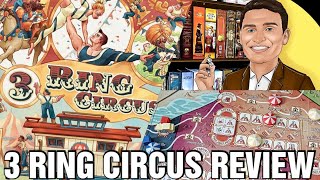
The second pillar involves traveling across the board to perform at different cities while a neutral P.T. Barnum token continuously circles the map, triggering area control scoring at key locations. Each performance move requires train symbols visible on your player board; as you cover these symbols with new performers, your movement range naturally shrinks, creating self-regulation that balances early-game mobility with mid-game tableau building. When Barnum reaches a major city, players score based on who controls the most spaces in that region. This mechanism works so cleanly because, as Chairman of the Board notes, the scoring triggers follow a fixed, predictable sequence around the board, allowing skilled players to plan which regions they will develop and when they should strike.
The 3 Ring Circus Experience
Whimsical and Colorful Production
The game creates an immediate visual impression through its vibrant, circus-themed components. Colorful performer cards feature thematic artwork of clowns, acrobats, strongmen, and exotic animals, while wooden circus tents and the board layout evoke a vintage carnival atmosphere. According to Chair of the Board, the production is absolutely fantastic with bright, vibrant visuals and excellent symbology that makes the rules clear without constant rulebook consultation. The physical presence at the table commands attention, drawing players into the theme rather than making them feel like they are managing abstract systems.
Nail-Biter Racing and Tight Competition
Despite its relatively simple ruleset, 3 Ring Circus generates genuine tension. The game functions as a race on two fronts: building the right performers to access high-value main city performances, and timing your presence in regions before Barnum triggers final scoring. Board of It describes the experience as quite tense and wonderful, noting that the scalable board ensures this tightness persists even at two players. Multiple reviewers emphasize that the race for limited performance slots creates meaningful blocking, and since Barnum's movement is deterministic, players who read the map correctly can orchestrate explosive scoring turns or prevent opponents from scoring efficiently.
What Makes 3 Ring Circus Stand Out
Elegant Simplification of Complex Strategy
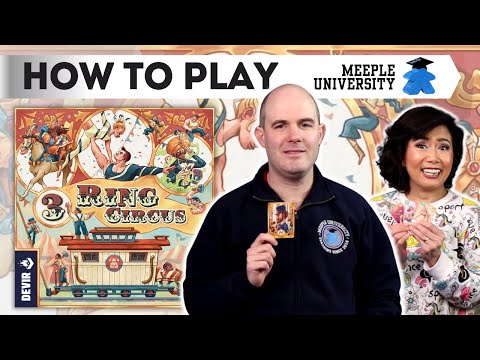
In an era where many Euros stack rules upon rules, 3 Ring Circus distills the experience into just two actions: engage an artist or perform a show. Within that framework exists surprising strategic depth. The game builds understanding in natural stages: first, accumulate money and basic performers. Next, convert those pedestals into tickets. Finally, cash in curated lineups of performers for big point payoffs at major cities. Meeple University illustrates this chain clearly, showing how early-game foundation work directly enables late-game scoring explosions. This architecture respects player intelligence by making the path obvious while leaving plenty of room for tactical variation.
Scalable Design That Respects Player Count
The game boards adjust the active regions based on player count, ensuring that whether you play with two or four people, the tension and pacing remain consistent. Board of It emphasizes that this scaling is the key to why 3 Ring Circus works equally well at two players despite being marketed for up to four. The blocked regions prevent the board from feeling sparse at lower counts, and the Barnum movement still creates the same pressure to claim valuable spaces before opportunities vanish.
Potential Drawbacks
Early Game Clarity Can Lead to Mechanical Autopilot
Once players understand the building blocks, the optimal early-game strategy becomes apparent: gather money, boost your podium track, access medium-city performances for tickets. Chairman of the Board notes that this can make players feel like they are executing a predetermined plan rather than making difficult choices turn after turn. The rules are so streamlined that decision complexity actually decreases as the game progresses, particularly at two players where less competition means you can often execute your intended plan unimpeded.
Luck Dependency on Card Draws Defines Game Outcome
The performers available in hand and the ticket cards dealt from the central display heavily influence your ability to execute high-value performances. If the lion cards you need for a specific major city performance never appear, or if your opponent draws them instead, you face severe constraints regardless of how well you managed your tableau. Chairman of the Board emphasizes this frustration: despite all your planning and foundation work, you can be subject to poor card luck that makes certain strategies impossible. This creates moments where satisfaction comes from luck rather than from earned tactical execution.
If You Enjoy 3 Ring Circus
Players drawn to 3 Ring Circus should explore Calamara, designed by the same creator. According to Chairman of the Board, Calamara executes a similar concept of timed area control scoring better, offering more interactive decisions around managing when regions score. Those seeking lighter Euro games with strong thematic components and excellent production values will appreciate the polish and accessibility of games from publisher Devir. For fans of the multi-use card system, Dominion and other deck-building games offer more prolonged engagement with card sequencing and combo rewards.
What Reviewers Are Saying
"I'm a big fan of games that streamline rules and I think this game has done a good job of that. This is essentially a two action game, yes there are different kind of variants on the towns but generally speaking they're very simple to understand."
— Chairman of the Board
"Just the fact that the spaces are scaling down makes it feel you know just as tight and we really feel like the tension because like you said it is a race, you're really keeping an eye on how many circuses your opponent is putting up."
— Board of It
"I do like the fact that the area control part of this game is timed and you can plan for it because again that's the P.T. Barnum wagon does go around in a fixed order, you know the order which these cities are going to score in, which is going to maybe give you a few more tactical decisions to overcome."
— Chairman of the Board