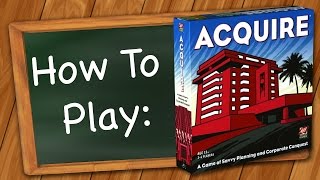











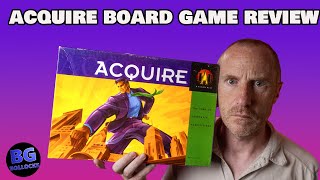
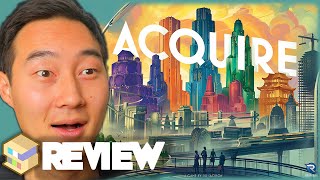




In Acquire, each player strategically invests in businesses, trying to retain a majority of stock. As the businesses grow with tile placements, they also start merging, giving the majority stockholders of the acquired business sizable bonuses, which can then be used to reinvest into other chains. All of the investors in the acquired company can then cash in their stocks for current value or trade them 2-for-1 for shares of the newer, larger business. The game is a race to acquire the greatest wealth.
History of Acquire: This Sid Sackson classic has taken many different forms over the years depending on the publisher, yet the rules and game play have stayed the same. The 1966 version of the 3M bookshelf edition included rules for a 2-player variant. The original version is part of the 3M Bookshelf Series.
Many books and websites incorrectly list this as a 1962 publication as the 3M Company used previously copyrighted artwork when they released the game in 1964. 3M actually received the idea for the game of "Vacations" from Sid Sackson in May of 1963 and decided to take his idea and put it into artwork they had developed the year before for a game called "ACQUIRE." 3M's original game idea for a game called ACQUIRE must not have been very good so they decided to take Sid's idea of Vacations and put it into their concept of ACQUIRE. They released some limited test market games in 8 Midwestern U.S. cities in December of 1963 with a box that had a 1963 copyright. These games had Sid's original rules. When 3M released the mass market games in 1964, they had developed some of Sid's original ideas and changed some rules and game play to match their production desires. They released them with outer boxes that were copyrighted 1962 and inner boxes with rules that were dated 1963.
December 1963 - Test Market World Map Wood Tile Edition
1964 - Dated 1962/63 wood tiles, chipboard with plastic overlay & stocks with printed backs
1965 - Dated 1962/63 plastic tiles, chipboard with plastic overlay & stocks with printed backs (last edition made with printed backs until 1999)
1966 - Dated 1962/66 plastic tiles, chipboard with plastic overlay & non-wax coated stocks (Only edition with these stocks)
1968 - Dated 1968/66 plastic tiles, clear plastic board with paper underlay (Both 1966 inner box games have a lot of mixed parts)
1971 - Dated 1968/71 plastic tiles, yellow hard plastic board
1975 - 3M sells rights for game of ACQUIRE to the Avalon Hill Company
1976 - Dated 1976 plastic tiles, yellow hard plastic board, redesigned money, no inner box (This edition was also produced in 1977, 79, 81, 82, & 86)
1989 - Dated 1976 Gray box edition with new box artwork same contents as regular 1976 editions (This edition was also produced in 1992)
1995 - Dated 1995 Large box cardboard edition with chipboard board and tiles, Special Powers Variant Tiles inspired by German editions
1997 - Avalon Hill sells the rights to the game of ACQUIRE to Hasbro
1999 - Dated 1999 Large box with large plastic board and tiles, 3D company buildings, redesigned stocks & money, large info cards
2006 - Hasbro assigns rights for the game of ACQUIRE to their subsidiary, Wizards of the Coast
2006 - Lloyd's (private) Rules of ACQUIRE are made public, two major rule changes that help to bring the balance of the game of ACQUIRE back to the intentions of Sid Sackson's original ideas. Lloyd Solon's Rules help players to correct poor strategy during the beginning of the game that can been seen with new and unexperienced players (running out of money soon is the main mistake that must be omitted!).
2008 - Dated 2008 cardboard edition with chipboard board & tiles, redesigned stocks & money
2016 - Dated 2016 The current affordable mass-market edition. It looks at first sight to be similar to previous modern editions, but has been criticised for the use of inferior design choices such as hard-to-read grey-on-grey embossed slots and the unusual tile fonts. It contains modified rules and a slightly smaller playing grid. Although these changes have been criticised for not ultimately improving upon Sackson's original design, they are generally regarded as not being too damaging to it.
2023 - Renegade Game Studio partners with Hasbro, and releases their new version, with Classic Mode or Tycoon Mode — play with or without tertiary stockholder merger bonus.
2024 - The Renegade 60th Anniversary edition includes a set of plastic weighted poker chips, and Special Powers Variant cards.
Mechanics (from transcript analysis)
- tile placement and hotel chains — players buy and place hotel chains to merge and profit from the evolving board.
Video topics + discussion points
Quotes (from this video)
- Trust us.
- Verify everything, trust nothing.
- The biggest lie board game companies tell might be the simplest. Trust us.
- You're buying version 1.0 that needs patches, but there's no disclaimer saying software may require updates.
- The app has potential for gamebreaking bugs, especially in stretch goal missions.
References (from this video)
- Distinct, personality-filled hotel components and vibrant artwork creating character for each chain
- Fast setup and approachable teaching; short intro before deep strategy
- Strong early-to-mid game arc with dynamic stock price movement and merges
- High engagement through memory (tracking stock) and strategic bluffing
- Turn-order advantages and shareholder bonuses provide meaningful decisions across play
- Flimsy paper money with no hiding mechanism; fiddly to handle and lacks a tracker
- Counting large hotel sizes can be tedious; no built-in counting tracker
- 2-player and low-player counts diminish engagement; 4-5 players is ideal
- Novelty can wane with repeated plays due to memorization requirement
- Limited asymmetry; many players want more powers or differentiated hotels to add variety
- Array
- Mid-20th century corporate hotel real estate market
- Analytical/Review
- Monopoly
- Tigers and Euphrates
Mechanics (from transcript analysis)
- Betting and bluffing — Hidden cash and hidden stock quantities shape decision making and allow bluffing about holdings.
- Endgame Conditions & Turn-Order Impact — End conditions (41 tiles in a chain or all chains too big to fail) create a climactic finish; turn order affects cash and number of turns.
- hidden information / bluffing — Hidden cash and hidden stock quantities shape decision making and allow bluffing about holdings.
- Investment — Merging hotel chains drives value changes and distributes shareholder bonuses; larger chains absorb smaller ones.
- mergers — Merging hotel chains drives value changes and distributes shareholder bonuses; larger chains absorb smaller ones.
- negotiation — Players can influence other players' placement and investment decisions through talk and signaling; a group can opt into higher interaction.
- Negotiation / Optional Interaction — Players can influence other players' placement and investment decisions through talk and signaling; a group can opt into higher interaction.
- Stock holding — Players buy, hold, and trade hotel stock to earn shareholder bonuses as chains grow or merge.
- Stock Holdings / Investment — Players buy, hold, and trade hotel stock to earn shareholder bonuses as chains grow or merge.
- tile placement — On your turn you place a tile to extend or merge hotel chains; placement creates or expands chains and can trigger mergers.
Video topics + discussion points
Quotes (from this video)
- Acquire is a memory and math game with hints of reading the table and some optional negotiation.
- paper money... awful... it folds constantly it is literally literally Monopoly paper money
- this game ends when one hotel chain hits 41 tiles or every hotel chain on the board is too big to fail
- going first you get the bonus of getting free stock from founding
- the turn order is well balanced… going later gives you more knowledge on what hotels are good
References (from this video)
- Deep, classic economic strategy
- High player interaction and strategic timing
- Rules can be intricate; takes time to learn
- Mergers and acquisitions, stock trading
- Corporate hotel industry with stock market dynamics
- Economic/market-driven strategy
Mechanics (from transcript analysis)
- Auction / Bidding — Buy and trade stock in hotels to maximize value.
- merger mechanics — Adjacent hotels merge; stock can transfer to the larger entity.
- stock bidding & management — Buy and trade stock in hotels to maximize value.
- tile placement — Place tiles to form hotel clusters on the board.
- tile placement & grid-building — Place tiles to form hotel clusters on the board.
Video topics + discussion points
Quotes (from this video)
- One thing that's really nice about board games and one thing why I think board games are a really good investment is the fact that they can sit in a closet for literally like decades and then you can pull them out and you can just play them cuz the rules haven't changed
- Chess ain't going to be on this list
- We've had this game for 40 50 years and so these would be games that we love that are older games.
References (from this video)
- A true classic with deep strategic depth and player interaction
- Elegant design that has aged well and inspired many later games
- Old components and printing quality; some editions feel dated
- Can be challenging for new players due to mergers and market mechanics
- Stock-market-like hotel chain acquisition and merger dynamics
- Corporate hotel-chain investment and mergers in a tiled grid
- Classic, highly influential, with a strong emphasis on strategic planning and confrontation
Mechanics (from transcript analysis)
- Auction / Bidding — Players bid for stock and negotiate positions to influence outcomes
- Auctioning and negotiation — Players bid for stock and negotiate positions to influence outcomes
- Stock/merger dynamics — Players buy into stocks and trigger mergers to score larger payouts
- tile placement — Tiles form a grid of hotel properties; players observe adjacency and opportunities
- Tile placement / set layout — Tiles form a grid of hotel properties; players observe adjacency and opportunities
Video topics + discussion points
Quotes (from this video)
- I like this a lot.
- This game was so popular that when Ticket to Ride came out, people were like, 'Well, was it like Union Pacific?' No, they're nothing alike.
- It's a classic for a reason.
- Oasis only lasted for another year. Um, it was off the list in 2006.
References (from this video)
- Monopolyesque economic feel with approachable rules
- Strategic depth in timing and mergers
- Older editions can be visually less accessible
- Some rules details can be intricate for newcomers
- Stock market-style dynamics with mergers and acquisitions
- Real estate tycoon economy with hotel chains
- Strategic real estate expansion and corporate growth
- Monopoly
- Magnate the First City
Mechanics (from transcript analysis)
- Hidden tiles / information management — Tiles are kept private and revealed during acquisitions; timing matters.
- Investment — Players merge chains and acquire stocks to maximize payouts.
- Mergers and acquisitions — Players merge chains and acquire stocks to maximize payouts.
- tile placement — Place tiles to form hotel chains and gain stock in those chains.
- Tile placement / stock-building — Place tiles to form hotel chains and gain stock in those chains.
Video topics + discussion points
Quotes (from this video)
- Monopoly, a very uh polarizing game.
- it's pure open negotiation.
- Open negotiation. Anything goes, you could trade anything for anything.
- The open negotiation in this game is awesome.
- Magnate the First City is an economic citybuilding game where you're trying to have the most money.
References (from this video)
- stock-driven, emergent strategy
- feel of building empires and executing mergers
- classic design with enduring appeal
- heavy use of paper money can be a downside in some editions
- stock market, mergers, and acquisitions
- early-to-mid 20th-century corporate exploration of hotel empires
- economic/stock-market simulation with a business-tycoon flavor
Mechanics (from transcript analysis)
- Area control / set collection — territory/board areas influenced by stock holdings and hotel mergers
- stock market / takeovers — players manage stocks to maximize payouts from hotel chains through mergers
Video topics + discussion points
Quotes (from this video)
- this one's a rolling right got a board
- Acquire is very neat.
- A classic for a reason from 1980.
- the best game I played today was Code Names
- my favorite game from the Saturday today is The Hobbit
- it's a really fun worker placement game with boats and colonies
References (from this video)
- Classic stock-and-share game; foundational to many later designs
- Rules depth not detailed in video
- Corporate acquisitions; real estate market
- Stock market/merger theme
- economic strategy
- Blitzkrieg
Mechanics (from transcript analysis)
- Market manipulation — board state changes via mergers and purchases
- merger/stock acquisition — invest in companies and merge for profits
Video topics + discussion points
Quotes (from this video)
- "Caesar sees Rome in 20 minutes"
- "this is like the spiritual successor or at least a sister game or a partner game to paulo maurice blitzkrieg"
- "I believe you're investing in these companies these companies can merge with each other so it's just all about making profit"
- "Detective Club and the expansion"
References (from this video)
- legendary classic
- tight, elegant merging mechanic
- older design may feel dated to some
- merging properties for profits
- hotel chains and stock market
- classic economic strategy with stock market mechanics
- Monopoly
- San Juan
Mechanics (from transcript analysis)
- tile placement / stock market — place plots to form hotels and trade stocks
Video topics + discussion points
Quotes (from this video)
- I really love this idea of designer diaries.
- There are designer diaries actually at this point pretty much constantly on board game geek.
- There's tons and tons of reviews coming out on BG. People are asking questions.
References (from this video)
- Deep strategic depth, classic design with timeless feel
- High-level competition showcased at World Series of Board Gaming
- Tangible, tactile tension around mergers and timing
- Older rules can feel dated to new players
- Players with modern euro sensibilities may find it slower
- economic tile-laying and hotel mergers
- Hotel chain development and stock market dynamics
- classic abstracted business strategy
- Azul
- Splendor
Mechanics (from transcript analysis)
- economic engine — players manage an economy of tiles and stock to maximize value.
- merging and stock mechanics — merging hotel chains yields stock value and payout.
- tile placement / pattern-building — players place tiles to create hotel chains and capture markets.
Video topics + discussion points
Quotes (from this video)
- This game has been around since 1963.
- This is Acquire. This game is fascinating.
- The world series of board gaming is super competitive, but super friendly.
- The art is beautiful; I wish I could punch in on it quick.
- Becca did The Elder Scrolls how-to play. It hurts to bring it inside the house; literally, it was like rocks.
- I love puzzle games; labberia looks wild.
- Magical Athlete is back now in a new version implemented by Richard Garfield.
- You just grab a tile, put it on. Nope, that's not it.
References (from this video)
- Deep, multi-layered endgame strategy driven by mergers
- Engaging, high-energy commentary and viewer engagement
- Classic design with enduring appeal and tactile components
- Strong table dynamics and banter that heighten excitement
- Can be slow and heavily arithmetic in spots
- Stock and merger tracking can be challenging for new players
- Open information can reduce memorization challenges for some groups
- mergers, stock market dynamics, hotel chain expansion
- Corporate hotel chain development in a board game format focusing on mergers and stock
- strategic, analytical with competitive banter
- Wingspan
- Terraforming Mars
- Heat Pedal to the Metal
- Galaxy Quest
- The Brady Bunch
- Dune (Spice Must Flow reference)
Mechanics (from transcript analysis)
- endgame and safe hotels — Game ends when a hotel reaches a threshold size; some large hotels become 'safe' and cannot be absorbed.
- founder shares — Founder shares grant an extra share when a hotel chain is established, adding additional payout potential on absorption.
- merger timing and payout optimization — Strategic decisions focus on when to trigger mergers and how to maximize payouts for primary/secondary owners.
- mergers and absorption — When two hotels touch and form a larger chain, mergers occur with cash payouts to primary/secondary owners.
- open versus closed information — Session utilizes open information; players track cash and shares to inform decisions, with occasional openness about open knowledge.
- stock purchasing and payouts — Players buy shares of hotel chains; payouts occur on mergers based on ownership stake.
- tile placement — Players place hotel tiles on a grid forming chains; adjacent tiles create chains.
Video topics + discussion points
Quotes (from this video)
- The mergers are what really make and break this game.
- Make your own luck.
- Open information, open cash, open shares.
- It's a memory game.
- Better be lucky than good.
- Open knowledge could change how you play.
References (from this video)
- deep strategic planning and timing
- classic design that influenced later games
- heavy rules
- steep learning curve for newcomers
- majorities and hotel mergers
- boardroom capitalism and hotel chains
- analytical, strategic
Mechanics (from transcript analysis)
- stock/majority — players buy stock in hotels and gain majority as chains merge
- Tile placement / area control — players place tiles to form hotel chains and influence their growth
Video topics + discussion points
Quotes (from this video)
- the now classic adorable card drafting Sushi go
- it's a quick little filler type game
- the audience thing which is very front and center in film I definitely think about a lot
- Misfit Heroes is the result of me I'm not a big ccg person but I really got into key Forge when it came out
- this mutating deck and it's probably the game I put the most hours into
- it's playful actually now that I think about it
- the best example is there this little card game which has just come out called Fairy
- you never know what cards are going to be in the deck
References (from this video)
- Elegant central tension: when to act in uncertain information
- Social reading and negotiation are core, not gimmicks
- Timeless, clear core that resists being bloated
- Often perceived as murky to new players
- Stock mechanics can be opaque without good teaching
- Merger-driven stock growth and realignment
- Corporate mergers and hotel chains
- Strategic stock speculation with social reading
- other economic/stock games
- games focusing on corporate strategy
Mechanics (from transcript analysis)
- auction/merger timing — Decide when to trigger mergers and how to cash out or hold stock.
- tile placement — Place hotel tiles to connect chains; buy stock in chains; trigger mergers.
- tile placement and stock — Place hotel tiles to connect chains; buy stock in chains; trigger mergers.
Video topics + discussion points
Quotes (from this video)
- Code Names did something that sounds impossible. It made a party game that's actually legitimately good.
- Dune eroded everything around it to pure theme. It succeeded through the devotion to its fiction and the corresponding chaos that comes from that.
- Diplomacy is all about perfect information and imperfect trust.
References (from this video)
- Timeless tension between expansion, mergers, and liquidity
- Accessible yet deep economic strategy
- Quality components (wooden tiles); durable board
- Rich historical context and design evolution
- Luck plays a significant role due to tile draws
- Older editions can have fragile components; modern editions improve durability
- Rule disputes around endgame and holdings visibility
- Corporate hotel chains and mergers
- Mid-20th-century North American hotel industry
- economic strategy with mergers
- Monopoly
- Settlers of Catan
- Shark
- Big Boss
Mechanics (from transcript analysis)
- end_condition — Game ends when all chains are safe or a chain reaches 41 tiles.
- merger_resolution — When a merger occurs, the largest chain survives; bonuses are paid to top shareholders; remaining shares are disposed.
- open_vs_closed_holdings — Strategy around whether holdings are openly tracked or kept hidden; affects risk and information flow.
- Stock holding — Players buy up to three shares per turn, with options to trade, sell, or hold during mergers.
- stock_management — Players buy up to three shares per turn, with options to trade, sell, or hold during mergers.
- tile placement — Place a tile to form or merge hotel chains; discard illegal tiles that would merge two safe chains.
- tile_placement — Place a tile to form or merge hotel chains; discard illegal tiles that would merge two safe chains.
Video topics + discussion points
Quotes (from this video)
- Acquire is really the first real hobby board game.
- Acquire has sold millions of copies over time and remains influential.
- This game holds up after 60 years.
References (from this video)
- classic, highly admired design
- deep strategic layer around mergers
- can be long and occasionally fiddly with rules
- merging hotels; stocks and majorities
- hotel chain mergers with stock market vibes
- economic, strategic
- Grand Austria Hotel
- There and Back Again
Mechanics (from transcript analysis)
- merger engine — merging hotels changes ownership and payout
- stock/investment — buy/sell stocks as hotels merge
Video topics + discussion points
Quotes (from this video)
- Don't tell me theme doesn't matter. Yes, it does.
- This is one of those games where drafting out different teams could be really cool.
- It's a banger.
References (from this video)
- Deep strategic depth and rich endgame decisions
- Tremendous interaction through mergers and stock trades
- Clear endgame incentives and dramatic payout possibilities
- High cognitive load and memory requirements
- Can be visually challenging due to tile colors and overlapping chains
- Not beginner-friendly; beginners may struggle to track stock counts and mergers
- Mergers and acquisitions, strategic stockholding, and endgame payout optimization
- Corporate hotel chain boardroom with mergers and stock maneuvers
- Live-play-by-play with strategic commentary and board-state analysis
- Wingspan
- Terraforming Mars
- Dune Imperium Uprising
- Great Western Trail
- Ark Nova
Mechanics (from transcript analysis)
- Endgame 41-tile condition — The game ends when a chain reaches 41 tiles (or when certain safe conditions exist), triggering endgame scoring.
- Investment — Special tiles allow companies to merge, creating larger entities and enabling payouts based on stock ownership.
- Market/money management — Money flows through mergers and stock purchases; managing cash is pivotal to securing mergers and payouts.
- Merger tiles — Special tiles allow companies to merge, creating larger entities and enabling payouts based on stock ownership.
- Stock ownership and payouts — Players collect stocks in companies; payouts are based on majority/minority holdings at endgame.
- tile placement — Players place tiles to create or extend hotel chains and potential merger opportunities.
- Two-for-one trades — Players can trade two stocks for one in another company as part of optimising positions.
Video topics + discussion points
Quotes (from this video)
- It's really going to test these players. The World Series is all about memory and counting, and the merger tiles are the power moves.
- Endgame payout is king; the biggest payouts come from the largest safe hotels like Continental and Worldwide.
- The order of operations matters; who gets to trade first can completely change the endgame landscape.
- You have to decide when to end the game—sometimes it’s better to let the game go on a turn, other times you pull the plug immediately.
- Acquire is a math-heavy game; memory, calculation, and strategic timing all matter just as much as luck.
References (from this video)
- Easy to teach and quick to pick up
- High interaction and negotiation among players
- Strategic depth with multiple paths to victory
- Older design may feel dated to new players
- Game length and variability can be a function of player count
- Acquiring, trading, and developing hotel properties for victory points
- Corporate expansion and hotel chain management in a mid-20th-century business milieu
- Competitive market dynamics with indirect direct conflict
- Settlers of Catan
- Magic: The Gathering
Mechanics (from transcript analysis)
- set_collection — Players aim to collect sets of properties and stock to maximize points.
- stock_market — Stock ownership and trading influence scoring as the map evolves.
- tile_placement — Players place tiles that represent hotel properties and board layout to form the market map.
Video topics + discussion points
Quotes (from this video)
- Mount Rushmore of tabletop game
- I feel that Sid Saxon crafted what modern board gaming is today
- it's the one game that brought it into the mainstream
- easy to teach
- there's a lot of player interaction due to negotiation and trading
- Gary Gygax my hero the man who designed Dungeons & Dragons
- there should be a statue to Gary Gygax
References (from this video)
- Dynamic board evolution as tiles are placed
- Historical significance and influence on modern board games
- Clear core tension between expansion and timing
- Punishing early mistakes
- Math-heavy stock calculations during scoring
- Older design feel; dislike of paper money
- Market manipulation, growth through acquisitions
- Global hotel market with corporate expansion and takeovers
- Macro-economic, board-state evolution with hidden information
- Chinatown
- Dawn of Ulos
Mechanics (from transcript analysis)
- end game bonuses — Game ends when safety conditions are met; players receive stockholder bonuses and liquidate remaining holdings.
- Endgame scoring and payout — Game ends when safety conditions are met; players receive stockholder bonuses and liquidate remaining holdings.
- Hidden Information — Private tiles and stocks are kept secret, creating information asymmetry.
- Investment — When two hotel chains connect, the smaller is taken over by the larger; ties are resolved by the active player.
- Stock market / investment — Buy and sell stocks to profit from hotel growth; founder status grants initial stock exposure.
- Takeover — When two hotel chains connect, the smaller is taken over by the larger; ties are resolved by the active player.
- tile placement — Place one tile per turn to expand and connect hotel chains; the board progressively changes.
Video topics + discussion points
Quotes (from this video)
- Acquire came out in 1963 and has been in print ever since
- If you're interested in the history of modern board games, Acquire is an absolute must play as its influence on the hobby has been profound
- the best thing about this game is watching the board slowly morph and evolve in front of your eyes, it's quite Dynamic
- there's also considerable math involved in calculating stocks and prices, especially during scoring
- I personally hate paper money
- for a fast-paced game with trading try Chinatown
- and for a very modern take on acquire try dawn of ulos
References (from this video)
Mechanics (from transcript analysis)
Video topics + discussion points
Quotes (from this video)
- one of the most kick-ass trophies I think I've ever seen built in the world.
- The real winners are all of us because lying to us.
- Mortal enemies, lifetime friends.
References (from this video)
- Corporate competition and building networks
- Hotel chain acquisition / stock market style
Mechanics (from transcript analysis)
- stock market / merger mechanics — players merge properties to form larger hotel chains
Video topics + discussion points
Quotes (from this video)
- Speaking of Terraforming Mars, there's going to be several live games where we're just playing them for your entertainment.
- The best thing about the World Series is the family atmosphere.
- It's the trailer before the trailer.
- You never know. Ticket to Ride on Saturday, you can find out maybe Ticket to Ride is back in 2025.
- I guarantee you you'll have the greatest experience on earth when you come.
- Dune Imperium has changed to Dune Uprising, which is a pretty substantial change in many ways.