








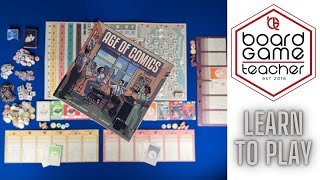





Age of Comics: The Golden Years Deep Dive
What the Community Thinks About Age of Comics: The Golden Years
Age of Comics: The Golden Years is a worker placement game in which players run a comic book publishing company during the golden age of comics, covering the years 1938 to 1954. Reviewers tend to describe it as a thematic game first. Foster the meeple reviewed a prototype of the Kickstarter edition and said that nearly every action in the game matches the real work of a comic publisher: you hire people, pay them, generate ideas, and then market the finished books. That tight fit between theme and mechanics is the quality reviewers return to most often.
Reviewers also praise how approachable the game feels once it is on the table. Foster the meeple compared its flow to Kanban: The Board Game, noting that the game feels similar in rhythm but is less punishing. Ian, Where There's A Wilz, There's a Play placed Age of Comics: The Golden Years in a personal top ten and said that making different comics by choosing publishers, writers, and artists is the satisfying core of the experience. Reviewers agree that the physical product carries much of the appeal, and they often note that the prototypes they handled were still subject to change before final production.
Core Mechanics That Define Age of Comics: The Golden Years
Worker Placement
The game is built around editors, the meeples that players send to a shared board. Each round, players in turn order place an editor and take that action, and the number of spaces for each action is limited to the player count plus one. The six actions cover the full publishing cycle. Players hire artists and writers, develop comic book cards, collect idea tokens, print comics, make sales with sales agents on the map, and collect royalties. Reviewers describe the choice of which action to take as the central tension, because a space taken by one player is simply unavailable to another. Foster the meeple highlighted how the sales agent movement on the map adds a spatial element that makes the placement decisions feel like running a business rather than filling abstract slots.
Engine Building Through Special Actions
Printing comics is also the path to the game's engine. Printing a second, third, or fourth comic unlocks special actions, and each one stays on the player mat for the rest of the game. These actions include repositioning special action cubes, gaining victory points for each original comic, converting idea tokens into fans, and taking an extra editor for the round. Foster the meeple observed that building more comics means taking more special actions, which "just kind of boosts your engine a little bit." The reviewer also noted that a competitive rush to add more actions to the board could develop, and that building steadily toward the end game is what the design rewards. Players who invest early in printing tend to gain momentum in the later rounds.
The Age of Comics: The Golden Years Experience
A Thematic Publishing Simulation
Reviewers consistently describe the game as one that makes its theme feel physical. Players do not simply collect tokens; they hire artists whose specialties match a genre, pay creators, develop a comic, and then announce it. Foster the meeple described reading the artist and writer names aloud while placing editors, saying it added a theme element that mirrors how a publisher would advertise a book. Board Games UnLocked noted that the game's fans decline over time because a comic that has been on the stands for a while becomes less popular, while a new campaign can boost sales again. Reviewers see that kind of detail as proof that the designers built the systems around the story they wanted to tell.
A Nostalgic, Colorful Visual Style
The game's look is the second element reviewers mention repeatedly. Board Games UnLocked described the art as having a nostalgic quality, saying it has "that old 30s like 50s look and OG comic covers." Foster the meeple was especially impressed that every comic book carries its own title and artwork rather than a generic superhero or western cover. Reviewers who are not comic readers still said the art appealed to them, and the production quality is often singled out as a reason the game stands out on a shelf.
What Makes Age of Comics: The Golden Years Stand Out
Unique Artwork for Every Comic
Foster the meeple described the component design as the game's most striking feature, noting that every comic has its own title and cover art. The rip-off comics are a visible variation on the originals: they appear slightly faded, with a changed title and a similar cover, which Foster the meeple found a clever way to show imitation on the table. Reviewers view this attention to detail as a major reason the game feels like a comic book industry simulation rather than an abstract resource game.
Rip-Offs and Genre Competition
Reviewers highlight the rip-off mechanic as a source of tension and humor. Players can print a copy of a comic another player has already published, which takes fewer resources and gives fans, but earns less than an original. Foster the meeple described it as a way to bully the other person while accepting a small cost to your own engine. Genre competition adds another layer: whoever has published the most comics in a genre earns a bonus of two points in that genre at the end of the game, so players must watch what opponents publish. Foster the meeple noted that this can shape a player's choices as much as their own plans.
Potential Drawbacks
Player Count Scaling
Foster the meeple played the game with two players and said it would play better with three or four, mainly because the limited number of worker placement spaces becomes tighter with fewer people. The reviewer still described the two-player experience as enjoyable, but the concern is that the strongest tension between players depends on having more editors competing for the same actions. Prospective buyers who mostly play with two should weigh that before committing.
Setup and Rule Density
The rules are often described as simple at their core, yet the setup and turn structure involve many steps, including a lengthy setup for a multiplayer game, with each round divided into beginning, middle, and end phases, and a final scoring that runs through several separate steps. All You Can Board called the game very intricate while noting that the rules are relatively simple, meaning that the challenge lies in the number of different options available each turn. New players should expect a learning curve during their first session, even though the flow of the game becomes intuitive quickly.
If You Enjoy Age of Comics: The Golden Years
Foster the meeple made the most direct comparison, placing Age of Comics: The Golden Years alongside Kanban: The Board Game because both games make every action feel logical for the business being simulated. Players who enjoy Kanban's connection between theme and mechanics, and its sense of managing a working operation, are likely to find the same satisfaction here. Reviewers also suggest the game suits players who enjoy worker placement with a strong narrative layer, especially those with an interest in comic book history or the mid-twentieth century publishing industry. Players who prefer deep combat or long campaigns may find the game lighter than they expect, while those who enjoy watching opponents and reacting to their choices will find the genre competition especially engaging.
What Reviewers Are Saying
"It's a simplistic rule set mechanically but there's a lot of strategy in terms of figuring out what the best way to score points is."
— Foster the meeple
"I do feel like I'm kind of making the comics you're trying to make, different comics, by getting different publishers or different writers and different artists so that you can get the most points for your comics."
— Ian, Where There's A Wilz, There's a Play
"The look of the game is really nice, just the choice of the color palette, the color scheme and everything. The production quality just looks really really good."
— All You Can Board