/pic8427963.png)






































Agent Avenue Deep Dive
What the Community Thinks About Agent Avenue
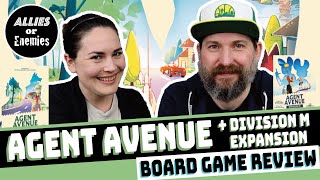
Agent Avenue, designed by Christian and Laura Kudal and published by Nerd Lab Games, has earned consistent enthusiasm across the board gaming community as a standout two-player card game. The consensus is clear: this is a game that achieves far more than its simple rules suggest. Reviewers who came in with modest expectations routinely left surprised by the depth of its decision space.
Jamie from Stonemaier Games captured this feeling precisely, noting that Agent Avenue "defied some of my expectations" and that the game elevated well beyond what he initially imagined. The Board Stupid channel called it "so simple, but so fun" with "infinite replayability," while Before You Play described it as "another one of those innovative, refreshing designs." Banter and Boards added that the game is "very mindbending" despite its brevity. The Dice Tower's Nick Murray called it "one of my absolute favorite bluffing games." Even Board Gaymes James gave it a brief but enthusiastic nod as one of only ten small-box games worth keeping on the shelf.
Reviewers consistently emphasize that Agent Avenue succeeds because it forces players to read each other rather than just optimize a system. It is a game of psychology first and card mechanics second, and that distinction is what makes it resonate so broadly.
Core Mechanics That Define Agent Avenue
I Cut, You Choose
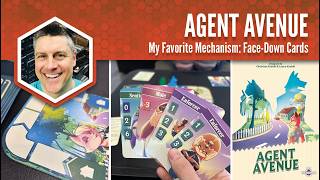
The central mechanism of Agent Avenue is an I-cut-you-choose structure that plays out with unusual elegance for a two-player game. On their turn, the active player selects two cards from their hand of four, placing one face up and one face down. The opponent then chooses which of the two cards to take, and the active player keeps the other. Both players add their card to a growing tableau of recruited agents.
What makes this mechanism sing is the bluffing layer it enables. As Banter and Boards explained, "the trick of the game is how you're playing the cards," because the face-down card is completely hidden information. Do you put a dangerous card face down hoping your opponent takes it? Do you put a tempting card face up to bait them away from something you want hidden? Board Stupid's Wayne put it bluntly: "You're going to set traps." The active player is always trying to engineer which card they receive, while the inactive player is trying to read the manipulation and pick correctly. Before You Play described the resulting meta-game: "Does she want me to take the one that's face down? Is she playing a trick on me?"
Banter and Boards captured why the mechanism works so well at two players: "It's so spicy and you're trying to set up traps. There's a lot of mind games of like, is he bluffing? Is it double-bluffing? The face down or the face up?"
Tableau Building with Set Collection
Every card a player recruits goes into a personal tableau organized by agent type. The key to movement on the board's circular track comes not from the card itself but from how many of that type a player has already accumulated. The first copy of an agent type moves a small number of spaces; the second moves more; the third can generate enormous movement or trigger a special condition entirely.
Stonemaier's Jamie explained this well: "How many copies of the card you have in play matters when you activate the card." He used the detective card as an example: "The first time someone takes a detective, no big deal. But if someone actually has two detectives, you really don't want them to gain another detective, and so that has a big impact on the game." This stacking mechanic means that players must track not just their own growing tableau but their opponent's accumulating sets, since one more copy of the wrong card for either player can be decisive. Board Stupid noted that "if you collect the same type multiple times, more movement is going to be allowed, more scoring is going to be allowed."
The Agent Avenue Experience
Suspense and Mind Games
The feeling that reviewers most consistently reach for when describing Agent Avenue is suspense: not the drawn-out tension of a long strategic game, but a rapid, pulse-quickening suspense that renews with every single turn. The Dice Tower's players described the immediate effect: "Instant mind games. You didn't even ease us into this." Banter and Boards put it memorably: "He knows that I know that he knows that I know that he knows." The face-down card is a constant unknown, and whether you are offering it or choosing whether to take it, the uncertainty never fades.
Before You Play highlighted how this suspense is sustained through the whole game: "The whole time you're engaged because the turns are quick, you always draw back up to four so you always have a set of four cards, and you're always thinking, what is he going to play in that face down card?" There is no downtime, no moment where you can disengage, because every turn requires reading the person across from you.
Confrontational and Social
Agent Avenue is an explicitly confrontational game, but the confrontation is psychological rather than aggressive. It does not play at you; it plays through you. Banter and Boards described it as something you can play with anyone because "it's so simple," and recalled the moment a new player first encountered the I-cut-you-choose choice: "I gave you the first offer, the first choice, and you went, I like this game. Like immediately." The social experience of watching someone deliberate over a face-down card, knowing you put something there deliberately, is something reviewers returned to again and again.
Board Stupid's Matt called Agent Avenue a game that is "very much play the player rather than heavy complex mechanisms," and Before You Play echoed that: "It's more about playing the player, reading them, seeing what cards I can play to force them to pick or make a different decision." The game creates shared stories at the table. The Dice Tower's Chris, on his first play, tried to hide a good card face down and got read immediately: "I read you like a book."
What Makes Agent Avenue Stand Out
Multiple Ways to Win
A pure tug-of-war race game would be one thing: catch your opponent on the track and you win. Agent Avenue adds two more win conditions that complicate every choice in the game. If a player collects three Code Breaker cards, they win instantly. If a player collects three Daredevil cards, they lose instantly. These alternative outcomes mean that the face-down card is never just about movement; it can also be a steering mechanism aimed at either an instant victory or an instant loss for either player.
Jamie from Stonemaier Games called this "a really interesting puzzle, especially with those face down cards. Am I steering you towards an instant loss? Am I steering myself towards an instant win?" Banter and Boards explained how this keeps players from ever feeling safe: "There are immediate win conditions and loss conditions. That mechanic in the game really is the difference. It keeps you on your toes. It makes you feel like you're never safe." The discard action, which allows a player to secretly remove a card from the game rather than play it, adds another layer: you can reduce the supply of dangerous cards before your opponent can acquire them.
Accessible Complexity in a Tiny Package
Agent Avenue fits in a small box, plays in 10 to 15 minutes, costs under $20, and can be taught to anyone in minutes. Yet it contains enough depth to sustain experienced players. Board Stupid called it a beginner-category game while also praising its "infinite replayability." Before You Play noted that the game is "clean" in design and "really is only like 10 to 15 minutes" while remaining fully engaging throughout. Banter and Boards called it "fantastic for $18.99, a 15-minute game, and you will play it a lot."
The base game's simplicity is extended by an advanced mode that introduces Black Market cards, which land when a pawn stops on a designated space on the board. These cards provide ongoing effects or immediate powers that can bend the rules in new ways. Before You Play noted that the advanced mode rewards players who think about positioning, sometimes accepting a less valuable card in order to land on the corner of the neighborhood and access Black Market options. An expansion called Division M adds a new agent that moves both forward and backward, extending the game's life further for those who want it.
Potential Drawbacks
Player Count Limitations
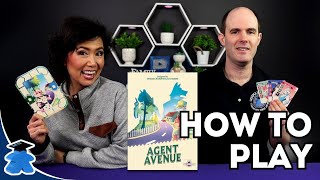
Agent Avenue is designed as a two-player game, and the core experience really belongs to that format. The game does offer a three-player or four-player team variant, but the I-cut-you-choose mechanism loses some of its sharpness when teams must coordinate without sharing hand information. Meeple University's tutorial noted the team mode requires players to discuss and agree on choices before cards are revealed, which introduces a different dynamic. For those specifically looking for a game that scales well up to four individuals, Agent Avenue may not fully satisfy.
Limited Depth for Heavier Gamers
Agent Avenue occupies a specific niche: it is a light, fast, psychological two-player game. Before You Play described it as not producing the same level of intensity as Hanamikoji, another I-split-you-choose adjacent game, noting that Agent Avenue "is not intense at all. It's definitely clever, but I don't feel tension. It's just silly." Reviewers who prefer longer, more complex games with deeper strategic arcs may find Agent Avenue satisfying as a filler or travel game but not as a main event. The game does not grow significantly heavier with experience; its pleasure is in the read-and-react dynamic, and players who prefer building toward a complex endgame may want something with more mechanical weight.
If You Enjoy Agent Avenue
Players who love Agent Avenue's I-cut-you-choose structure and the bluffing it enables will find familiar pleasures in New York Slice, where one player slices a pizza and the other chooses first. Before You Play mentioned New York Slice as a natural point of comparison, though that game works better with more players and plays out over a full meal-themed scoring system rather than a race track. Hanamikoji is another comparison that Before You Play raised directly. Hanamikoji is also a two-player game built on card-splitting decisions and the battle for a geisha's favor. It is somewhat more intense in tone and plays over multiple rounds with clearer area-control stakes. For players who want that same psychological sharpness but with more sustained tension, Hanamikoji is the natural next step.
Code Breaker, listed alongside Agent Avenue in community comparisons, is another game in the same design space: compact, fast, and built on bluffing and deduction. Reviewers who find themselves gravitating toward Agent Avenue because of its miniature-neighborhood theme and animal art style may also enjoy how Code Breaker deploys similar mechanisms in a puzzle-solving context. All three games reward players who want to outthink a single opponent rather than optimize a solitaire engine, making them natural companions on a two-player shelf.
What Reviewers Are Saying
"I love games that have a little bit of face down, a little bit of face up cards when there's interaction involved. This dynamic is my favorite mechanism in the game because it creates these mind games of which card face down. When I put this card face down, am I trying to get you to choose it? Am I trying to get you to not choose it? What am I doing with that hidden information versus the card that I'm placing face up?"
— Stonemaier Games
"It's a very simple game, but it's so mindbending and you really need to play the player. It's so spicy and you're trying to set up traps. I know you really want this card, so I'm going to offer it to you, but what I really want to come back to me is the one that is face down."
— Board Stupid
"This is a bluffing game, and with bluffing games most are fairly simple at its core, but I love games that allow me to not just play the game and try to strategize. It's more about playing the player, reading them, seeing what cards I can play to force them to pick or make a different decision. I love games like that. And this is so simple where you can teach this to anyone and start playing immediately."
— Banter and Boards